Portuguese
  Spanish


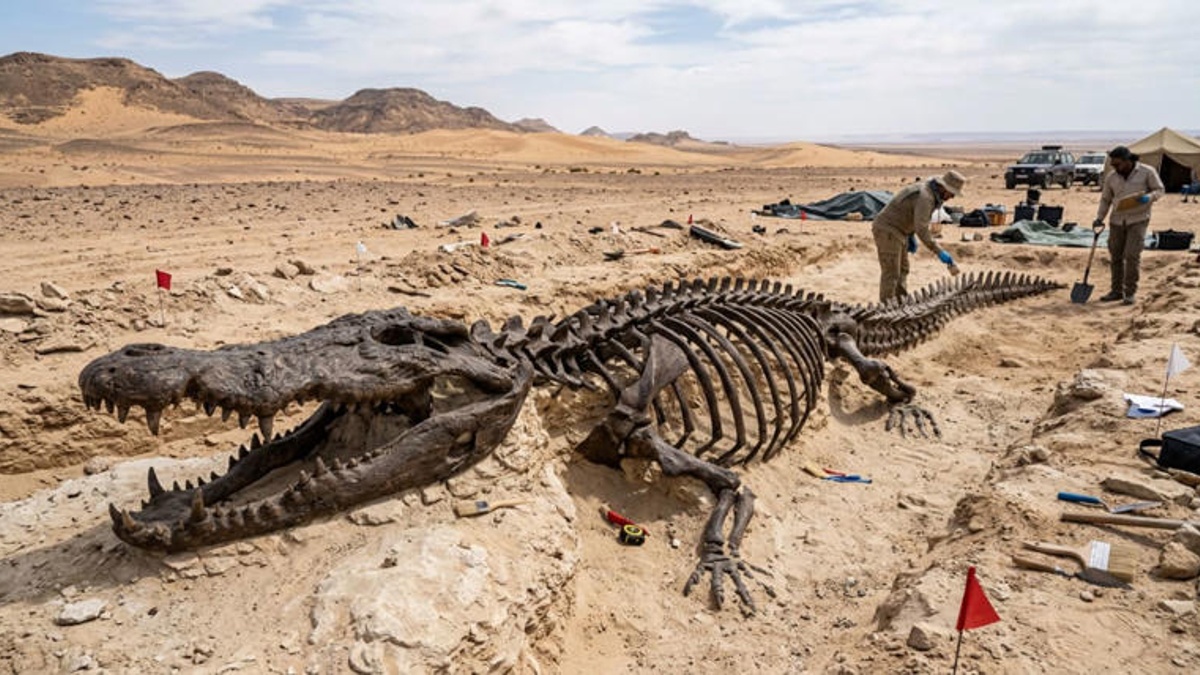


Researchers have discovered in the Tunisian Sahara desert an almost intact fossil of a gigantic marine crocodile that lived approximately 130 million years ago. The species, identified as Machimosaurus rex, measured over 10 meters in length and could weigh about three tons, making it one of the largest marine predators ever recorded from the period.
Furthermore, the find surprised the scientific community by challenging established theories about extinctions that occurred at the end of the Jurassic period. The study was published in the scientific journal Cretaceous Research and conducted by researchers led by the University of Bologna.
Discovery happened in the Sahara desert
The fossil was found in the Tunisian Sahara during a scientific expedition carried out by paleontologists.
-
At 17, she hand-painted her first watercolor design for school uniforms; her brand grew without investors, sold 135,000 pieces, and aims for $3 million in revenue by 2026.

-
Shell Discovers Intact Early 19th-Century Wooden Shipwreck in the Gulf of Mexico at Over 1,300 Meters Deep
-
Brazilian Entrepreneur Turns Door-to-Door Jewelry Sales into a Family Business Empire with Over 70 Stores

-
$75 Million Bridge in Brazil Opens to Connect Cities, Create Jobs, and Cut Travel Time from 30 to 2 Minutes; Spanning 1.24 km, It’s Among the Country’s Largest and Ends Decades of Ferry Queues.




Additionally, the researchers located the animal’s remains just a few centimeters below the desert sand.
Experts state that the excellent state of preservation of the fossil made the discovery even more significant for science.
In this context, the find may bring new information about prehistoric ecosystems.
Machimosaurus rex impresses with its size
The Machimosaurus rex was a gigantic prehistoric marine crocodile.
Moreover, the animal exceeded 10 meters in length and had an estimated weight of about three tons.
Experts state that the species was among the largest marine predators of the period.
For this reason, the discovery draws the attention of researchers in different parts of the world.
Fossil challenges theories about extinctions
The existence of the animal in a later period than expected may modify theories about extinctions at the end of the Jurassic.
Moreover, scientists believed that many large marine reptiles had disappeared before the time when the Machimosaurus rex lived.
Experts state that the fossil indicates possible survival of species previously considered extinct.
In this scenario, new research may alter historical interpretations about the evolution of marine reptiles.
What is the Jurassic period
The Jurassic period is part of the Mesozoic Era and is known for the presence of large dinosaurs and giant reptiles.
Furthermore, this period occurred between approximately 201 million and 145 million years ago.
Experts state that the oceans of the time also housed enormous marine predators.
Therefore, fossil discoveries continue to be fundamental for understanding the evolution of life on Earth.
The importance of fossils for paleontology
Preserved fossils help scientists reconstruct ancient ecosystems.
Furthermore, they provide information about the behavior, diet, and adaptation of prehistoric species.
Experts state that almost complete fossils are considered extremely rare.
In this context, the find in the Sahara gains even more scientific importance.
University of Bologna led research
The research was conducted by an international team led by the University of Bologna, in Italy.
Furthermore, paleontology experts participated in the excavations and analyses of the material found.
The study was published in the scientific journal Cretaceous Research.
Experts state that publications of this type have great academic relevance in the international scientific community.
How the fossil was found
The researchers located the animal’s remains almost intact under the desert sand.
Furthermore, the shallow depth facilitated the recovery of important parts of the skeleton.
Experts state that specific environmental conditions helped preserve the fossil over millions of years.
Therefore, the state of conservation surprised the scientists involved in the expedition.
The Sahara was once a different environment
Although it is currently a vast desert, the Sahara once had completely different environments in the past.
Furthermore, millions of years ago, various regions had rivers, lakes, and coastal areas.
Experts state that natural climate changes radically transformed the landscape throughout Earth’s geological history.
In this context, fossils found in the region help reconstruct ancient ecosystems.
What scientists intend to investigate now
The researchers still intend to deepen analyses of the discovered species.
Furthermore, new studies should investigate the behavior, diet, and adaptation of the animal to the marine environment.
Experts claim that the fossil can reveal important information about species survival after extinction events.
Therefore, the discovery opened new possibilities for paleontological research.
Marine reptiles dominated prehistoric oceans
For millions of years, large reptiles dominated Earth’s oceans.
Additionally, giant marine crocodiles, ichthyosaurs, and plesiosaurs occupied different positions in the food chain.
Experts claim that these animals played a fundamental role in ancient marine ecosystems.
In this scenario, the Machimosaurus rex emerges as one of the most impressive predators ever identified.

The importance of scientific journals
The publication of the study in Cretaceous Research reinforces the relevance of the discovery.
Moreover, specialized scientific journals serve as an important space for academic validation.
Experts claim that peer-reviewed studies ensure greater credibility to scientific research.
Therefore, discoveries of this type receive international attention after official publication.
The impact of the discovery on science
The fossil may provoke a revision of already established hypotheses about late Jurassic extinctions.
Additionally, new scientific evidence often helps correct previous interpretations.
Experts claim that paleontology constantly evolves as new fossils are found.
In this context, discoveries in the Sahara continue to expand knowledge about prehistory.
The fascination with prehistoric animals
Giant prehistoric animals continue to spark curiosity among scientists and the public.
Moreover, fossils help understand how different species lived and evolved over millions of years.
Experts claim that each new discovery contributes to expanding understanding of the history of life on Earth.
Therefore, findings like that of the Machimosaurus rex receive great worldwide repercussion.
What specialists expect from upcoming research
Researchers believe that the Sahara may still reveal many important fossils in the future.
Furthermore, new excavations are expected to expand information about the region’s ancient ecosystems.
Among the main points being investigated are:
- Species survival
- Ancient climate changes
- Evolution of marine reptiles
- Prehistoric ecosystems
- Extinction events
All these factors should help scientists better understand the planet’s geological history.
Discovery may change understanding of the Jurassic
The fossil of the gigantic Machimosaurus rex represents one of the most significant paleontological discoveries of recent years.
Moreover, the excellent state of preservation and the possible survival of the species after extinction events challenge theories already established by science.
While researchers deepen analyses on the animal, the find in the Tunisian Sahara reinforces how new discoveries can still transform human understanding of Earth’s prehistory.