Portuguese
  Spanish


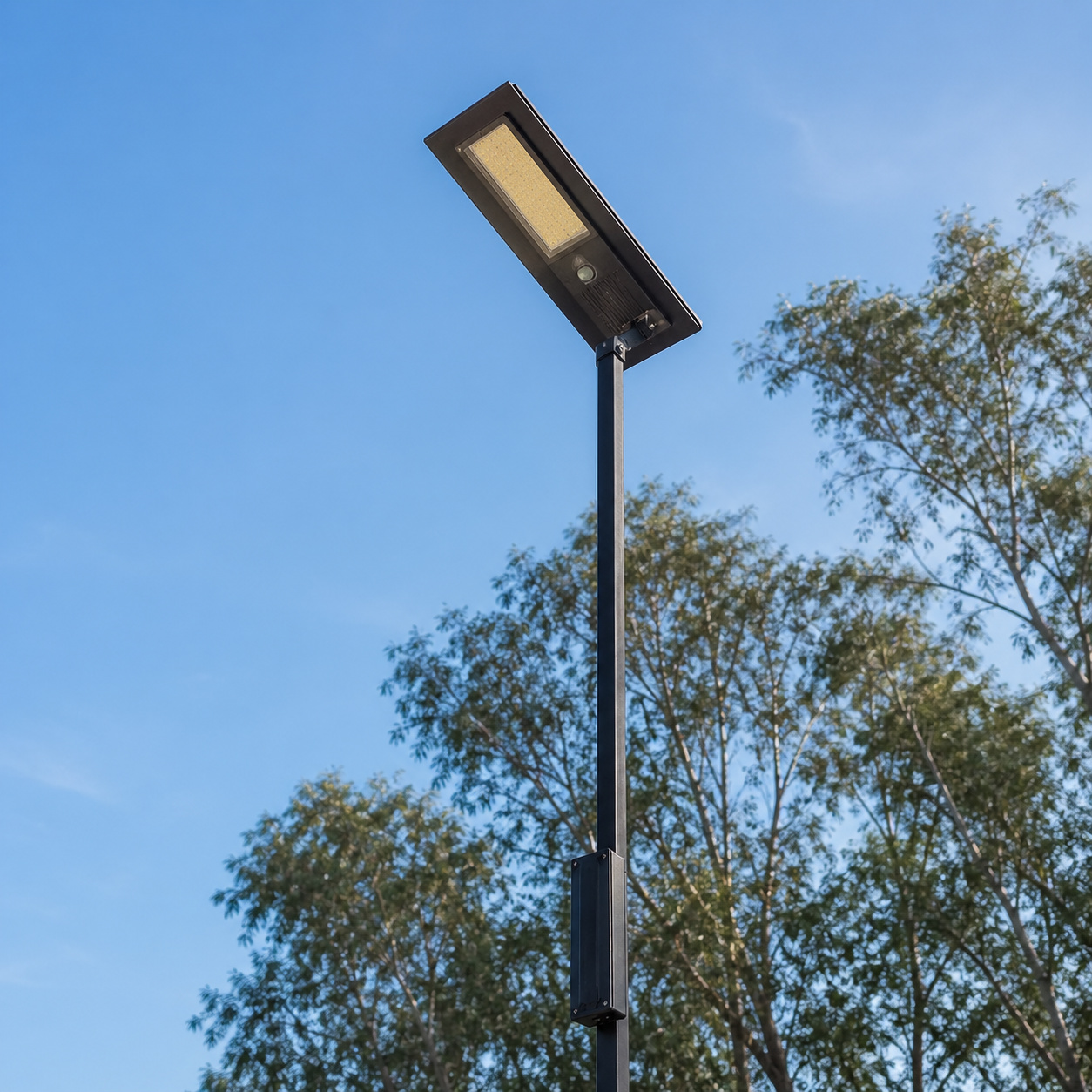

RPA Technology’s solar tilting pole uses solar energy to reduce costs, eliminate grid use, and bring efficient lighting to cities and rural areas
The search for cheaper and more sustainable alternatives for public and private lighting has accelerated the adoption of solutions based on solar energy. In this scenario, the solar tilting pole developed by RPA Technology emerges as a new technology capable of eliminating dependence on the electrical grid, reducing operational costs, and expanding access to lighting in urban and rural areas.
The main differential is its autonomy. The system operates independently, capturing energy during the day and ensuring lighting at night, reducing electricity bills. This model is already being adopted by municipalities and agricultural properties seeking efficiency, economy, and sustainability simultaneously.
Furthermore, the financial impact is direct. The absence of traditional electrical infrastructure significantly reduces initial investments and recurring costs, making the solution even more attractive for medium and large-scale projects.
-
Giant Batteries Take Center Stage in Chile Auction as Company Offers 960 GWh of Solar Energy for Nighttime Use, Aiming to Stabilize Solar Power Supply

-
World’s Largest Engie Solar Plant in Brazil Highlights Billion-Dollar Energy Waste Issue: Company Considers Batteries and Bitcoin Mining to Avoid Wasting Production

-
Over 60 Tractors Take to the Streets in Lopera as Solar Parks Compete with Olive Groves, Affecting 13,000 to 100,000 Trees According to Conflicting Reports
-
Brazil’s Vitória Airport to Launch Solar Plant Covering Area of 10 Soccer Fields, Boosting Clean Energy and Cutting Costs


How RPA Technology’s solar tilting pole transforms lighting with new technology
The operation of the solar tilting pole is based on an integrated photovoltaic system. RPA Technology developed this new technology to capture solar energy throughout the day and store it in internal batteries, ensuring continuous operation during the night.
Even on cloudy days, the system maintains significant efficiency. According to project information, the equipment can operate for up to four consecutive nights without needing direct recharging. This offers security and reliability, especially in regions with climatic variations.
Another relevant point is the lighting power. According to the company, each unit delivers approximately 3,600 lumens, equivalent to four domestic LED lamps. This level of luminosity allows covering wide areas efficiently, making it suitable for roads, patios, agricultural areas, and public spaces.
The technology also enables strategic distribution of the poles. The recommendation is to install them every 20 meters, ensuring adequate visibility and reducing the need for multiple light points.


Cost cutting in practice: where the solar tilting pole generates real savings
One of the strongest arguments for adopting the solar tilting pole is the direct reduction of costs. RPA Technology developed this new technology precisely with the aim of eliminating expenses that burden the budgets of companies and municipalities.
Among the main avoided costs are:
- Electricity bill, as the system exclusively uses solar energy
- Infrastructure works, such as excavation and cable installation
- Equipment such as transformers and electrical connections
- Complex maintenance requiring trucks and specialized teams
According to Palace, managing partner of the company responsible for the project, the savings directly impact cash flow, especially in agricultural operations and public projects. This happens because the system eliminates three immediate fixed costs, something rare in traditional solutions.
Another important factor is durability. The equipment has a lifespan similar to conventional poles, potentially exceeding 10 years, depending on the installation site conditions.
Practical applications in cities and farms seeking efficiency and autonomy
The versatility of the solar tilting pole allows its use in different contexts. The proposal of RPA Technology with this new technology is precisely to serve both urban and rural areas, expanding the reach of solar energy.
Today, the system is already used in places such as:
- Rural roads and agricultural areas
- Silos and machine yards
- Public squares and roundabouts
- Cemeteries and construction sites
- Remote regions without access to the electricity grid
Palace highlights that municipalities have adopted the solution in areas where electrical infrastructure does not reach or where the implementation cost would be too high. This includes hard-to-reach locations where the installation of a conventional grid becomes unfeasible.
In the field, the technology also contributes to operational safety. Adequate lighting allows activities to continue at night, especially during harvest periods when work extends for long hours.
Sustainability and ESG goals drive the use of solar energy
In addition to economy, the reclinable solar pole meets a growing demand for sustainable practices. RPA Technology positions this new technology as an important ally for companies and governments seeking to meet ESG goals.
The use of solar energy reduces dependence on traditional sources and contributes to the reduction of carbon emissions. This factor has gained relevance in public and private projects, especially in initiatives aimed at energy transition.
Another important point is the social impact. The technology brings lighting to regions that previously did not have access to electricity, improving the quality of life and increasing safety in remote communities.
Mobility and quick installation make the reclinable solar pole even more attractive
One of the great differentials of the reclinable solar pole lies in its flexible structure. RPA Technology developed this new technology to facilitate installation and allow the equipment to be relocated as needed.
Unlike conventional poles, which require concrete foundations, this model can be installed directly into the ground. This reduces construction time and eliminates additional costs.
Another highlight is its practicality. The system can be removed and reinstalled in about 8 minutes, using simple tools, such as a post-hole digger. This feature is especially useful on farms and at temporary events, where lighting needs can change quickly.
This mobility also prevents waste. If there is a change in the logistics of a property or project, the pole can be reused in another location without material loss.
Safety, efficiency, and integration with other technologies
The efficiency of the reclinable solar pole goes beyond economy. RPA Technology designed this new technology to ensure reliable lighting in different conditions.
Autonomy of up to four nights without direct recharging reinforces safety, especially in locations with low solar incidence for a few days. This ensures operational continuity and prevents interruptions.
Another differential is the possibility of integration with other systems. The pole can accommodate monitoring cameras and other devices, expanding its functionality and making it an even more complete solution.
The use of solar energy as a base ensures energy independence, which is essential for remote areas or those with limited infrastructure.
The silent advance of a solution that can redefine costs and lighting in Brazil
The growth of the reclinable solar pole shows how innovation can transform traditional sectors. RPA Technology bets on this new technology as a viable alternative to reduce costs, increase efficiency, and expand the use of solar energy in the country.
With clear benefits, such as immediate savings, ease of installation, and sustainability, adoption is expected to continue growing in the coming years. Municipalities, companies, and rural producers are already beginning to realize that investing in autonomous solutions is not just a technological choice, but a strategic decision.
By combining efficiency, mobility, and low cost, the model positions itself as a direct response to Brazil’s current energy challenges. And, in the face of the search for more accessible and sustainable alternatives, solutions like this tend to gain even more market share.
With information from G1