Portuguese
  Spanish


Swiss 3D-printed brick uses water evaporation to reduce temperatures by up to 9°C and can inspire new solutions for cooler cities.
Amid the advancement of heatwaves and the pressure on cities, two young Swiss designers created a solution that mixes ancient technique and digital manufacturing. The project, called Bloc°, uses 3D-printed terracotta, water, evaporation, and solar energy to reduce air temperature by up to 9°C in public spaces exposed to heat.
According to the James Dyson Award and ZHdK, the system was developed by Andrin Stocker and Luc Schweizer from the Industrial Design course at the Zurich University of the Arts, and was recognized in the 2025 James Dyson Award. The proposal is not to replace traditional air conditioning but to create urban cooling micro-areas in places like squares, school courtyards, and public transport stops.
Bloc° uses evaporative cooling to combat urban heat
The operation of Bloc° is based on evaporative cooling, a physical principle known for centuries. Terracotta has a porous structure, absorbs water, and when hot air passes over its moist surface, some of this water evaporates, removing heat from the environment. It is the same logic that keeps clay containers cool in various hot regions of the world.
-
Detroit Microhouse Village Offers Former Homeless Residents Ownership After 7 Years: First 3 Tenants Receive Deeds

-
Brazilian Factory in Ivoti Produces 500 Modular Steel and Fiberglass Concrete Homes Following 2024 Floods, Securing $13 Million Contract
-
Brazilian Startup Develops Recycled Plastic Bricks, Cutting Construction Costs by 40% and Speeding Up Building by 90%

-
Tarcísio Opens New São Paulo Metro Line After 18-Year Wait, Offering Free Rides at 6 Stations and Aiming to Cut Commute to 23 Minutes for 633,000 Daily Passengers


According to the James Dyson Award, the system was designed to make overheated urban areas more habitable during extreme heat events. Instead of relying on compressors, refrigerant gases, and high electrical consumption, it works with natural materials and a simpler cooling mechanism with lower energy impact.
This point is central to the project’s value. The Bloc° does not attempt to compete directly with conventional systems in enclosed environments. It tries to solve another problem: the lack of thermal comfort in open public areas, where urban infrastructure usually only heats the surroundings more.
3D-printed terracotta allows for the creation of internal channels that increase efficiency
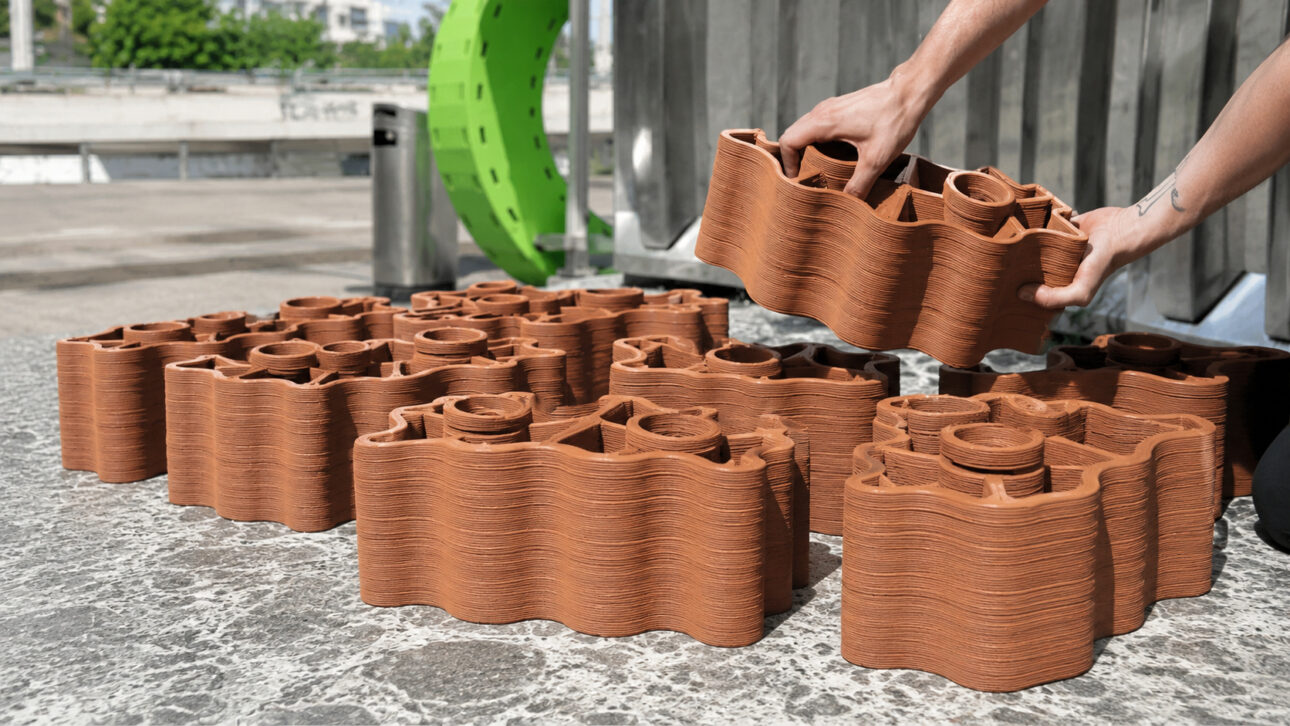
According to the James Dyson Award, each module of the Bloc° is made of 3D printed terracotta and has an internal geometry designed to maximize the contact between air and water. The design includes cavities, channels, and curved surfaces that increase the efficiency of evaporative cooling.

When air passes through these internal chambers, it loses heat during the evaporation process and exits cooler on the other side. This makes the module function not only as a constructive element but as a kind of active climate infrastructure, capable of altering the surrounding microclimate.
According to ZHdK, the project was developed as a modular cooling system for urban heat zones, focusing on discreet integration into public spaces. Instead of looking like an aggressive technical equipment, the system was designed to blend into urban furniture and operate quietly in the environment.
Rainwater and solar energy help the system operate autonomously
Another important feature of the Bloc° is the attempt to reduce dependence on the conventional power grid. According to the James Dyson Award, the system uses a solar panel to generate about 200 watt-hours per day, enough energy to power the fan and water pump that keep the internal flow running.
The water can come from urban infrastructure or an integrated rainwater harvesting system. Also according to the official award page, the funnel-shaped roof can collect an average of 24 liters of rainwater per day, while on days above 30°C, a Bloc° installation consumes about 56 liters daily, a number that can vary depending on the climate and size of the structure.
This design reinforces the project’s appeal in cities seeking more sustainable solutions for extreme heat. Instead of merely consuming energy to cool, the system attempts to use sun, water, and ceramic material to deliver thermal comfort with a lower operational load.
The project is still a prototype, but already points to new bioclimatic architecture
According to the James Dyson Award, the Bloc° is still in the development phase and the next steps include real-scale tests in an urban environment to measure long-term performance, especially in more humid climates. This means that the results released so far belong to the prototype stage and still need to be confirmed in continuous use.
The team itself presents the system as an initial solution for public areas and not as an immediate substitute for conventional bricks or complete building air conditioning systems. Even so, the project opens up space to think about a new generation of materials and urban structures capable of actively participating in thermal control.
This is the strongest point of the Bloc°. It shows that a very old technology, evaporation in porous ceramics, can gain new relevance when combined with 3D printing, computational design, and renewable energy. Instead of just building cities, architecture can start helping to cool them.
Extreme urban heat drives search for materials that cool without high energy consumption
The growing interest in projects like the Bloc° is directly linked to the increase in urban temperatures. In dense cities, hard and dark surfaces accumulate heat throughout the day and release this energy slowly, worsening the urban heat island effect and making staying spaces increasingly hostile.
In this context, solutions that can generate local cooling without relying on high electrical consumption start to attract the attention of designers, urban planners, and architects. The value of the Bloc° is not just in the number of up to 9°C reduction, but in the idea that the urban infrastructure itself can be redesigned to better respond to extreme climates.
If real-scale tests confirm the performance of the prototypes, the project could influence a new front of bioclimatic architecture and heat-adapted urban design. And this helps explain why a 3D printed terracotta module garnered so much international attention in 2025.