






 Portuguese
  Spanish


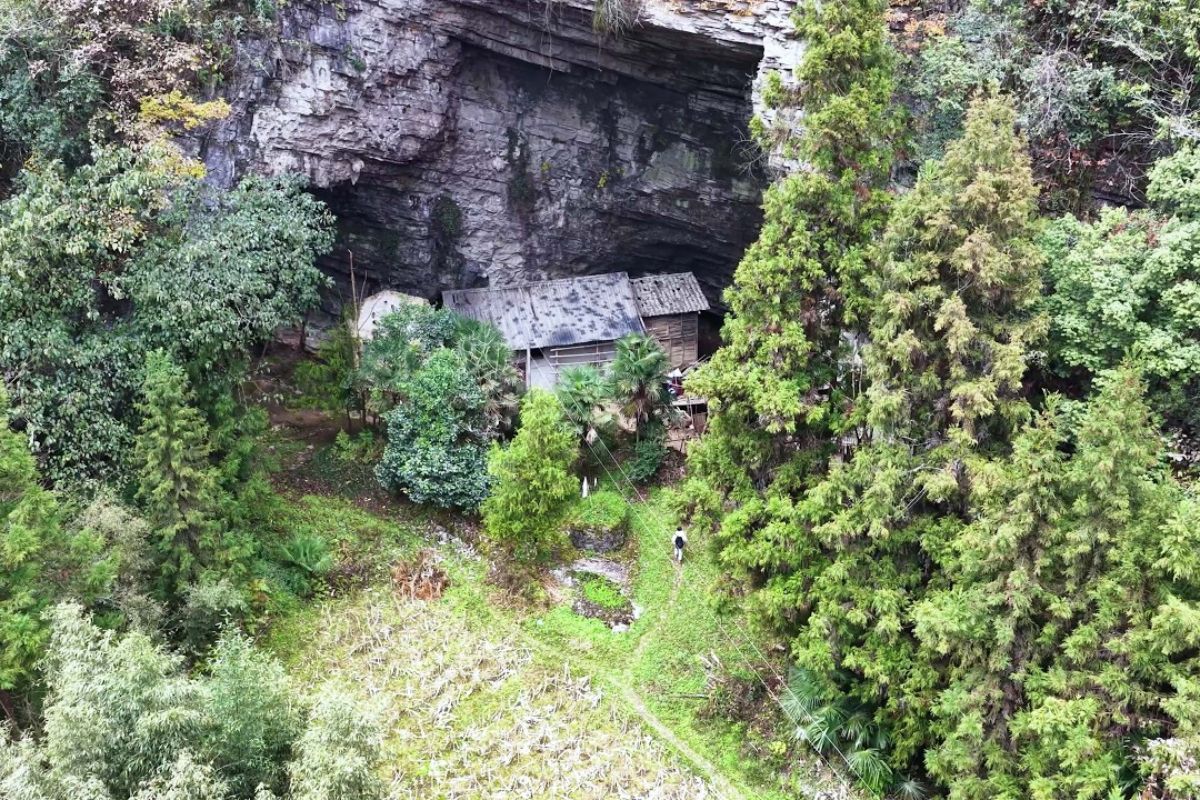


In Hubei Province, in Lichuan, a resident maintains a self-sufficient routine in the cave in the mountains of China, with abundant water, electricity, and a life isolated from the modern world.
In the cave in the mountains of China, nestled among the mountains of Lichuan, Hubei, there is a house built at the foot of a cliff and hidden by dense trees. The place looks like a movie retreat, but it is real: an uncle with the surname Yang still lives there, alone, in a setting that mixes isolation and natural beauty.
The story draws attention because it is not a recent adventure. His family settled in the cave since his parents’ generation, and nearly a hundred years have passed. After his parents died, he became the only one left in that vast space and continues to lead a peaceful life, away from crowds.
An Unlikely Home in the Middle of a Cliff

The cave in the mountains of China is not just a hole in the rock. A house was built there using various materials, from adobe bricks to stones, in addition to wooden structures. It is not total improvisation; it is adaptation to the terrain.
-
Award-Winning Korean Electric Scooter Concept Folds to Briefcase Size, Eases Transport Challenges

-
YouTuber Discovers Surreal Collection in 400-Year-Old Italian Fortress Near Florence: 419 Anvils, Giant Walruses, Ancient Church, and WWII Tunnels

-
Creative Uses for Toilet Paper Rolls That Will Change Your Perspective
-
Crab Trapped in Plastic Bottle for 62 Days Near Okinawa Highlights Little-Known Impact of Marine Pollution on Small Animals


Around, there are signs of a life that used to be fuller: areas where he raised pigs, cattle, and chickens, but which have now been left behind because he cannot manage everything on his own. Nowadays, he does more occasional work to sustain himself.
Solitude as a Choice and as a Consequence
The tone of the story is not one of misery, but rather of a way of life. The account itself indicates that Uncle Yang enjoys the place because it is peaceful and he does not like crowds. It is isolation, but not necessarily abandonment.
And although it seems like “the end of the world,” there is relatively close infrastructure. The road is less than 300 meters away, even if the walking access is inconvenient.
Own Water: The Heart of the Cave
When someone hears “living in a grotto,” the first question is obvious: where does the water come from? In the cave in the mountains of China, the answer lies within the natural system itself.
Upon exploring the interior, natural pools with crystal-clear water appear, along with the constant sound of dripping from the cliffside. There is also a water pump, and the water from these pools is described as the main source for the resident. With so many pools, the concern over water practically disappears.
Stable Temperature and a House Protected from the Weather
Another point explaining why someone could live there for so long is the microclimate. The description reinforces that the grotto remains warm in winter and cool in summer, with a constant temperature throughout the year.
The position of the house also helps: being under the cave, rain does not easily enter, and sunlight can still reach parts of the space. Result: greater thermal comfort and natural protection.
Electricity, Wood-Burning Stove, and a Simple Routine

Even in a cave in the mountains of China, life is not 100% “pre-modern.” There are indications of electricity being connected, with a power pole near the house, and the account also mentions electricity and the Internet being available.
At the same time, the routine is very manual. He uses a wood-burning stove and needs to feed the fire frequently to keep it from going out. It is technology where it makes sense, and simplicity where it can handle.
Marks of History Inside the Grotto
Exploring the interior reveals a detail that changes the tone of the narrative: remnants of old constructions and structures were found within the cave, associated with the idea that people would have used the place to escape wars in the past.
This reinforces a curious point: that cave in the mountains of China may not just be an individual shelter, but a space used by different generations and purposes over time, with signs of ancient human occupation inside the rock.
Could you live for years in a cave in the mountains of China, with silence, a simple routine, and little companionship, or would that be unthinkable for you?




Os 100 anos mencionando na matéria deve se referir a FAMÍLIA correto. Já viver recluso é bem mais comum que imaginarmos. Tem muiiiiita gente que evita aglomerações por considera DESNECESSÁRIO e eu concordo…
Sim, conseguiria.
Foram cobra o IPTU do cara