Portuguese
  Spanish


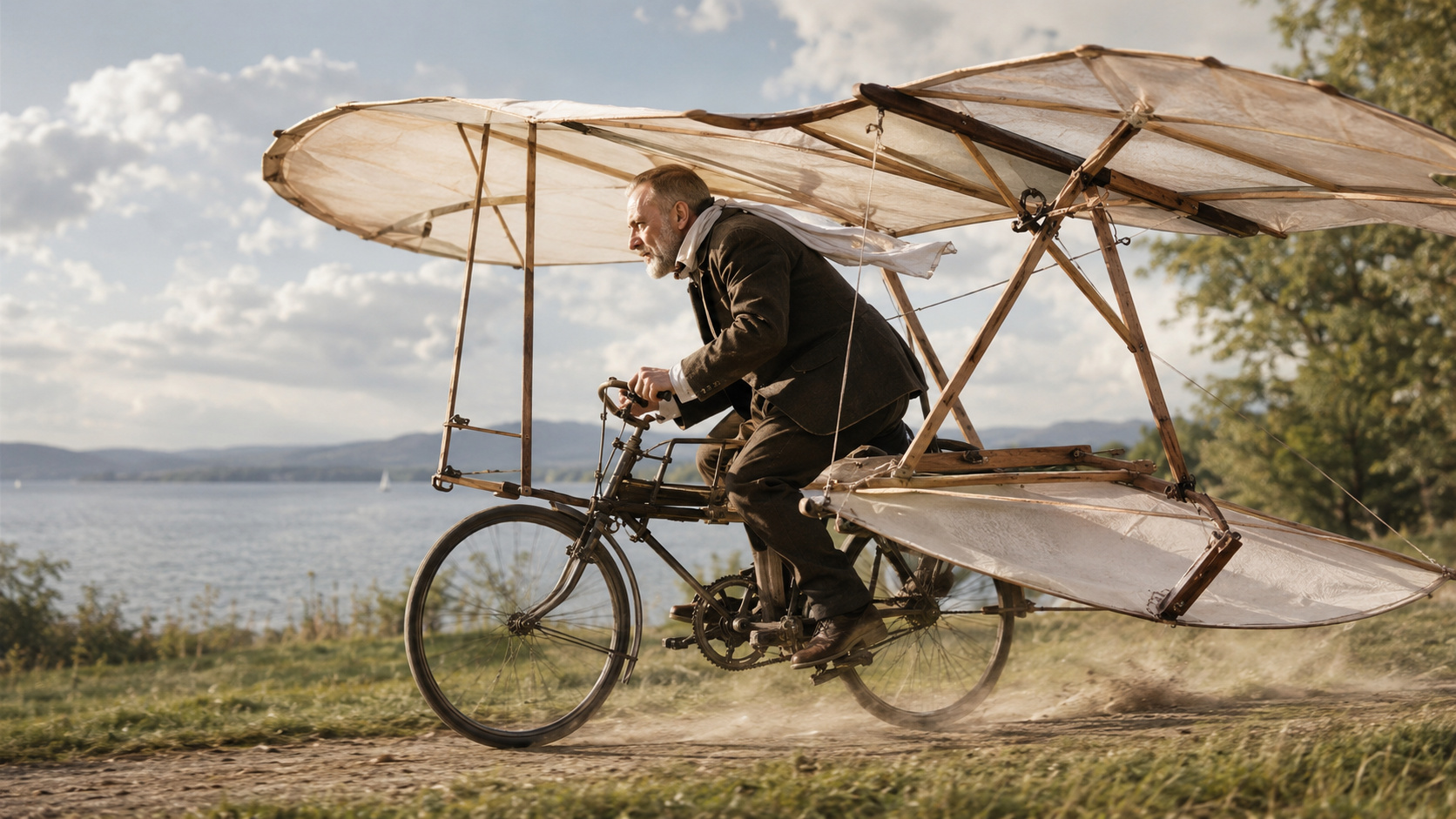

Flying bicycles made with wheels, wings, and pedals show Gustav Mesmer’s quest for human-powered flight, while models, drawings, and photographs preserve in Germany a mechanical experience that should not be confused with an aircraft ready to transport people
He didn’t build a plane, but he spent decades trying to make bicycles fly with wings and pedals. Gustav Mesmer’s flying bicycles combined a common vehicle with large structures, in a personal attempt to lift off the ground using human power.
The information was released by Zeppelin Museum, a German museum dedicated to aviation and technology. The institution recorded an exhibition that ended in 2015, in Friedrichshafen, with models of flying bicycles, drawings, photographs, and other objects related to Mesmer’s creations.
The interest in this story is not in presenting a transportation solution. What draws attention is the persistence of a man who tried to bring together wheels, wings, and pedals to fulfill an old desire, to fly.
-
Roraima Security Secretary Poses as Doctor to Expose Technician Charging $600 for Free Public Health MRI in Brazil; Technician Confessed

-
To Protect Its Beaches, the Netherlands Deposits 21.5 Million Cubic Meters of Sand into the Ocean, Letting Nature Reinforce Dunes and Shoreline

-
Swedish Mall Focuses on Sustainability by Repairing and Reselling Discarded Items
-
Mother Leaves Stable Job to Support Gamer Son’s Dream, Sees Channel Surpass 10 Million Subscribers, Now Helps Run a Million-Dollar Online Empire: The Story of Angie Baker





Who was Gustav Mesmer, the man behind the flying bicycles
Gustav Mesmer became known for imagining bicycles capable of flying without relying on an engine. His projects placed the bicycle at the center of an experience very different from common use on the streets.
The proposal sought to transform pedaling into something greater. The wheels allowed circulation on the ground, while the wings attempted to take the machine to another level, away from roads and traffic.


This idea reveals a type of invention made with simple resources and a lot of persistence. Mesmer used the bicycle as a starting point, not as a limit to what he could create.
Flying bicycles mixed wheels, wings, and pedals in unusual machines
Gustav Mesmer’s models started from bicycles but received wide wings and parts that completely changed their appearance. The result was a machine that resembled both a bicycle and an aircraft at the same time.
A bicycle with wings does not become capable of flying just by having large surfaces on the sides. To lift off the ground, a machine needs to balance weight, force, and control throughout the movement.
This challenge helps explain why creations should be viewed as mechanical experiments. They record an artisanal attempt to do something that requires much more than pedaling.
Exhibition in 2015 brought together models, photographs, and drawings in Germany
Zeppelin Museum, a German museum dedicated to aviation and technology, presented an exhibition on Gustav Mesmer from March 27, 2015, to June 28, 2015, in Friedrichshafen.
The images of the exhibition capture models of flying bicycles installed on wooden structures. There are also photographs of Mesmer on a bicycle with wings, as well as drawings of different proposals created by him.
Some projects showed bicycles connected to objects that resembled airships, propellers, and rockets. These images help to understand that Mesmer was testing various paths to imagine a pedal-powered transport.
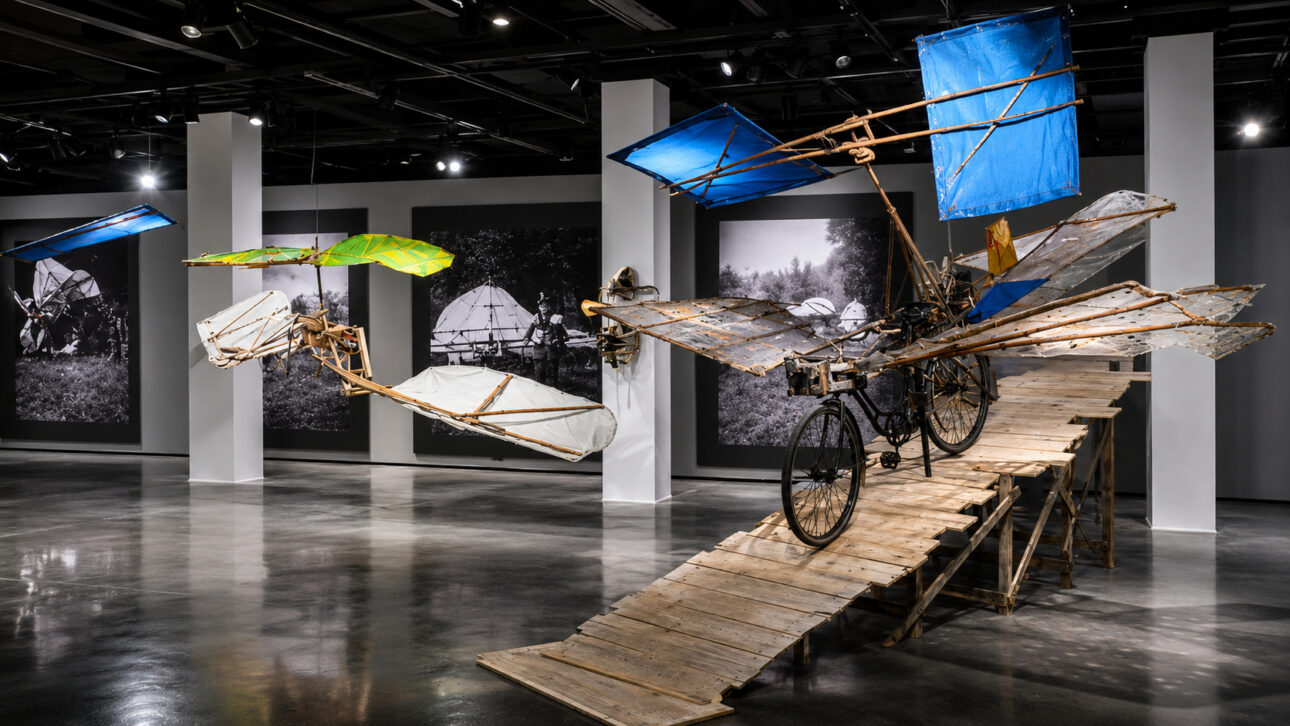
The exhibition brought together real objects, drawings, and photographs that made visible an idea that could have remained confined to the memory of its creator.
Why Gustav Mesmer’s flying bicycles still spark interest today
The strength of this story lies in the combination of an everyday object and a huge ambition. The bicycle is known by almost everyone, but it becomes strange and fascinating when it gets wings.
Mesmer did not create an ordinary machine. He built objects that show how imagination can change the function of a simple piece, like a wheel or a pedal.
The flying bicycles also provoke an easily understandable question: how far can a person go when trying to solve a problem with their own hands? This curiosity keeps the models relevant as records of mechanical creativity.
Mechanical dream is different from certified aircraft
A certified aircraft is a vehicle evaluated to fly within technical rules and safety limits. This involves a tested design, control, suitable materials, and defined conditions of use.
The models of Gustav Mesmer should not be treated as ready-made projects for reproduction or air transport. They are part of a historical experiment and show the difference between a creative idea and a machine prepared to take people to the sky.
The value of these flying bicycles lies precisely in this boundary. They show that the desire to fly can inspire remarkable inventions, even when the result does not become a real aircraft.
Gustav Mesmer’s flying bicycles left an unforgettable image: a common vehicle transformed by wings, wood, and pedals. The models, drawings, and photographs help preserve a personal quest for freedom and movement.
For you, is a flying bicycle proof of creativity or a reminder that flying requires much more than wheels, wings, and pedals? Comment and share.