Portuguese
  Spanish


Aerial Operation in Vale do Taquari Launches Millions of Seeds on Unstable Slopes and Turns Helicopters into Allies of Reforestation after Landslides in Rio Grande do Sul, Strategy Aimed at Reducing Erosion and Accelerating Environmental Recovery in Areas Where Land Access Still Poses Risks.
Helicopters were used in Rio Grande do Sul to drop about five million seeds on unstable slopes in the Vale do Taquari, in an action aimed at reforesting areas affected by landslides and difficult to access by land.
According to the official communication from the state government, the seed drop occurred on July 17, 2024, and was part of an initiative carried out with support from the Brazilian Army, Ibama and other partners, combining aerial seeding and planting on firm ground.
In sections where the slope remains “alive,” with the risk of new mass movements, reaching on foot or by vehicle can put teams in danger, in addition to requiring the opening of temporary access routes that disturb the terrain and increase the impact.
-
How to Prevent Brown Recluse Spider Bites: Common Hiding Spots and Free Tips to Reduce Risks

-
Natto: The Unusual Japanese Superfood Gaining Popularity on Social Media and Driving Record Exports
-
Brazilian Mayor Goes Undercover as Homeless for 24 Hours to Assess Public Services

-
15-Year-Old Entrepreneur Malu Lira Publishes 20 Children’s Books on Financial Education, Earns $500,000, and Expands Her Project to the Amazon Rainforest




The option for air, in this context, acts as a logistical shortcut: the aircraft delivers the input to the right point without requiring constant circulation of people in fragile areas, and allows coverage of large surfaces in less time, with planned routes.
Aerial Seeding as an Environmental Recovery Strategy
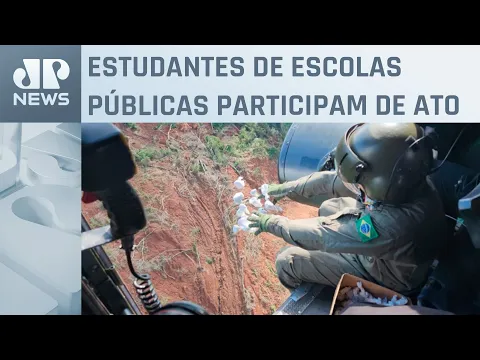

The focus of the work is to accelerate the reestablishment of vegetation cover on steep hills, because when vegetation is reestablished, it tends to reduce surface erosion and the wash of particles, decreasing the direct exposure of the soil to the impact of rain.
The government’s communication also cited a scenario of numerous landslide alerts during the most critical rain period, with consolidated records between the end of April and the end of May in dozens of municipalities, which helps to measure the scale of the problem.
With degraded slopes and limited access, the strategy attempts to initiate the reforestation process before the rain starts acting on bare soil, without depending on the opening of temporary roads or heavy machinery in unstable areas.
Still, aerial seeding is not treated as an isolated solution, because the result depends on environmental conditions and management, and reestablishment usually goes hand in hand with monitoring, containment actions, and drainage measures when necessary.
How the Seed Launch Worked
According to the state government, “mixes” of seeds were launched packed in germination paper, a material designed to favor initial germination conditions, and part of these mixes was produced by students from public schools in the region.

The same action included planting in the ground, with 340 seedlings of native Atlantic Forest trees, donated by the Botanical Garden of Porto Alegre, in a complementary effort for locations where teams could safely operate.
The project was presented as a partnership involving the Secretary of the Environment and Infrastructure of RS, the Joint Command of Operation Taquari 2, Ibama, Univates, and the municipalities of Santa Clara do Sul, Marques de Souza, and Pouso Novo.
In practice, the helicopter acts as a distributor that needs to repeat routes accurately, because the difference between covering a planned strip and losing material off-target can be determined by variations in wind and turbulence common in rugged terrain.
This planning usually involves defining altitude, speed, and more stable weather windows, as rapid changes in wind affect dispersion and can compromise uniformity of coverage, especially when the goal is to reach large areas.
Operational Safety and Coordination Between Agencies
Low-altitude operations with drops require coordination, delimitation of areas, and control of people circulation on the ground, to avoid curious bystanders or workers being under the drop route, especially when the action takes place near communities.
In addition to the natural risk of the terrain, there are operational restrictions related to power lines, roads, and inhabited areas, which forces planning of flight corridors that reduce unnecessary overflight and maintain a safety margin during passes.
The mission design aims to be repeatable and quick, because spending too much time over sensitive areas increases risk variables, and the weather can change during the operation, altering the predictability of the launch and requiring interruptions.
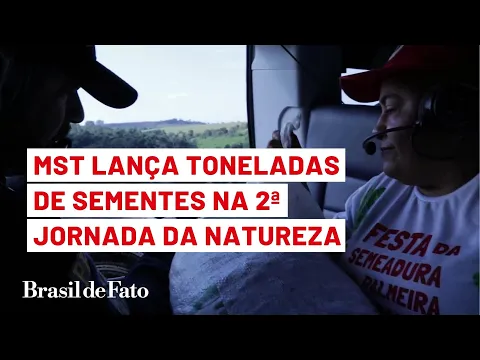
The articulation of various agencies appeared as a key piece in the public communication of the initiative, with participation from federal and state institutions, in addition to technical and logistical support from partners who contributed with inputs used in preparing the mixes.
Use of Helicopters in Environmental Actions in Brazil
Aerial seeding with helicopters has already been publicized in other operations in the country, including with institutional participation from the Federal Highway Police in restoration projects, using aircraft adapted for the safe launch of seeds in difficult locations.
In initiatives of this kind, the logic tends to be similar: gain scale and speed to cover large areas, especially where land displacement is slow or dangerous, without turning the restoration attempt into a new front of degradation.
In the case of Vale do Taquari, the public exposure of the method also drew attention for highlighting a post-disaster dilemma, where the urgency to recover slopes coexists with physical limits that prevent traditional planting work.
The operation, however, does not eliminate the need for monitoring, because dropping seeds does not guarantee germination, and factors such as rain, sunlight, and soil conditions remain decisive for the vegetation to really cover the slope again.
If helicopters can deliver seeds to places that no one can safely reach, what other essential steps in disaster response in Brazil could gain efficiency with aerial support without replacing the technical work on the ground?