






 Portuguese
  Spanish
  4 min of reading
  0 comments


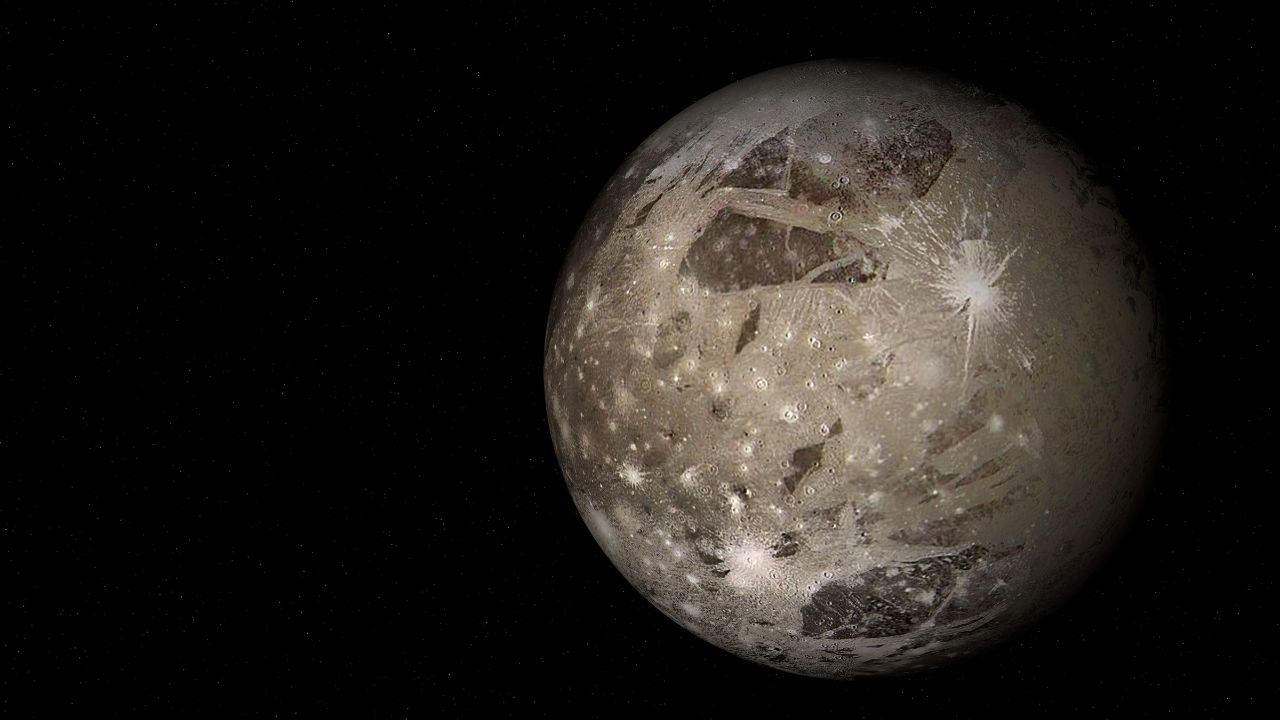
Ganymede may have an internally active heating system, according to a study analyzing the magnetic field of Jupiter’s moon.
The largest moon in the Solar System has returned to the spotlight of astronomy after researchers presented a new hypothesis about its interior. Published this month in the Science Advances journal, a study suggests that Ganymede, Jupiter’s natural satellite, may be undergoing a continuous internal heating process capable of sustaining its magnetic field. The discovery broadens the understanding of the evolution of celestial bodies and may impact future searches for habitable environments beyond Earth.
With approximately 5,300 kilometers in diameter, Ganymede surpasses even Mercury in size. Among the more than one hundred known moons of Jupiter, it stands out for a rare characteristic: it is the only confirmed natural satellite with its own magnetic field. The moon was detected in 1996 by NASA’s Galileo mission.
How Ganymede’s magnetic field can remain active
Scientists believe that the moon’s magnetism is linked to the so-called dynamo mechanism. This process occurs when moving liquid metallic materials produce electric currents capable of generating a magnetic field.
-
Oil Company Robots Discover 3,300-Year-Old Canaanite Shipwreck in the Mediterranean, Proving Ancient Mariners Navigated Open Seas Using Stars Long Before Historians Thought

-
Helicopter Drops 180 Tons of Sand and Gravel on Swedish River to Revive Ecosystem Damaged by Decades of Exploitation

-
Brazilian Company Launches Retro Smartphone with 48 MP Camera, T9 Keyboard, and Privacy Features for Social Media-Free Use

-
Self-Taught Chinese Farmer Builds 5-Ton Submarine from Scrap, Launches It in Anhui River




Until now, some scientific models argued that Ganymede’s metallic core would have formed early in the moon’s formation. Another line of research, however, indicated that the satellite’s initial environment would be too cold to allow this complete formation.
The new work proposes an intermediate solution to this impasse. According to the researchers, small masses of molten iron could slowly sink towards the center of the moon over billions of years. This gradual movement would help fuel the system responsible for the magnetic field.
According to the study, the process may not belong only to the past. There is a possibility that it continues to occur currently within the satellite.
Ganymede is directly influenced by Jupiter’s gravity
The study points out that two main sources would be responsible for the moon’s internal heating.
Among them are:
- heat produced by radioactive elements present within the celestial body;
- gravitational force exerted by Jupiter during orbit;
- friction generated by the constant deformations of the moon’s structure;
- partial maintenance of iron in a liquid state.
The researchers explain that the enormous gravity of the giant planet continuously compresses and stretches Ganymede. This effect produces enough thermal energy to keep internal regions warm.
Meanwhile, radioactive materials present in the moon’s structure continue to naturally release heat over time. The sum of these factors would create suitable conditions to keep the so-called dynamo functioning.

What makes Ganymede different from other moons
Besides its unusual size, Ganymede has characteristics that have sparked scientific interest for decades. Its complex internal structure is considered one of the most intriguing among the natural satellites of the Solar System.
The research published in Science Advances reinforces this uniqueness. Instead of a completely active core from its origin, the study suggests that the moon may have developed its magnetic system gradually.
This challenges some traditional theories about the formation of metallic cores in planets and moons. According to the study’s authors, initially cold worlds could also develop internal activity over time.
“This process may still be ongoing,” the researchers highlight when explaining the hypothesis presented in the scientific work.
Study on Ganymede may influence research on exoplanets
The study’s conclusions are not limited to Jupiter’s moon. Scientists claim that similar mechanisms may exist in other natural satellites and even in distant exoplanets.
The existence of magnetic fields is considered important because they help protect atmospheres and surfaces against radiation from space. On Earth, for example, the magnetic field deflects charged particles coming from the Sun.


With this, understanding how different celestial bodies can generate magnetic protection has become one of the main objectives of modern astronomy.
Researchers highlight that the hypothesis raised for Ganymede may pave the way for new interpretations of worlds considered cold or inactive.
New phase of astronomy expands investigation of distant worlds
The advancement of space research has been allowing increasingly detailed analyses of moons, planets, and objects outside the Solar System. In this scenario, Ganymede appears as an important natural laboratory to understand complex internal phenomena.
The moon was already seen as a strategic target for studies due to its size and the confirmed presence of a magnetic field. Now, the possibility of continuous heating in its interior further increases scientific interest.
Researchers emphasize that the new model does not completely discard previous hypotheses but proposes a more dynamic view of the satellite’s internal evolution.
Thus, the investigation of Ganymede not only contributes to understanding Jupiter and its moons but also deepens the search for potentially habitable environments in other regions of the Universe.
With information from Olhar Digital




Be the first to react!