






 Portuguese
  Spanish




A Curious Experiment Put ChatGPT in Charge of a Stock Portfolio with Only US$ 100. The Proposal Was Simple: Test Whether Artificial Intelligence Could Operate Like a Real Trader in the Financial Market, with Daily Decisions and Focus on Little-covered Stocks.
With only US$ 100, about R$ 550, the user Nathan Smith, from the USA, decided to test whether artificial intelligence, in this case ChatGPT, could really profit from investing in stocks.
To do this, he put ChatGPT in the role of financial analyst and turned the model into a day trader.
The experience is being documented on Reddit.
-
11-Year-Old Entrepreneur Sells 60 Homemade Sweets Daily, Mastering Cost Calculation, Social Media Promotion, and Client Negotiation Since Age 7

-
Peruvian Mountain’s 5,200 Aligned Holes May Unveil Ancient Indigenous Market for Corn and Cotton
-
The Little-Known Story of a Home-Built Airplane That Promised Freedom but Faced Safety Issues After Numerous Accidents

-
He Didn’t Build a Plane, But Spent Decades Trying to Make Bicycles Fly with Wings and Pedals; Remaining Models Tell This Unusual Story in Germany



The most important thing is that the idea arose after Smith saw dubious ads promising high profits from using AI in the financial market.
Instead of falling for the promise, he decided to investigate on his own.
The experiment was structured to last six months, with a clear goal: assess whether a language model is capable of picking undervalued stocks on a minimal budget.
Encouraging Initial Results
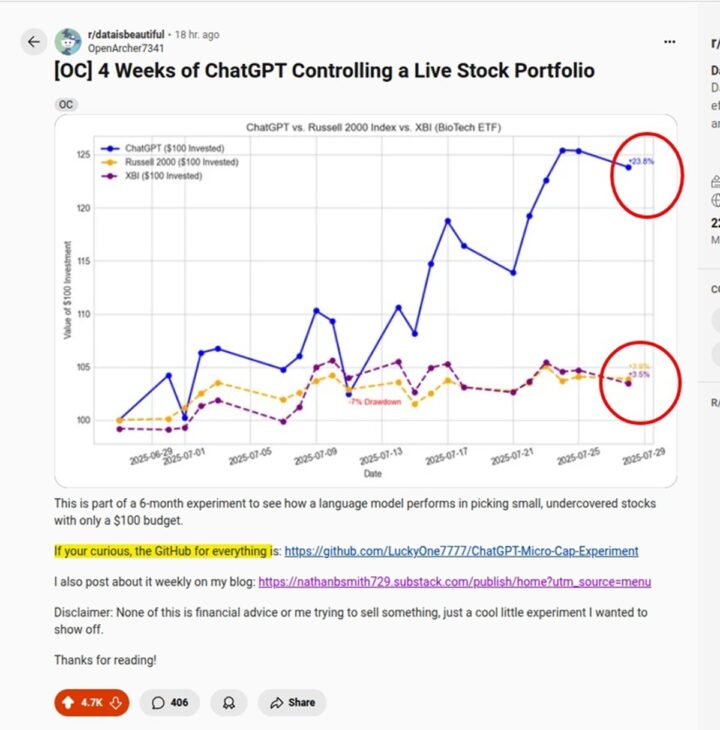
In the first month, the portfolio managed with the support of GPT-4 — one of OpenAI’s latest models — had a growth of 25%.
This represents a profit of US$ 25 on the initial amount of US$ 100.
Although the number seems small, it draws attention when compared to the performance of traditional indices like the S&P 500, which rose less than 3% in the same period.
Additionally, the return also outperformed the Russell 2000 and XBI indices, both composed of small-cap companies.
This indicates that, at least in the short term, ChatGPT made good choices based on the information it received.
AI Alone Is Still Not Enough
Despite the initial success, Smith acknowledges that artificial intelligence is not operating alone.
He explains that he provides daily data to ChatGPT about the stock portfolio, such as updated prices and market movements. The system analyzes this data and suggests decisions.
Moreover, the experiment includes a strict “stop-loss” rule.
Whenever a stock hits a certain negative value, it must be sold immediately. This practice helps reduce losses and is a traditional mechanism in high-risk trading.
Thus, although the aim of the project is to test the AI’s ability to “manage money without guidance,” this has not yet materialized.
Smith himself admits he will continue to do the “homework” until the end of December, maintaining daily oversight of the information.
Previous Experiments with AI
This is not the first attempt to use artificial intelligence in the financial market.
In December, a study from the University of Duisburg-Essen showed that OpenAI’s models seemed to identify good investment opportunities.
Still, the authors themselves acknowledge that simulation results are better than actual performance with real money.
In an interview with Morningstar, Professor Alejandro Lopez-Lira from the University of Florida warned that, at larger amounts, AI tends to struggle.
This is because the market reacts to the actions of large investors. If everyone started using AI, the market’s behavior would change, making the algorithms less effective.
What to Expect Until December
Nathan Smith makes it clear that the initial motivation was curiosity. He wanted to know if the promise sold by ads about AI and stocks made sense.
So far, the results indicate that the idea works — but only with human participation and constant attention.
The question that remains is whether the portfolio will still be in the black at the end of six months. Until then, the experiment offers an interesting sample of how humans and AI can work together to invest — even with a tight budget.
Despite the positive results, it is important to remember that this was merely a controlled experiment with a small amount. Investing in stocks involves real risks, and financial decisions should be made with caution, study, and planning.
Does Artificial Intelligence Change the Game in Investments?
Artificial intelligence has transformed the way people invest in the stock market. Previously, stock analysis relied almost exclusively on human experts and technical reports.
Today, with accessible AI systems in apps and platforms, novice investors can access quick and tailored recommendations.
The most important thing is that these algorithms analyze thousands of data points in seconds. They cross-reference information from financial statements, market news, and historical stock behavior.
With that, they can indicate opportunities more accurately and quickly than a human could.
Personalized Profiles and Less Emotional Error
Many people lose money in the stock market due to impulsive decisions. Fear and greed interfere.
AI, on the other hand, feels nothing. It follows defined parameters and can recommend stocks based on the user’s history, without being swayed by emotion.
Therefore, investors using tools with artificial intelligence tend to make fewer mistakes. Because, in addition to identifying good opportunities, these systems also alert about risks.
They indicate when a stock is overvalued or when there is a sharp decline outside the norm.
Furthermore, the more modern platforms already map the profile of each investor.
Those who are more conservative, for example, receive different suggestions than those seeking more risk. This avoids random choices and reduces the risk of poorly planned decisions.
Sentiment Analysis and Trend Forecasts
Another important resource of AI in the stock market is sentiment analysis.
It examines social networks, forums, and headlines to understand how people are talking about a particular company.
If there is a positive vibe around a company, it may indicate an upward trend. If the sentiment is negative, the system alerts the investor to be cautious.
This type of information was difficult to measure in the past. Now, AI can read it almost in real time. This provides more security for those trading in the stock market, especially in the short term.
Trend forecasts have also become more reliable. Because the algorithms learn from past data and adjust the prediction models.
The more they are used, the more accurate they get. For this reason, investors have adopted these resources even if they still manually apply part of the decision-making process.
AI Does Not Replace Strategy but Improves Results
Despite the advances, artificial intelligence does not make decisions on its own. It serves as a support tool. The final choice is still the investor’s.
Even so, AI-based systems help save time, avoid mistakes, and find good opportunities.
For this reason, the use of artificial intelligence in the stock market is expected to continue growing.
Not as a substitute for the investor but as a strategic partner for more informed and well-founded decisions.


O problema é que o chatgpt tem um limite, por isso precisa da participação do homem.
A IA até te auxilia em criar sua carteira, mas a base de dados é antiga e não acompanha a internet ao vivo e a cores. Ela tem esse limite como parte da regra interna da ia.
Cagou pelos dedos
Base de dados antiga… pelamordeDeus