






 Portuguese
  Spanish


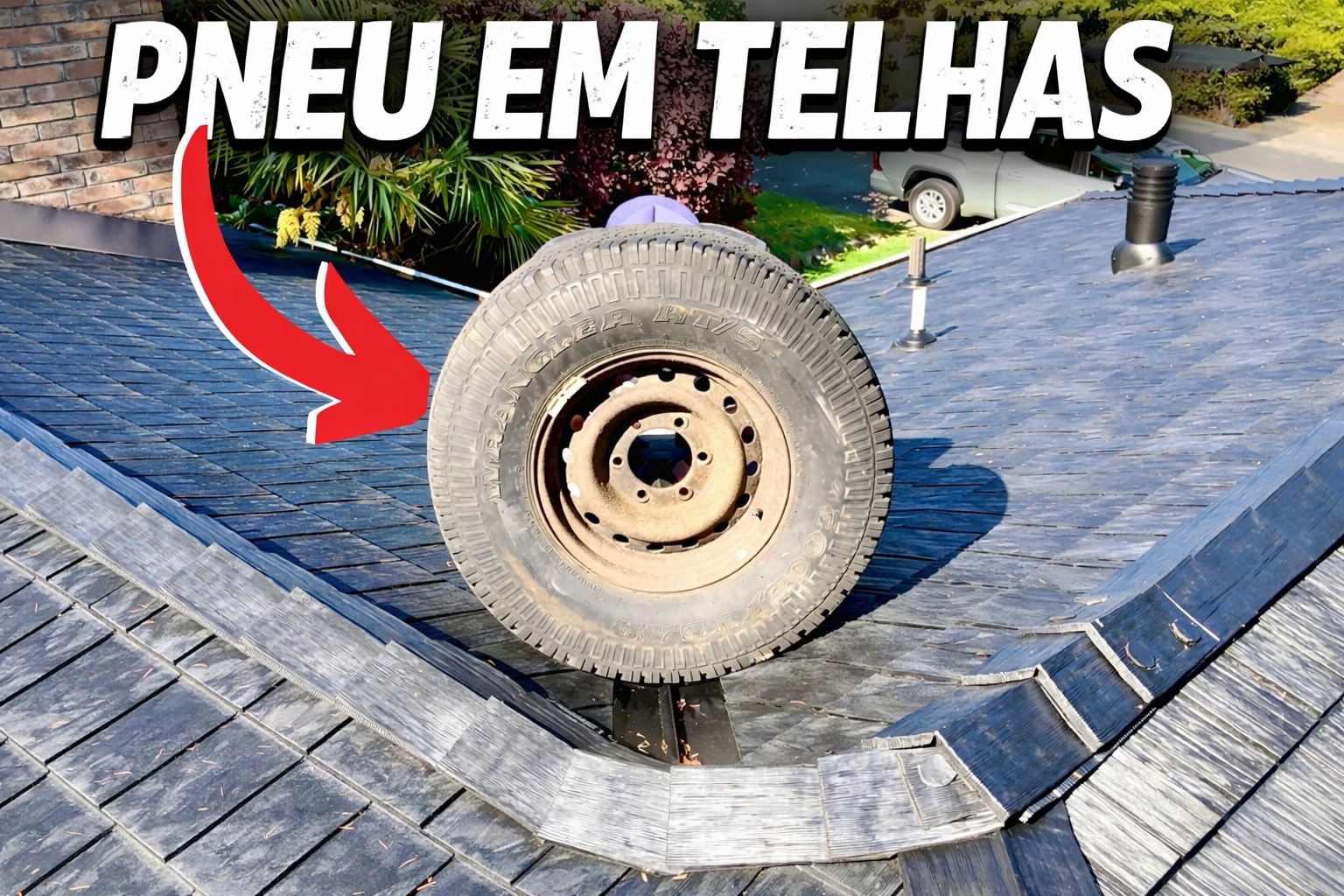


2023 Video and Another from 2025 Show Men Reusing Old Tires to Create Cost-Free, Durable Roof Tiles That Can Cover Houses, Farms, and Sheds Without Leaks.
On June 15, 2023, a video published on the Popular Santos channel on YouTube caught attention by showing in detail a handmade technique for reusing discarded automotive tires to create interlocking flexible tiles, visually similar to the “Brasilit” model. In the content, the author demonstrates step-by-step how tires with rims of 15, 16, and 17 are cut, molded, and installed to form a functional roof resistant to rain, hail, and impact, with a practically zero cost, using only simple hand tools and recycled materials.
The video, recorded in Brazil and published by the Popular Santos channel, documents a practical solution primarily aimed at rural roofs, verandas, sheds, barns, stables, storage facilities, and auxiliary structures, transforming an urban waste product that is difficult to discard into a durable construction element.
The Problem of Discarded Tires and the Logic of Reuse
Used tires are among the most problematic solid wastes in urban and rural areas. Their decomposition is extremely slow, they occupy a large volume in landfills, and when discarded irregularly, they become breeding grounds for insects and environmental hazards.
-
Engineering Feat in Brazil: 6.4 km Tunnel and Powerful Pumps Overcome 200-Meter Elevation to Save São Paulo’s Cantareira Water System

-
Engineering Students Build Off-Grid Tiny Home with Sustainable Features and Offer Free DIY Guide
-
Historic Brazilian Championship Stadium Demolished for New Supermarket and Shopping Center Development

-
Workers excavate one of the world’s longest railway tunnels beneath the Alps between France and Italy, stretching nearly 60 km, 600 meters deep, with an investment of 11 billion euros.



The proposal presented in the video stems from a simple logic: to use the entire usable length of the tire, leveraging the natural resilience of rubber and its structure reinforced with internal wires to create long, flexible, and durable tiles without the need for industrial molds or electrical equipment.
According to the author, each tire yields tiles with an approximate length of 1.86 meters, which reduces the number of pieces needed per square meter of coverage.
Materials Used and Simple Tools
One of the central points of the technique demonstrated in the video is the simplicity of the materials involved. There is no use of industrial machines, presses, or electric tools.

The items used include:
- Used tires with rims of 15, 16, or 17
- Common detergent (any brand)
- Serrated knife
- Hand saw for metal
- Nails or screws
- Recycled rubber from the tire itself for sealing the fastening points
The detergent plays a crucial role in the process, acting as a lubricant, making it easier to cut the rubber and reducing the physical effort required.
How the Tire is Transformed into a Tile Step by Step
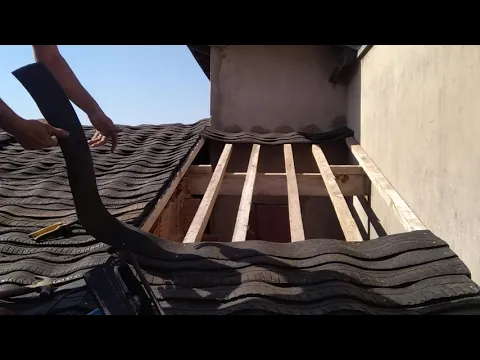

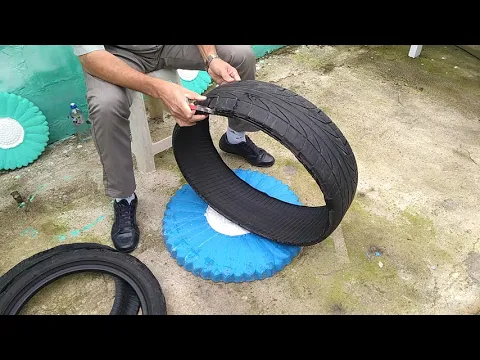
The process begins with the removal of both sides of the tire. The cut is not made at the top, but slightly displaced to the middle of the band, in order to preserve a geometry that allows for interlocking between the tiles.
After removing the sides, the tire is opened longitudinally. At this point, two distinct materials emerge:
- Pure rubber
- The segment reinforced with internal wire, typical of automotive tires
The pure rubber can be cut with a serrated knife. The segment with wire requires the use of a hand saw for metal, always applying detergent to facilitate the blade’s movement.
According to the video’s author, the average time to cut a tire in half, even with wire, is under 2 minutes, provided the tool is in good condition.
The Interlocking of the Tiles and the Secret Against Leaks
One of the most emphasized aspects in the video is the interlocking system. The tiles are not installed all in the same orientation.
The correct method alternates:
- One tile with the curvature facing up
- Another with the curvature facing down
This pattern creates an overlapping interlock that prevents water passage even in wind-driven rain, eliminating the risk of leaks without the need for membranes, special gutters, or industrial sealants.
The author states that when well cut and correctly positioned, the tiles fit “snugly” and do not allow infiltration.
Fixation: Nails, Screws, and Reused Sealing
The fixation can be done with nails or screws, as long as they are not over-tightened. Over-tightening can deform the rubber and compromise the fit.

An important detail shown in the video is the reuse of the rubber from the tire itself to create small sealing washers, positioned under the head of the nail or screw. This rubber prevents the fastener from pulling the tile down and improves the sealing at the fastening point.
Interestingly, the author shows that the central tiles often do not even need to be nailed, as the fit and weight of the assembly already ensure sufficient firmness.
Resistance to Impact, Hail, and Weight
According to what is shown in the video, the coverage made with tire tiles has characteristics that are not common in conventional tiles:
- Complete resistance to hail: ice stones do not break the tile
- Impact cushioning: the noise of heavy rain and hail is significantly reduced
- High mechanical strength: it is possible to walk on the roof without risk of breaking
- Structural flexibility, which absorbs expansions and impacts
These properties are a direct result of the composition of automotive rubber, originally designed to withstand weight, friction, and temperature variations.
Estimated Durability and Maintenance
In the video, the author states that the coverage can last more than 100 years without significant structural maintenance. Although this estimate is not supported by laboratory tests, it reflects the known durability of vulcanized rubber in outdoor environments.
Another highlighted point is that the tiles can be painted, allowing for improved visual appeal or adapting the coverage to the environment. Still, the author states that even without paint, the tile does not heat up excessively and maintains a temperature considered normal.
Where This Type of Tile Can Be Used
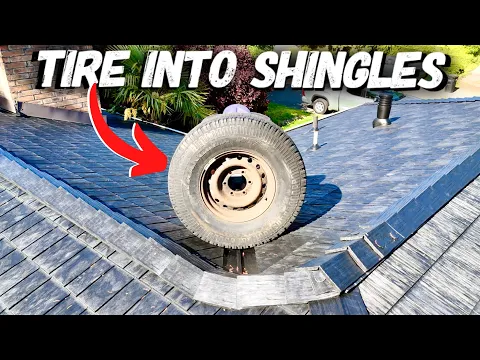
The technique presented is not suitable for structures that require formal structural certification, but it proves extremely functional for uses such as:
- Verandas
- Sheds
- Farms
- Stables
- Manure pits
- Storage facilities
- Rural shelters
- Provisional or permanent roofing in remote areas
By utilizing locally available waste, the solution adapts well to rural and peripheral contexts, where the cost of conventional materials can be prohibitive.
Environmental Impact and Waste Reuse
Each coverage of this type consumes dozens and in larger projects, hundreds of tires that would otherwise be discarded irregularly. It is a clear example of direct reuse, without industrial intermediate processes, burning, or generation of new waste.
The author of the video himself emphasizes that it is a “sustainable and ecological” work, contributing to the environment by giving a new function to a material that is widely problematic from an environmental viewpoint.
The video published on June 15, 2023 by the Popular Santos channel documents a simple, accessible, and functional technique for transforming discarded tires into durable interlocking tiles, at a practically zero cost and with wide practical applications.
Without miracle promises or generic discourse, the content practically shows how urban waste can be transformed into durable construction solutions, especially in rural and low-budget contexts, reinforcing the potential of alternative techniques when applied with knowledge and precision.







Existe gente ingeniosa y busca soluciones sin propaganda ni publicidad. Realmente felicidades y gracias por compartir