






 Portuguese
  Spanish
  5 min of reading
  0 comments


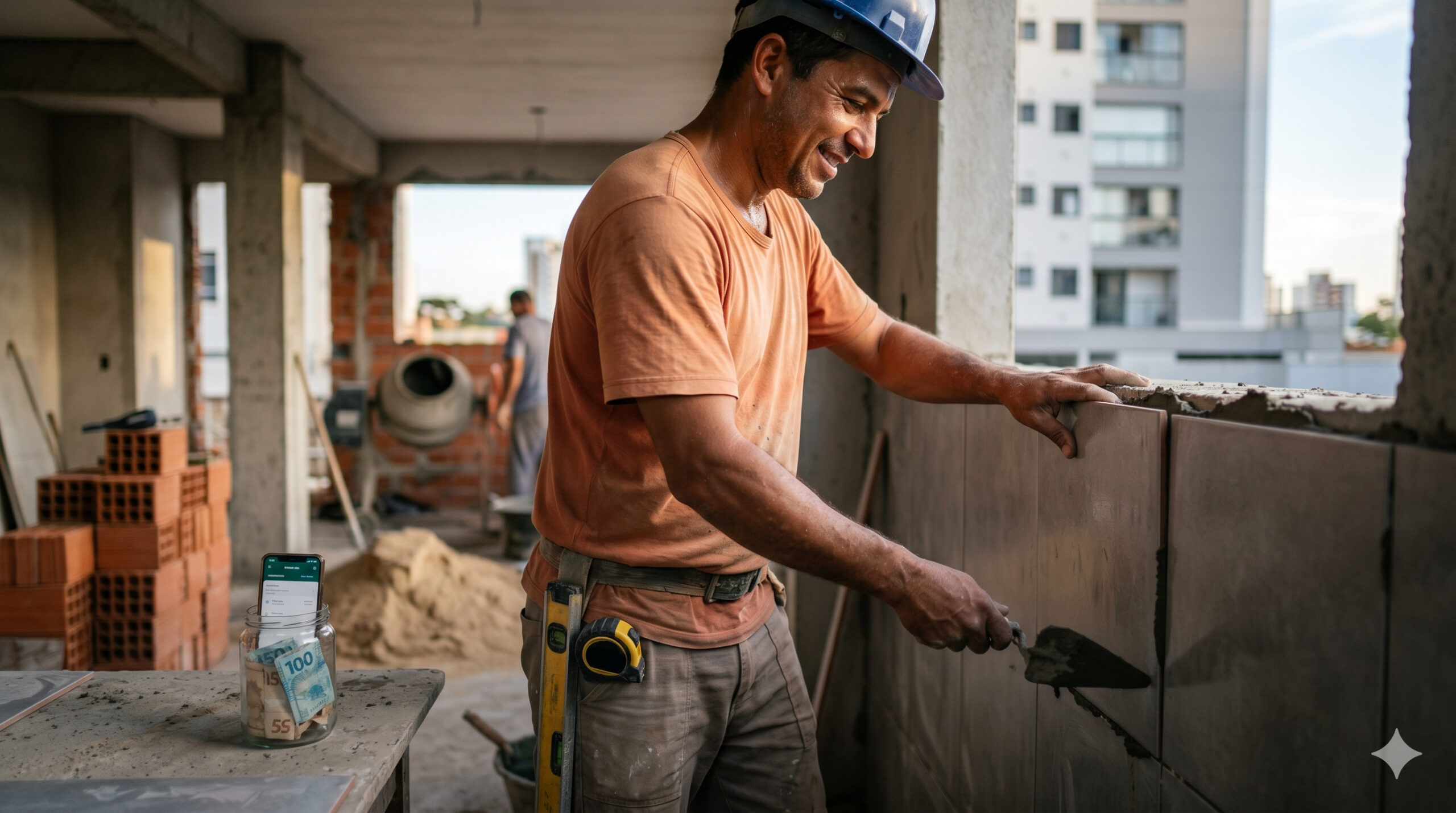
Self-employed bricklayer can earn up to R$ 400 per day and exceed R$ 10,000 monthly in 2026, depending on demand and specialization.
In 2026, the self-employed bricklayer has drawn attention not only for the constant demand but also for the income potential in booming construction regions. While the average formal salary of a bricklayer in Brazil ranges between R$ 2,200 and R$ 3,500, possibly exceeding R$ 5,000 in some cases, the professional working independently can go beyond — especially when working on a daily basis and with specialized services.
This work model allows greater control over prices, choice of services, and direct negotiation with clients. In large urban centers and projects with tight deadlines, the daily rate can reach values much higher than the national average. The mentioned values are described on the portal ta contratando.
Next, see how much a self-employed bricklayer earns in 2026, how daily income works, and in which situations earnings can exceed R$ 10,000 per month.
-
The La Galerie Nortis, a real estate launch by developers Cyrela and Nortis in Moema, São Paulo, arrives with apartments featuring 4 suites ranging from 283 to 416 square meters, an estimated gross development value of R$ 765 million, and the proposal to redefine the high standard in the region.

-
Transnordestina sets record by installing 1.69 km of tracks in a single day, reaches 81% completion, and plans to deliver an additional 100 km of railway by the end of June 2026.
-
Instead of plastering the wall, Argentine architects left ordinary bricks exposed, without traditional mortar, without finishes, without paint, and created a perforated pavilion that looks like an art installation.

-
Prefabricated wooden house surprises in Spain with 132 m², two floors, up to four bedrooms, and a price starting from 45,751 euros, while the version with insulation for living can reach 80,059 euros without assembly, installation, and architect included.




Daily rate of self-employed bricklayer in 2026 ranges from R$ 150 to R$ 300, but can reach R$ 400 in more demanding projects
The daily rate is the main factor that defines the income of the self-employed bricklayer. On average, the Brazilian market works with values between R$ 150 and R$ 300 per day, depending on the region and the complexity of the service.
However, this value can rise significantly in some scenarios. Urgent projects, specialized services, or regions with high demand can raise the daily rate to R$ 300 to R$ 400 or even more.
Additionally, factors such as fine finishing, porcelain tile installation, complete renovations, and short deadlines increase the charged amount.
Monthly income can exceed R$ 10,000 with high demand and specialized services
The monthly earnings of the self-employed bricklayer depend directly on the number of days worked and the daily rate.
In a simple scenario:
- Working 22 days with a daily rate of R$ 250 → about R$ 5,500 per month
- With a daily rate of R$ 400 → about R$ 8,800 per month
In situations of high demand, multiple services, or contracts closed per project, this value can exceed R$ 10,000 monthly.
This mainly occurs when the professional works on more than one service at the same time or operates with their own team.
Self-employed earns more than CLT, but assumes more risks and costs
The main advantage of the self-employed bricklayer is the income potential. Unlike the formal regime, they can adjust their prices according to demand.
On the other hand, there are no guarantees. The professional needs to deal with periods without work, transportation costs, tools, and possible unforeseen events.
Moreover, there are no benefits such as paid vacations, 13th salary, or stability.
Experience, reputation, and recommendation are factors that increase the daily rate
One of the most important points for those working as self-employed is reputation. Well-rated professionals with a history of good services and recommendations can charge more. This happens because the client reduces the risk by hiring someone reliable.

Experience also directly influences. Bricklayers specialized in fine finishing or complete projects have greater negotiation power.
Not all work pays the same. Simple services, like small renovations, tend to have lower daily rates.
More technical activities, such as:
- large format porcelain tiles
- waterproofing
- complete construction
- structural renovations
can significantly increase the charged value.
This means two bricklayers in the same city can have very different incomes.
Regions with more construction and renovations concentrate the highest earnings
Cities with strong real estate growth or a high number of renovations tend to pay more. Capitals like São Paulo, Brasília, Belo Horizonte, and inland cities with urban expansion offer greater demand.
In smaller regions, the daily rate tends to be lower, but it can still be competitive depending on the supply of professionals.
Demand for bricklayers remains high with the growth of construction and renovations in Brazil
Even with economic fluctuations, the civil construction sector maintains constant demand. Residential renovations, private constructions, and commercial projects ensure a continuous flow of work.
This makes the self-employed bricklayer continue to be one of the most sought-after professions, especially during periods of real estate growth.
Profession does not require formal education, but qualification increases earnings
One of the characteristics of the profession is the relatively easy entry into the market. However, technical courses and specializations make a difference. Professionals who master new techniques and materials can charge more.
Professionalization also helps with financial organization and client acquisition. In practice, the self-employed bricklayer functions as a small business owner.
He sets prices, negotiates contracts, organizes his schedule, and in some cases, assembles teams. This expands the earning potential but also requires discipline, planning, and management.
Difference between common and specialized bricklayer defines the income ceiling
While many professionals stay in the income bracket of R$3,000 to R$5,000 per month , those who specialize can go further.
The market values those who deliver quality, meet deadlines, and master modern techniques. This difference is what allows some bricklayers to exceed the R$10,000 monthly bracket.
Despite the advancement of technologies and new construction methods, the bricklayer remains essential. A large part of construction still directly depends on manual labor.


This ensures the continuous relevance of the profession in the Brazilian market.
The self-employed model offers freedom but requires constant effort. The more the professional works, qualifies, and positions themselves in the market, the higher their income tends to be. At the same time, the absence of guarantees requires financial planning.
Do you think the self-employed bricklayer can become one of the most profitable professions in Brazil with the high demand for construction and renovations, or does the market still limit this growth?







Be the first to react!