






 Portuguese
  Spanish
  4 min of reading
  0 comments


Pavilion in City Bell shows how common bricks can create a perforated wall, filter light, protect privacy, and renew masonry in an Argentine residential project
Instead of plastering the wall, Argentine architects left common bricks exposed and created a perforated pavilion that looks like an art installation. The construction is located in City Bell, La Plata, Buenos Aires, Argentina, and uses dry panels to form a facade with solids and voids.
The information was published by Brick Architecture, a platform specialized in brick architecture. The project is by Estudio Botteri Connell and shows a different use for a material well-known in Brazilian construction: the common brick.
The pavilion is 120m², registered in the year 2016 and was designed for a small-scale residential project. The solution does not transform the brick into a common structural wall. It uses the pieces as a perforated skin, with filtered light and more privacy.
-
Prefabricated wooden house surprises in Spain with 132 m², two floors, up to four bedrooms, and a price starting from 45,751 euros, while the version with insulation for living can reach 80,059 euros without assembly, installation, and architect included.

-
China builds a bridge over a river in just 24 hours using two 650-ton Zoomlion cranes, 9 beams of 125 tons, and a convoy of over 100 km with trailers, counterweights, and heavy trucks in synchronized operation during the early hours.
-
Man builds house with concrete made from recycled paper and attracts attention in Portugal; named Porta do Caracol, the home features solar panels, a vertical garden, and a pool with natural filters.
-
Goodbye to conventional plaster? New material used on walls reduces waste and steps in construction and draws the attention of engineers by offering faster application and greater construction efficiency – discover the advantages of smooth gypsum.




Common bricks were left exposed and changed the appearance of a residential project
The most curious point of the project is the choice to leave the common brick as the protagonist. In many constructions, this material disappears behind plaster, paint, or other finishes. In the Argentine pavilion, it appears as the design of the facade itself.
The construction was carried out on a suburban plot on the outskirts of La Plata, in an area that already had a pool house and a swimming pool. The new volume was designed for four bedrooms used on weekends.
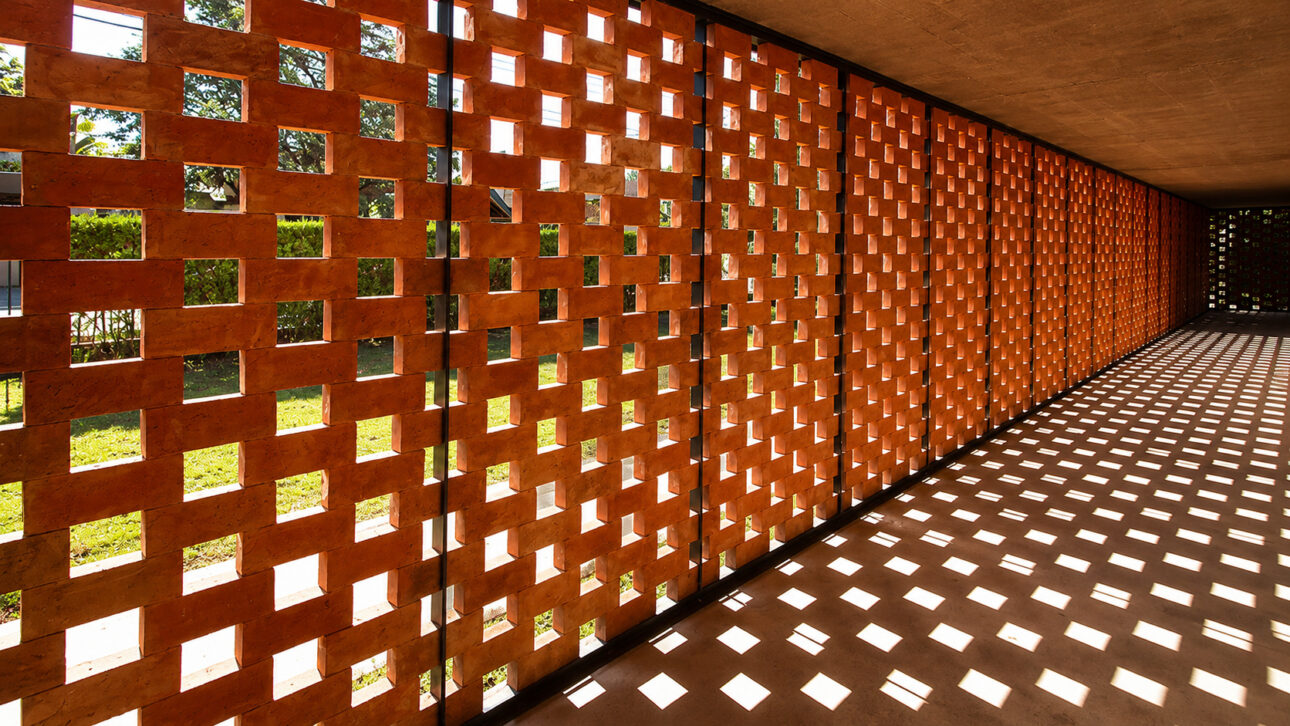
The visual reading is different because the bricks do not form a closed wall. They create an open mesh, similar to a rigid screen, that separates environments without blocking everything.
How the dry panels use 55 whole bricks and 22 half bricks in each module
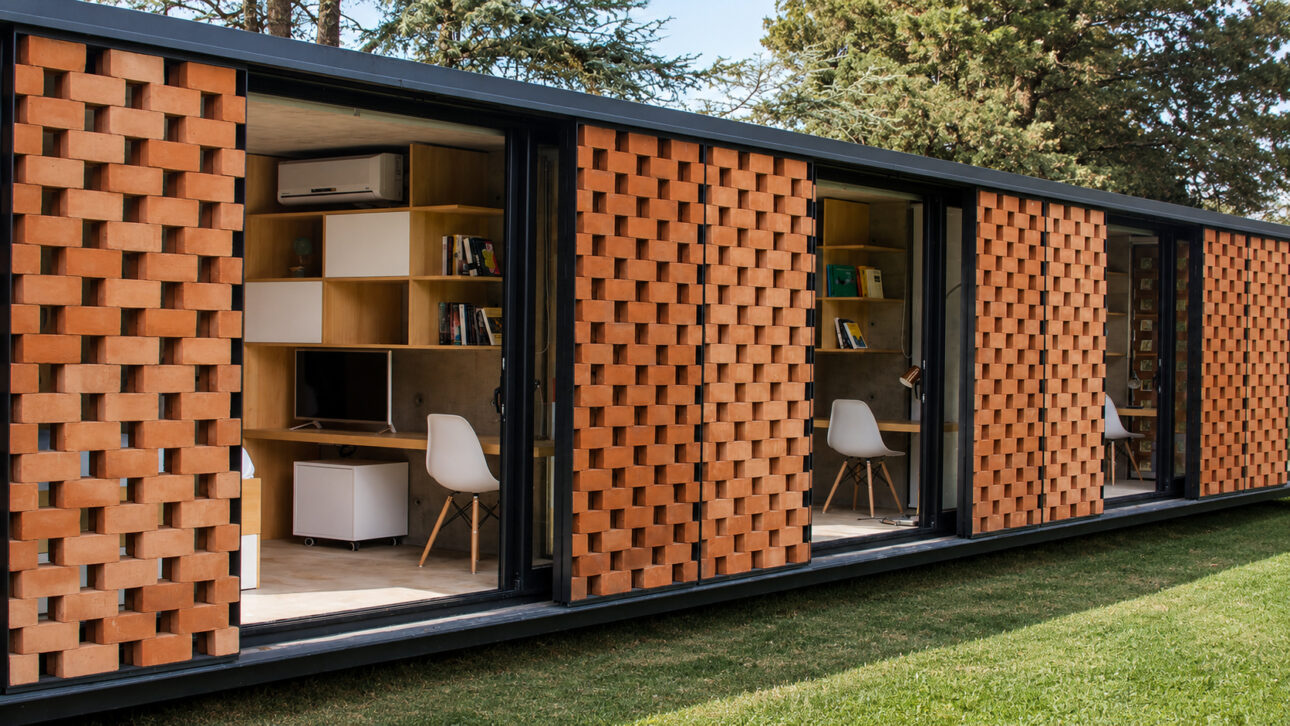
The system uses self-supporting brick panels in dry construction. In simple words, the pieces are arranged without the common mortar, that mixture used to bind bricks in a traditional wall.
Each module gathers 55 whole bricks and 22 half bricks. The alternation between complete pieces, cut pieces, and empty spaces creates a semi-open wall.
This arrangement makes the brick work in a different way. Instead of becoming just a heavy and closed surface, it starts to function as a visual filter.
The metal frame helps keep the brick pattern in place
The set uses a metal frame to organize the pieces. This structure serves as a contour for the assembly and allows the bricks to follow a repeated rhythm, with full and empty parts.
Brick Architecture, a platform specialized in brick architecture, detailed that the external closure is formed by self-supporting dry panels. This helps to understand why the pavilion should not be seen as a common masonry.
The main structure also involves horizontal and vertical planes of reinforced concrete, which is concrete reinforced with steel. Therefore, the perforated brick wall does not appear as a direct substitute for a traditional structural wall.
The perforated wall filters light and protects privacy without closing everything
The brick pattern allows light to pass through the voids between the pieces. Thus, light enters in a filtered way, without creating a completely open facade.
This design also helps with privacy. Those outside encounter a visual barrier, while the rooms continue to receive light and connection with the external area.
In the south facade panels, the composition also includes the possibility of displacement. This solution allows for a connection between the rooms and the outside, without abandoning the logic of the perforated wall.
The result resembles cobogó and muxarabi but uses common brick in a different way
For the Brazilian public, the easiest comparison is the cobogó, a perforated piece widely used to let light and visual ventilation pass through. The muxarabi also helps to understand the idea, as it is a type of perforated closure that protects privacy.
The difference lies in the material and assembly. The pavilion uses common bricks, whole pieces, and cut pieces within a dry system. Thus, a simple material gains the appearance of an experimental work.
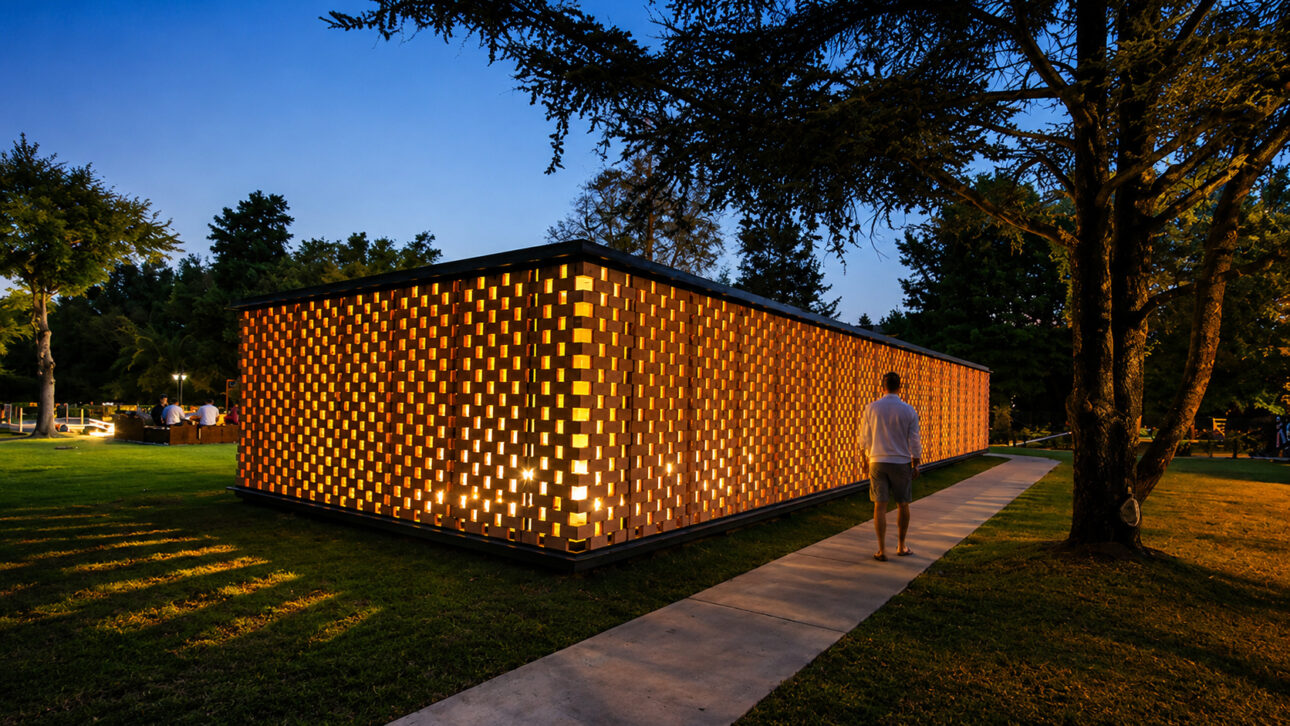
The facade does not just become a wall. It becomes part of the space experience, creating shadow, texture, and visual movement.
Why this Argentine pavilion draws attention to construction in Brazil
The project is interesting because it uses a common material in a less obvious logic. The brick remains a brick, but it ceases to be just a hidden piece in the construction.
For Brazilian construction, the idea opens a simple reflection. Known materials can gain new functions when the project changes the way each piece is organized, supported, and exposed.
This does not mean that any wall can be made this way. A solution with bricks without traditional mortar depends on proper design, structure, support, and execution.
The City Bell pavilion shows that innovation in architecture does not always need to come from a rare or expensive material. Sometimes, it appears when an old piece gains a new assembly logic.
The Argentine work transformed common bricks into a perforated facade, light filter, and privacy element. Do you think a solution like this would have space in Brazilian homes, or is exposed brick still seen as too simple here?








Be the first to react!