Portuguese
  Spanish


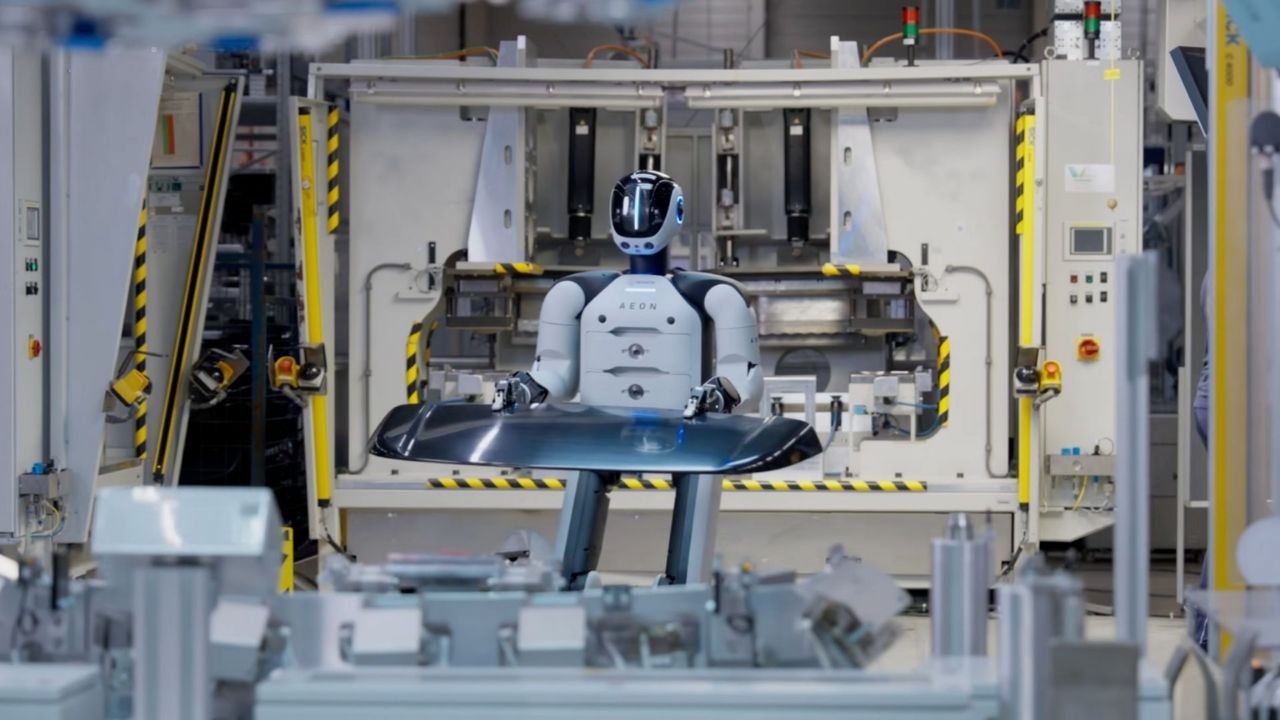

The AEON humanoid robot began testing in a real industrial environment in Austria to perform machine tending, inspections, and operational support, in an initiative that unites Swiss Hexagon Robotics and Austrian Fill Maschinenbau and seeks to accelerate the entry of physical AI into the heart of advanced European manufacturing
The AEON humanoid robot entered a new stage of development with a pilot project announced on May 5, 2026, aimed at operation in a real factory in Gurten, Austria. The initiative was structured by Hexagon Robotics, a Swiss company, in partnership with Fill Maschinenbau, an Austrian engineering company, with the objective of deploying the system to perform concrete factory floor tasks, such as machine tending, inspection, and operational support.
In this new test, the humanoid robot will be used as a complement to existing automation systems, rather than replacing them entirely. The proposal is to measure how it can increase autonomy, efficiency, and productivity in complex industrial environments, especially in lines with high production variety and precision assembly. It’s a step that moves AEON from technological discourse and pushes it into the real world of industry, where performance needs to translate into results.
The humanoid robot left the lab and entered the factory rhythm
The big change in this phase is the setting. AEON had already undergone initial evaluations and validations in the laboratory, but now it enters a real-world customer application. This changes everything, because an operating factory does not tolerate vague promises, theoretical delays, or a robot that only works in a controlled environment.
-
Spain Launches World’s Largest Floating Dry Dock: 56-Meter Giant Produces Massive Concrete Structures in A Coruña Using Technology Proven in Brazil

-
AI-powered toys that talk, recognize faces, and collect data face scrutiny from Brazilian government over children’s privacy concerns

-
4,000-Year-Old Child’s Skull Unveils Ancient Burial in 7,500-Year-Old Norwegian Rock Shelter, Impressing Archaeologists

-
Norway Defeats Brazil in World Cup but Invests Billions to Preserve the Amazon, Strengthens Amazon Fund, and Joins Brazil in Leading Global Effort Against Tropical Deforestation


The pilot in Gurten was designed precisely to place the humanoid robot in front of existing manufacturing flows. The goal is to discover if it can coexist with real production, integrate with what is already installed, and generate measurable value within a demanding industrial routine.
What AEON will do in practice inside the factory
The plan points to three central fronts for the humanoid robot pilot. The first is machine tending, which means operating and supplying machines. The second is inspection, a critical activity in production lines that depend on precision and repeatability. The third is operational support, a broader layer of help for factory routine.
These tasks were chosen because they are precisely where flexible automation can gain ground. They are not abstract functions, but recurring, repetitive, and sensitive activities, in which a humanoid robot needs to prove that it can manipulate, observe, record data, and support processes without becoming an obstacle to operation.
Why Austria became the project’s new testing ground
The test will be conducted in Gurten, Austria, within Fill Maschinenbau’s advanced production environments. This places the project in a factory with real demands for integration, precision, and operational continuity.
The choice of location does not seem casual. If the proposal is to validate industrial autonomy in complex scenarios, it makes sense to take the humanoid robot to an engineering company that already works with advanced production and can rigorously measure where the technology helps, where it hinders, and where it needs to evolve.
Europe accelerates the race for more autonomous factories
The move by Hexagon Robotics and Fill Maschinenbau makes it clear that the race for autonomous manufacturing is no longer restricted to the United States or Asia. The AEON humanoid robot pilot fits into a broader next-generation automation strategy, focusing on flexible, data-driven solutions capable of generating measurable operational value.
This project also shows a shift in the industry’s tone. The question is no longer just whether humanoids can work in manufacturing, but where they can generate more efficiency without dismantling what the factory already does well.
Before Austria, the humanoid robot had already been at BMW


AEON doesn’t arrive completely raw to this new phase. The base reports that, in December 2025, the humanoid robot entered its first real pilot at the BMW Group factory in Leipzig, after being introduced in June 2025.
This history matters because it shows continuity. The project was not born from an isolated demonstration. There is a clear sequence of development, presentation, initial validation, and testing in real industrial environments, which strengthens the perception that AEON is being carried forward as a serious automation platform.
How the humanoid robot was designed to work alongside humans
According to the base, AEON was designed to operate alongside human workers. Its focus includes manipulation, inspection, and data capture tasks, rather than isolated operation or disconnection from the production flow.
This approach is important because it avoids selling the humanoid robot as a miracle machine that solves everything on its own. The proposal is to integrate it as a capacity reinforcement in dynamic environments, where collaboration, spatial awareness, and rapid adaptation are as important as strength or speed.
Sensors and spatial intelligence are central to the proposal
AEON combines sensor fusion, spatial intelligence, and a wheeled locomotion system. This combination allows the humanoid robot to move and operate more efficiently in industrial scenarios, where space is shared with people, machines, parts, and constantly changing routines.
In practice, this means the robot doesn’t rely solely on programmed movement. It needs to perceive the environment, understand position, navigate, capture data, and act within variable contexts, which helps explain why the company relies so heavily on physical AI and not just traditional mechatronics.
Humanoid robot training begins in the virtual world
One of the most important points in AEON’s development is the **simulation-first** approach. The humanoid robot is extensively trained in virtual environments with NVIDIA Isaac Sim and NVIDIA Isaac Lab before being brought into the physical world.
In this simulation environment, it learns navigation, locomotion, and manipulation. According to the base, this process reduces training cycles from months to weeks. It’s a huge advantage because it accelerates learning, cuts physical testing costs, and allows behavior correction before the robot reaches the factory floor.
Embedded intelligence aims to ensure real-time decisions
To operate directly on the device, AEON uses NVIDIA Jetson Orin, which enables real-time perception and decision-making. The base also mentions that future updates to NVIDIA IGX Thor are expected to enhance collaborative safety in industrial environments.
This detail helps understand how the humanoid robot’s autonomy is being conceived. It’s not enough to see and calculate. In a factory, it needs to perceive quickly, decide quickly, and act safely, without relying on a slow processing chain that would make the operation sluggish or risky.
The humanoid robot also learns by observing humans
Another relevant point is the use of NVIDIA Isaac GR00T and Mimic tools, which help AEON learn from human demonstrations and generate synthetic motion data.
This type of feature shortens the path between an observed task and an executable task. Instead of relying solely on rigid programming, the humanoid robot gains a layer of learning closer to human behavior, which can accelerate the development of new skills for the industrial environment.
The cloud enters the factory to connect the physical to the digital
AEON also operates with a set of high-resolution sensors that capture detailed spatial data and send this information to Hexagon Reality Cloud Studio via HxDR. Integrated with NVIDIA Omniverse, this system enables real-time 3D modeling and collaboration with digital twins.
This expands the role of the humanoid robot within the factory. It not only performs tasks but also helps feed a digital layer of the operation, connecting what happens in the physical world to cloud-based industrial flows, data, and three-dimensional visualization.
What the industry wants to discover with this pilot
Hexagon states that the deployment should generate important information about system performance, integration, and scalability. In other words, the pilot is not just to show that the robot walks or manipulates parts. It exists to measure if this technology can truly grow within the industry.
This is perhaps the most important question of all. A humanoid robot impresses in video, but it only changes manufacturing if it can scale, integrate into the existing industrial park, and deliver real operational gain. This is exactly the test that begins in Austria.
The AEON humanoid robot enters the factory to be judged by its results
Ultimately, what’s at stake is not just another advance in robotics. AEON enters the factory at a time when the industry wants more flexibility, more data, more autonomy, and less rigidity between man, machine, and software.
If the pilot works, the humanoid robot could consolidate as a new layer of automation in complex environments. If it doesn’t work, it returns to the laboratory as an incomplete promise. That’s why this entry into Austria matters so much, because there, discourse meets real production, and real production is not usually kind to technology that doesn’t deliver.
If the AEON humanoid robot can operate machines, inspect processes, and support real production in Austria without disrupting industrial routine, is Europe on the verge of autonomous factories with physical AI, or will this leap still take longer than the market imagines?