Portuguese
  Spanish


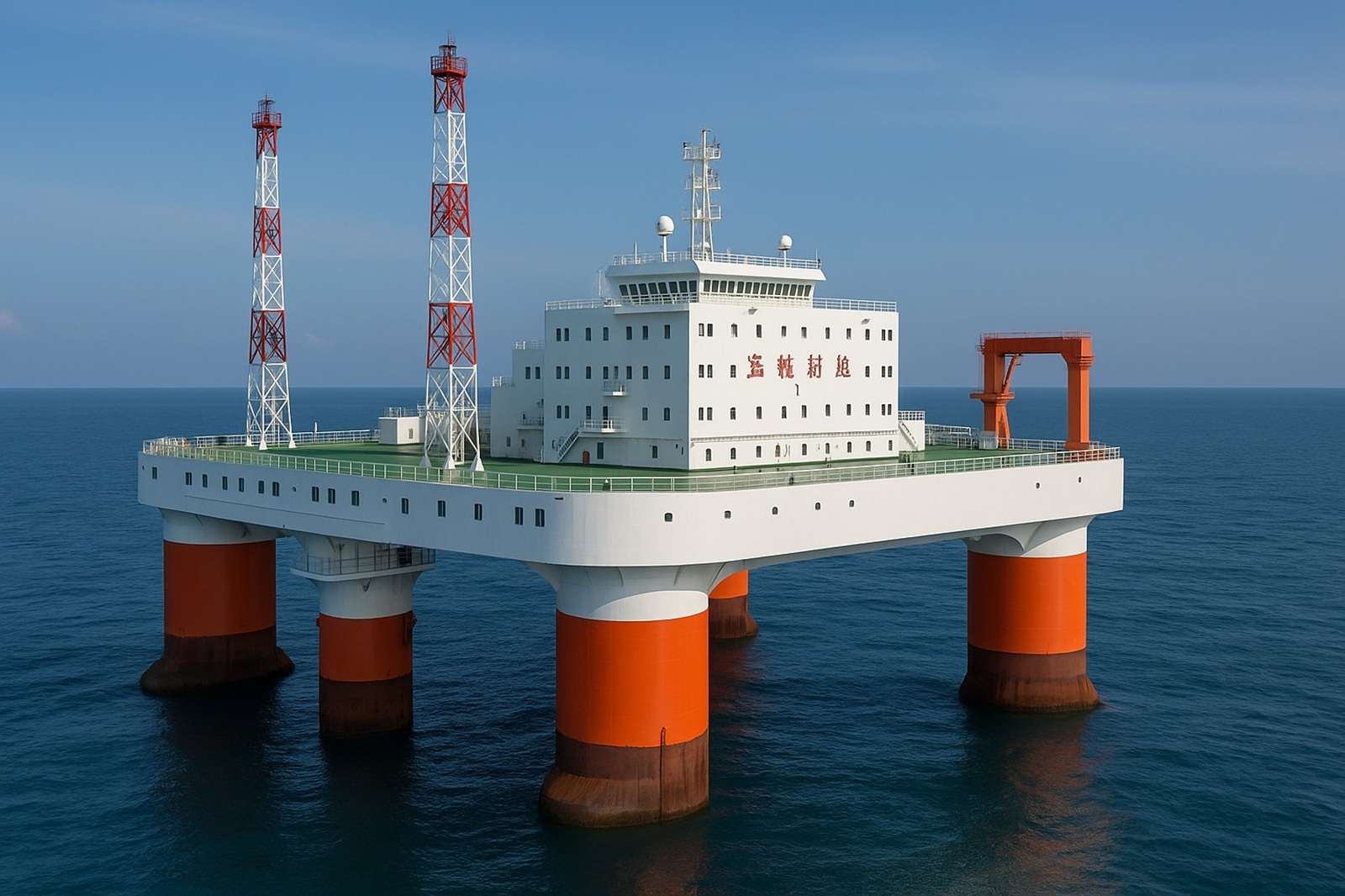


Chinese Project Builds A Floating Semisubmersible Artificial Island Capable Of Operating For Months, Withstanding Nuclear Explosions And Maintaining Stability Even In Extreme Seas.
China is developing a gigantic floating artificial island semisubmersible designed to withstand nuclear explosions.
The platform, with a double hull and 78,000 tons, integrates a protective system capable of transforming the shock of a detonation into light compressions thanks to the use of metamaterial sandwich panels.
According to the information released, the installation is expected to begin operations in 2028 and will accommodate a crew of 238 people, with a four-month autonomy.
-
World’s First Nuclear Hydrogen Unit Begins Operation: Copper-Chlorine Technology with Initial Capacity of 150 Liters per Hour, Aiming for 3,000 Liters per Hour

-
Mechanics Retrofit Old Fiat Uno with BYD Electric Motor for Silent, Low-Voltage Operation Reaching Nearly 60 km/h in Home Test
-
Free Internet Begins Testing in São Paulo Metro Stations, Network-Wide Rollout Expected by 2026
-
Man Transforms Desert Ranch into Forest by Harvesting Rainwater, Captures 15,000 Gallons in One Downpour, Builds 100 Dams with 6 Volunteers



Structure And Scientific Proposal
Named the Floating Research Facility for Deep Water and Variable Climate Conditions, the structure will have a displacement close to 80,000 tons, a value similar to that of the Chinese aircraft carrier Fujian.
The project anticipates operation in any weather condition, as well as providing adequate conditions for prolonged habitation at sea.
The platform will feature systems dedicated to ensuring emergency power, stable communications, and efficient navigation control.
Researchers from Shanghai Jiao Tong University and members of the China State Shipbuilding Corporation participated directly in the design of the infrastructure.
Resistance Capacity And Continuous Operation
The revolutionary nature of the project combines mobility with prolonged permanence. The floating island will be able to navigate at 15 knots and host over a hundred researchers who will conduct constant observations in deep waters, test advanced maritime equipment, and explore underwater mining technologies, according to reports from SCMP.
At 38 meters long and 85 meters wide, the platform was designed to operate even in turbulent seas and survive high-intensity tropical cyclones.
The semisubmersible construction will leave most of the structure below the waterline, ensuring stability even in severe conditions, while the deck and laboratory modules will remain at the surface.
Sensitive Use Technology
Resistance to nuclear explosions will be made possible thanks to the metamaterials employed, developed with properties nonexistent in conventional materials. However, the practical validation of this resistance on a large scale still poses a challenge, especially under real nuclear explosion impact.
In a peer-reviewed article published in the Chinese Journal of Ship Research on November 4, the team led by Professor Yang Deqing highlighted that the superstructure includes essential compartments for emergency power, communications, and navigation control. Therefore, protection against nuclear explosions in these sectors is considered fundamental.
Strategic Repercussions
The commencement of operations could allow China to project a resilient presence in distant regions from its borders. The platform, officially classified as a scientific installation, already raises concerns about potential military applications, especially in disputed maritime areas.
Reports indicate that the structure may also function in non-military risk situations, such as underwater explosions, accidents, or extreme weather events.
Additionally, the facility may be equipped with environmental monitoring sensors, ocean analysis equipment, and autonomous submersible vehicles, enhancing its role for continuous observation in deep waters.