Portuguese
  Spanish




Among Gardens, Pigs, Ducks and a Rowboat, He Builds a Self-Sufficient World on Three Islands of a Deep Reservoir in Guizhou and Turns Abandoned Ruins into a Survival Routine
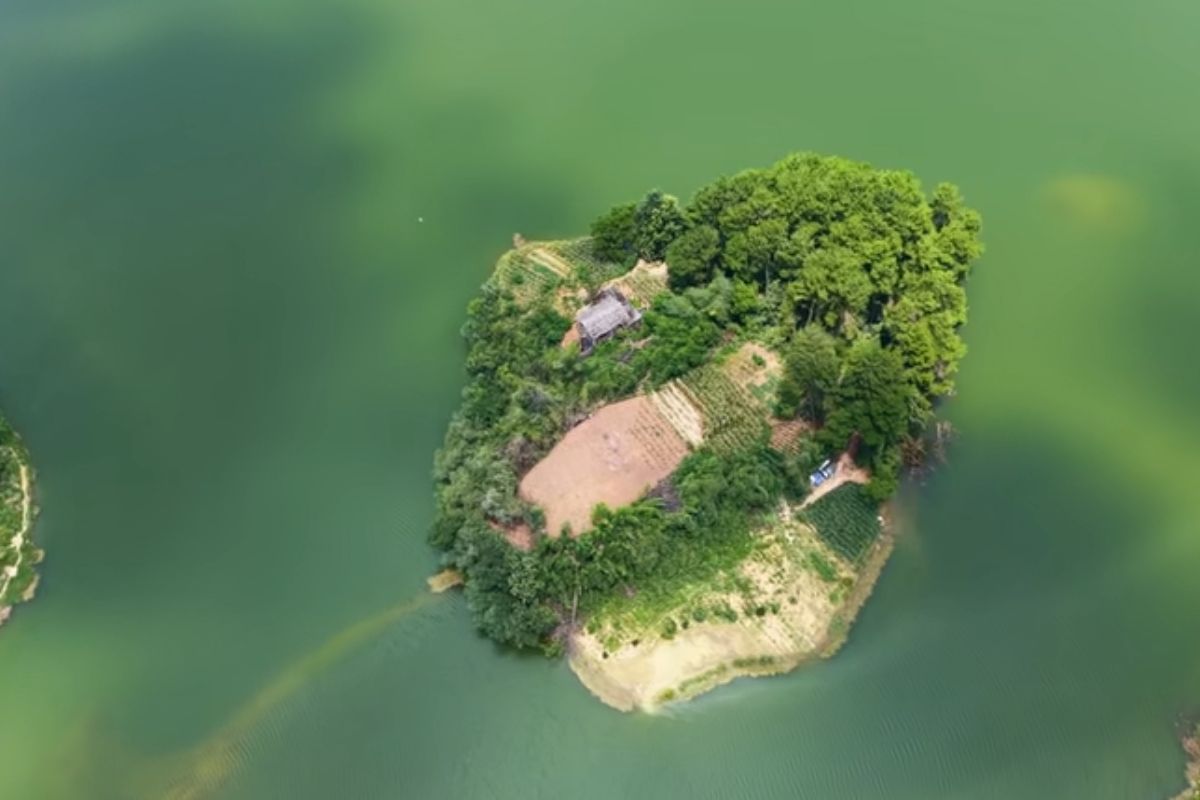
It does not appear on tourist maps, receives no visitors, and has no neighbors nearby. In the middle of a lake surrounded by mountains in Guizhou, three green islands seem like mere forgotten pieces of land, until an approach reveals something unlikely: organized plantations, sheds, animals, and a two-story house.
There, a man in his 60s decided to trade the city’s pace for a secluded and practical daily life. Between trips back and forth by boat, growing food, and raising animals, he claims to have found a simpler yet more demanding way of life, where every resource must be earned with one’s own hands.
The Lake Hides More Than Landscape: There Are Signs of Life on the Islands
From a distance, the islands appear untouched, surrounded by vegetation and silence. But the aerial image shows clear signs of occupation: cultivated areas, open paths, and structures indicating a human presence.
-
At 17, she hand-painted her first watercolor design for school uniforms; her brand grew without investors, sold 135,000 pieces, and aims for $3 million in revenue by 2026.

-
Shell Discovers Intact Early 19th-Century Wooden Shipwreck in the Gulf of Mexico at Over 1,300 Meters Deep
-
Brazilian Entrepreneur Turns Door-to-Door Jewelry Sales into a Family Business Empire with Over 70 Stores

-
$75 Million Bridge in Brazil Opens to Connect Cities, Create Jobs, and Cut Travel Time from 30 to 2 Minutes; Spanning 1.24 km, It’s Among the Country’s Largest and Ends Decades of Ferry Queues.




The surprise is precisely this: it is not a preserved natural setting, but rather a worked territory.
Access is not trivial. To get there, the team registers the crossing of the lake and reports the depth of the reservoir, which exceeds ten meters in certain spots.
The isolation is reinforced by the risk of the water and by the fact that the crossing is usually done carefully, in groups, when there is more than one person in the area.
Who Is the Resident and How Did He End Up There

The island’s owner introduces himself with the surname Wu and greets visitors naturally, as someone accustomed to a routine without an audience.
The house where he stays draws attention because it was not built by him: the structure was reportedly started years earlier, in a village project that ended up abandoned after the investor withdrew. What was a construction skeleton turned into the shelter of a restructured life.
He says he began living on the island about two years ago. Before that, there were big trees everywhere, and the area was practically taken over by weeds.
Upon arrival, he cut down part of the vegetation and began to rejuvenate the land. The goal was not tourism or adventure, but rather work: to plant and raise animals, with a self-sustaining logic.
The Routine to Keep the Island Running


Movement is done by boat, usually by rowing, because the reservoir has rules and is not a place where you “turn on a motor and that’s it.”
The crossing takes just a few minutes, but life there requires consistency: feeding animals, caring for planting areas, gathering firewood, cooking, and keeping the space minimally usable.
He explains that he goes back to the house off the island whenever he wants: sometimes in two or three days, sometimes after a week.
The distance, according to him, can be covered in about 10 to 20 minutes by car when he is on firm ground, suggesting that isolation is more of a daily choice than a permanent exile.
Planting and Raising: The Basics to Survive Without Depending on the City

The structure of the place revolves around food and maintenance. He raises ducks and geese, as well as pigs. There are also chickens in sheds belonging to relatives who occupy nearby areas. It’s a simple yet functional system: corn and grass become feed and sustenance, and the surplus becomes a reserve.
In cultivation, there are various fronts. He mainly planted corn to feed pigs and birds. There are records of sweet potatoes, beans, pumpkins, and peppers, as well as attempts with mushrooms and watermelons.
Some endeavors failed, such as part of the watermelon seeds and the experience with mushrooms which, according to him, would require a cooler and more humid environment.
“Builds a Self-Sufficient World” with Medicinal Herbs as a Long-Term Plan
The most strategic point of the project is not just planting food, but establishing a minimum income. He repeatedly talks about medicinal herbs: mentions an interest in medicinal asparagus and other traditionally used plants, as well as the intention to replace areas of the island with more profitable crops.
The logic is clear: builds a self-sufficient world not only with food but with something that can turn into money without depending on formal employment.
He acknowledges limitations of the soil and climate in some attempts, but continues to adjust what to plant, what to uproot, and what to restart.
Energy, Communication and Comfort: The Minimum to Not “Disappear from the World”
Even isolated, he is not completely disconnected. There is a solar lamp that, according to him, can also charge a cellphone.
He mentions that there is not a “traditional” signal all the time, but he can make calls over the internet, which changes the dynamic of isolation: it’s recluse living, but not necessarily uncommunicative.
Regarding comfort, he describes the island as cooler than the other side of the lake. He says he doesn’t need air conditioning and that the place is “warm in winter and cool in summer,” reinforcing the idea of a microclimate. For someone living with daily physical tasks, this is also part of the choice.
A Refuge that Requires Effort and Yet Attracts with Simplicity
The narrative does not romanticize the work: swimming to the island is exhausting, rowing is routine, planting goes wrong, and raising animals requires time and discipline.
Still, the owner seems satisfied. His children are adults living in other cities, and he treats the project as a way to age with occupation, autonomy, and purpose.
In the end, the island becomes a synthesis of a rare choice: less hurry, more manual work, less consumption, more direct responsibility for every detail.
And it is precisely for this reason that so many people look at this type of life with astonishment and admiration at the same time.
Could you give up city life and live for years in a place like this, or do you think it only works for a short time?