






 Portuguese
  Spanish
  3 min of reading
  0 comments


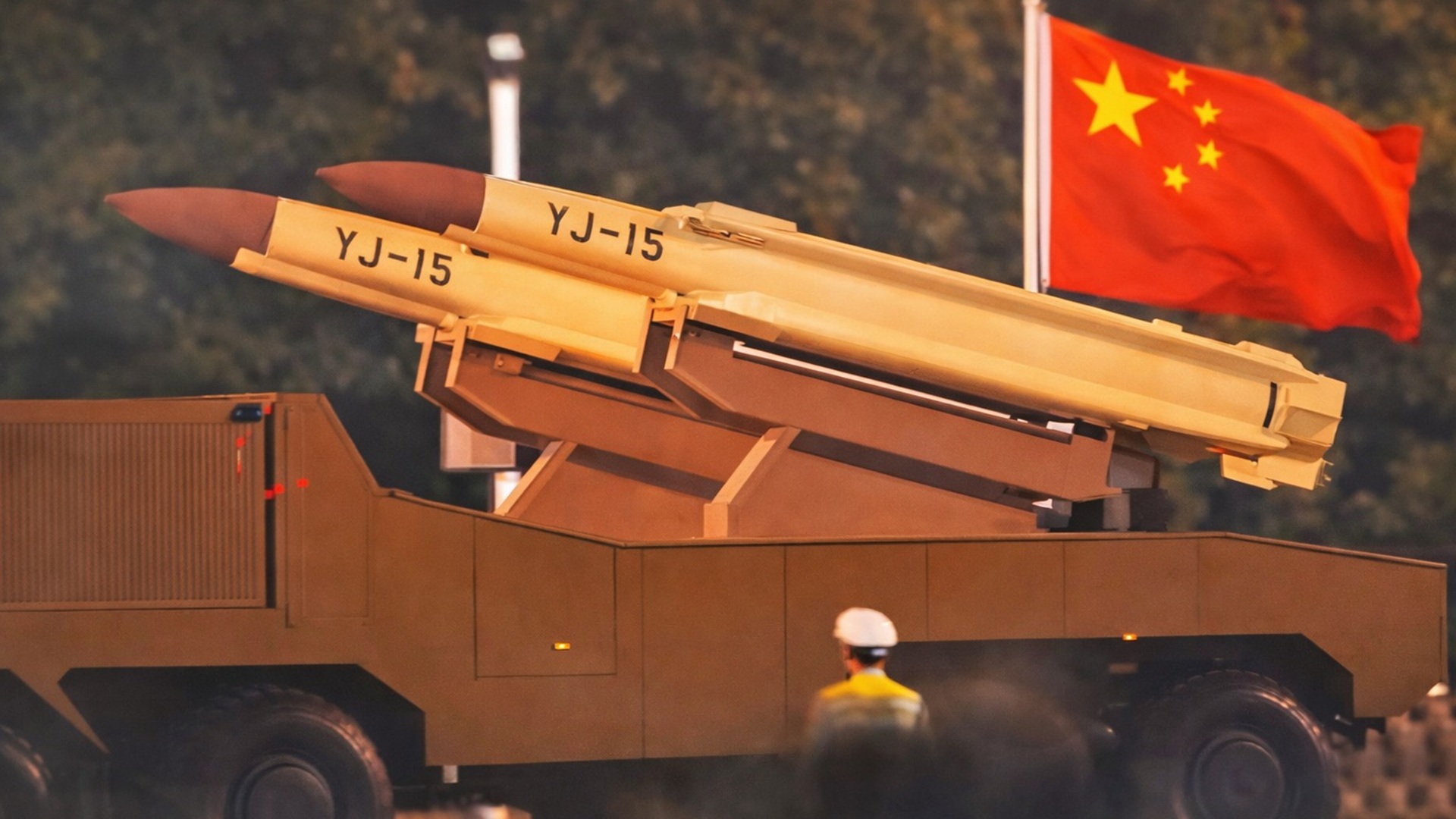
Image Circulating Online Indicates Possible Discreet Entry into Service of Anti-Ship Missile YJ-15 in Chinese Navy, Suggesting Operational Integration into Naval Fighters, Estimated Range of at Least 500 Kilometers and Terminal Speed between Mach 4 and Mach 5, Expanding China’s Naval Aerial Strike Capacity
The circulation of an image indicating an anti-ship missile YJ-15 in operational configuration suggests that the weapon may have quietly entered service in the People’s Liberation Army Navy, pointing to integration into carrier-based aircraft and expanding China’s long-range naval strike capability.
Visual Evidence and Indications of Operation of the Anti-Ship Missile
A photograph circulating online shows what appears to be a fighter jet from the People’s Liberation Army Navy carrying two YJ-15 missiles. The observed configuration suggests real-world deployment rather than a mock-up intended for parades or public displays.
If the image is authentic, the record indicates that the anti-ship missile has surpassed the prototype phase and has been integrated into carrier-based aircraft. This would imply the capability to strike ships from the air at considerable distances.
-
Helicopter Drops 180 Tons of Sand and Gravel on Swedish River to Revive Ecosystem Damaged by Decades of Exploitation

-
Brazilian Company Launches Retro Smartphone with 48 MP Camera, T9 Keyboard, and Privacy Features for Social Media-Free Use

-
Self-Taught Chinese Farmer Builds 5-Ton Submarine from Scrap, Launches It in Anhui River
-
Invisible Induction Technology Enables Wireless Power for Blenders, Coffee Makers, and Air Fryers, Reducing Countertop Cables




Operational Gap and Public Presentation of the YJ-15
Until the emergence of the image, the operational role of the YJ-15 had not been clearly defined. The missile had been publicly showcased for the first time during China’s last Victory Parade, with no official confirmation of its service entry.
The new image fills part of that gap by indicating a potential practical employment of the anti-ship missile. The integration into naval fighters suggests a specific role in naval aerial attack, as opposed to systems intended solely for ground platforms or bombers.
Range, Speed, and Comparison with Other Systems
Although no official data has been released, it is estimated that the YJ-15 has a range of at least 500 km, equivalent to 311 miles. Analysts also indicate a terminal speed positioned between Mach 4 and 5.
This combination would make the anti-ship missile difficult to intercept, as reaction times would be measured in seconds. In comparison, the Indian BrahMos-A reaches about Mach 3, the Russian Kh-31AD achieves approximately Mach 4, and the American Harpoon hits Mach 0.9.
Integration into Fighters and Position in the Chinese Arsenal
The YJ-15 appears to have been specifically designed for fighters, not bombers. Aircraft like the J-15T and J-16 could theoretically carry multiple units of the anti-ship missile, enhancing the offensive capacity of Chinese aircraft carriers.
This feature would fill a gap in China’s naval aerial arsenal. Currently, the country operates the YJ-21, described as hypersonic, and has developed the YJ-12, a heavy supersonic missile launched by bombers, leaving space for an intermediary system like the YJ-15.
Guidance, Survivability, and Final Questions
Reports indicate that the anti-ship missile has satellite, radar, and infrared guidance systems, as well as anti-jamming capabilities. The possibility of terminal maneuvering is also mentioned, which would increase survivability in intense electronic warfare environments.
Despite this, the authenticity of the image remains questionable. Still, it suggests the possibility that China may already possess advanced anti-ship weapons, while the United States continues to rely on subsonic munitions and faces challenges in developing new hypersonic weaponry.





Be the first to react!