Portuguese
  Spanish


Discover the inflatable domes installed in Guangzhou, Shenzhen, and Jinan to isolate large constructions and reduce impacts in busy urban areas.
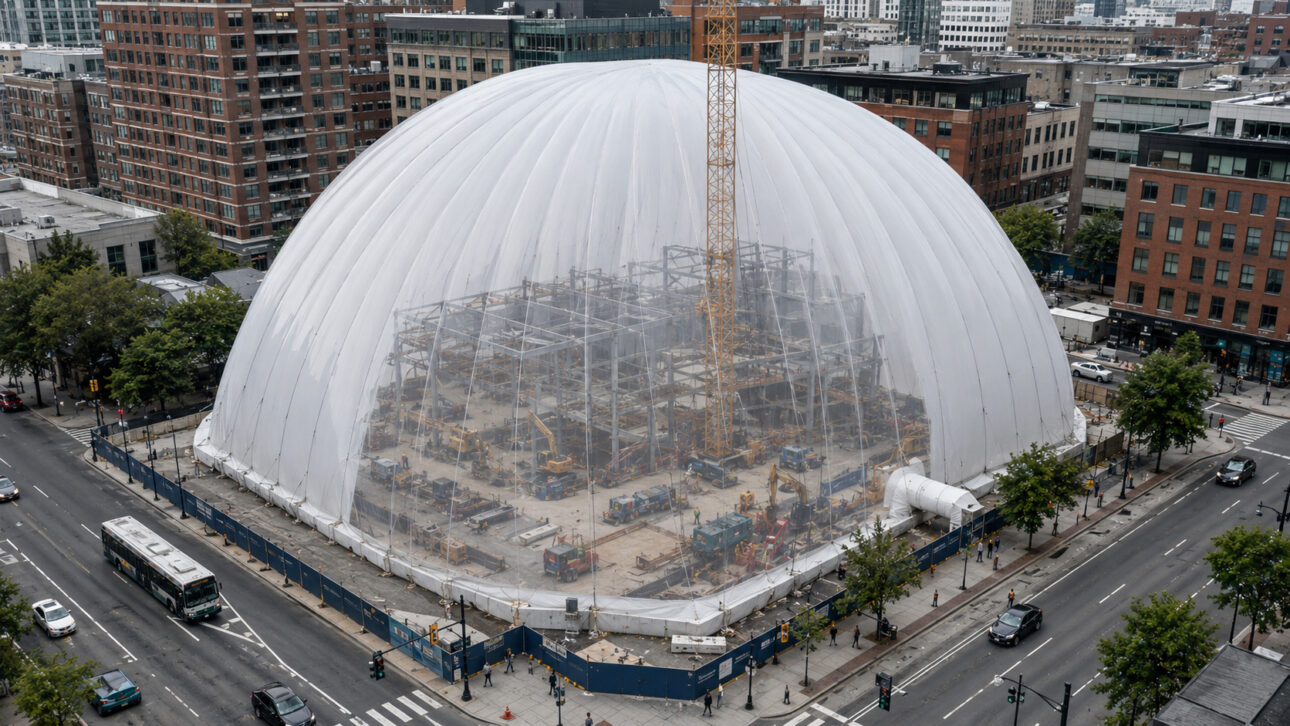
A technological solution has started to attract attention in different Chinese cities in recent years. Between 2025 and 2026, construction companies began installing huge inflatable domes over construction sites to contain dust, reduce noise, control temperature, and prevent particles from being spread through the air.
According to information released by the Shenzhen Municipal Government and the state agency Xinhua, these structures have already been adopted in cities like Guangzhou, Shenzhen, and Jinan, where large projects are surrounded by schools, residential buildings, businesses, residents, and historical constructions.
Without interrupting the operation of the construction sites, the domes create a barrier between the construction and the external environment. Trucks, heavy machinery, and teams continue to work normally within the covered areas, while part of the impacts produced by the activities remains concentrated inside the structure.
-
Brazil’s Minas Gerais Government Signs Agreement for Ring Road to Divert Heavy Trucks Away from Urban Center

-
The Great Wall of China was built with a surprising kitchen secret: sticky rice mixed with lime created a mortar so durable it has withstood centuries, earthquakes, and human destruction.

-
Tired of Seeing Homelessness, New Westminster in Canada to Open Region’s First Tiny Home Village: 30 Container Homes with Central Kitchen, Meals, and Facilities
-
Brazil’s Santa Catarina Port Drives 770 Tons of Steel Piles into the Sea, Reaches Midpoint of $100 Million Project to Dock Two Ships Simultaneously by October



Discover the giant bubbles installed over the constructions
When placed over the construction sites, the inflatable covers transform open areas into large enclosed environments. The support occurs through continuous ventilation systems, responsible for maintaining internal pressure and preventing the membrane from descending onto the work area.
Knowing that pillars could hinder the movement of vehicles and equipment, the project leaders adopted a structure supported only by air. This way, trucks, excavators, and other equipment can move freely within the dome.
The covers are made with polyester membranes coated with PVDF. The material combines lightness and strength, necessary characteristics to protect extensive areas without requiring internal metal support structures.
The ventilation system also participates in temperature control and air circulation. Additionally, some projects received spraying, cooling, and environmental monitoring equipment to track internal conditions during service execution.
Dust containment is among the main functions of the technology. The membranes prevent a significant portion of the particles produced by demolitions, excavations, and material movements from reaching the streets and buildings around.
Noise reduction also represents an important advantage. By enclosing the entire construction area, the cover limits the propagation of sounds produced by machines, tools, and heavy vehicles used during the works.
How inflatable domes can be reused
After the completion of each stage, the structures can be deflated, folded, and transported to other projects. This mobility allows the same dome to be installed again at different points in a city or on new sites.
The possibility of reuse has made the solution more suitable for temporary works. Instead of building a permanent cover, companies can dismantle the membrane and send it to another area that needs isolation.
Moreover, the domes help reduce the visual impact caused by large urban sites. Activities remain concentrated within the structure, decreasing the direct exposure of equipment, waste, and materials accumulated during the execution of the work.
According to Chinese authorities, the technology also helps companies comply with stricter environmental regulations. The reduction of dust, noise, and particle dispersion can decrease complaints from residents and merchants in nearby areas.
Cases recorded in Guangzhou, Shenzhen, and Jinan
In Guangzhou, a dome of nearly 9,000 square meters was installed over an urban redevelopment area. The information was released by the Shenzhen Municipal Government on April 17, 2026.
The data presented by the authorities indicate that the structure can block up to 99% of the dust produced during the work. The noise generated within the site is also kept below 60 decibels under the conditions informed by the project.
In Shenzhen, another inflatable cover reached approximately 40 meters in height and exceeded 12,000 square meters in area. The space received intelligent spraying, cooling, and environmental monitoring systems.
The structure was adopted to reduce the impacts on residents, buildings, and establishments located nearby. Even covered, the area remained available for the movement of heavy machinery and construction teams.
In Jinan, one of the largest inflatable bubbles of this type reached about 50 meters in height and occupied approximately 20,000 square meters. The installation took place in an area surrounded by schools, residential buildings, and a historic church.

How Giant Bubbles Reduce Urban Impacts
Currently, inflatable domes represent an attempt to make large construction sites less aggressive to the surrounding communities. The technology concentrates dust, dirt, and noise within a defined area, without hindering the progress of the works.
The presence of these coverings also enhances control over temperature and internal air circulation. In the most advanced projects, sensors and automated systems monitor environmental conditions during the operation of the equipment.
Thus, the enormous structures adopted in Guangzhou, Shenzhen, and Jinan show how a construction site can remain active without directly exposing the entire neighborhood to the effects produced by civil construction. After all, will large urban projects increasingly operate within these giant bubbles?