Portuguese
  Spanish


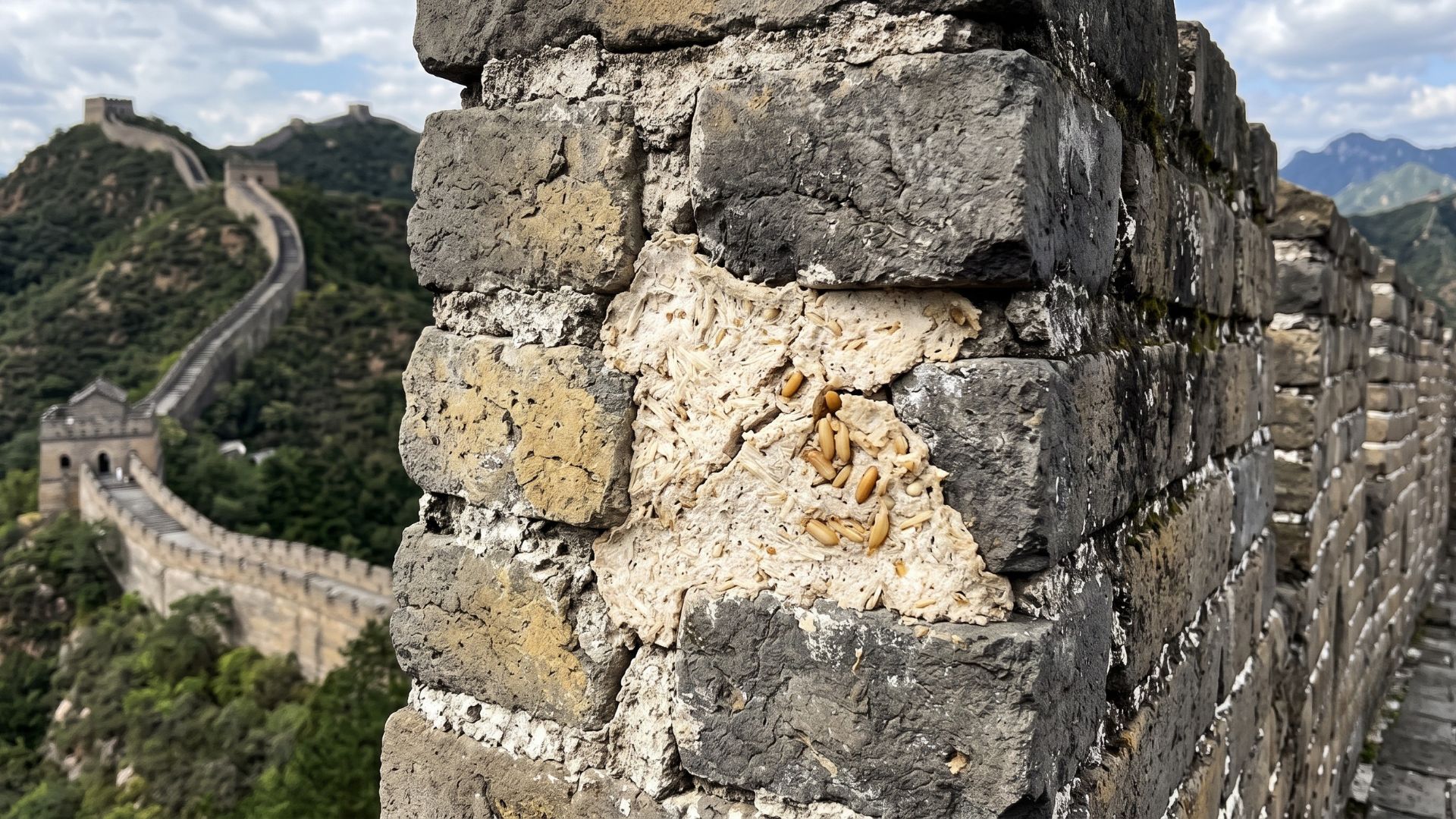

Study shows how sticky rice strengthened the mortar of ancient China and helped walls, temples, and tombs withstand for centuries.
The idea that a food as common as sticky rice helped keep standing some of China’s most resilient historical constructions seems unlikely at first glance. But scientific analyses have confirmed that the so-called sticky rice mortar was used in ancient works and that its composition helped walls, bridges, temples, and tombs endure centuries with unusual stability. The most important fact is that this technique was not just folklore or oral tradition.
A study published in Accounts of Chemical Research identified, in historical Chinese mortars, the combination of lime and amylopectin, a carbohydrate present in rice, confirming the chemical basis of an engineering solution that became especially associated with the constructions of the Ming dynasty.
Sticky rice mortar in ancient China explains the resilience of walls, tombs, and constructions of the Ming dynasty
For a long time, the exceptional durability of various Chinese structures was treated as a historical enigma. The answer began to become clearer when researchers analyzed mortar samples from the Nanjing wall, about 600 years old, and identified that the material was made of powdered limestone and sticky rice soup.
-
Tired of Seeing Homelessness, New Westminster in Canada to Open Region’s First Tiny Home Village: 30 Container Homes with Central Kitchen, Meals, and Facilities

-
Brazil’s Santa Catarina Port Drives 770 Tons of Steel Piles into the Sea, Reaches Midpoint of $100 Million Project to Dock Two Ships Simultaneously by October
-
Expanded Polystyrene Gains Ground as a Lightweight Alternative to Traditional Masonry in Construction
-
Abandoned Brazilian Coastal Stadium, Once Hosting Major Soccer Matches, to Be Demolished for $10 Million NASCAR-Inspired Racetrack


This discovery helped explain why so many ancient constructions withstood better than expected against the effects of time, water, and even seismic shocks.
Scientific literature and coverage on the topic indicate that the use of the mixture spread widely in imperial China and gained special prominence during the Ming period, between 1368 and 1644.


More than a curious detail, the recipe has come to be regarded as a technological milestone. The research itself describes this formulation as a very ancient example of composite mortar, as it combines organic and inorganic components in a single construction material.
Scientific study reveals how amylopectin from sticky rice strengthens lime mortar
The central point of this story lies in amylopectin, the main component of sticky rice mentioned by the researchers. When it is added to lime mortar, it interferes with the formation process of calcium carbonate and alters the microstructure of the hardened material.
Without this organic additive, the crystals tend to grow larger and more fragile. With the presence of amylopectin, crystallization is controlled, forming a more compact and uniform network, with better adhesion and lower water permeability, decisive characteristics for the longevity of walls and masonry exposed to the climate for centuries.

This mechanism also helps explain why sticky rice mortar still draws attention today among materials and conservation researchers.
The interest is not only in mechanical resistance but in the fact that the mixture better controls shrinkage, infiltration, and degradation, two classic problems in traditional lime mortars.
Great Wall of China, Nanjing wall, and historical bridges show where the sticky rice technique was applied
The Great Wall of China is the most famous example associated with this technique, but it was not the only one. The sources used in this review indicate that sticky rice mortar also appeared in bridges, temples, tombs, and urban walls, showing that the material was widely used in defensive and monumental works.
The case of the Nanjing wall is one of the most cited because it served as a concrete basis for modern laboratory analysis.
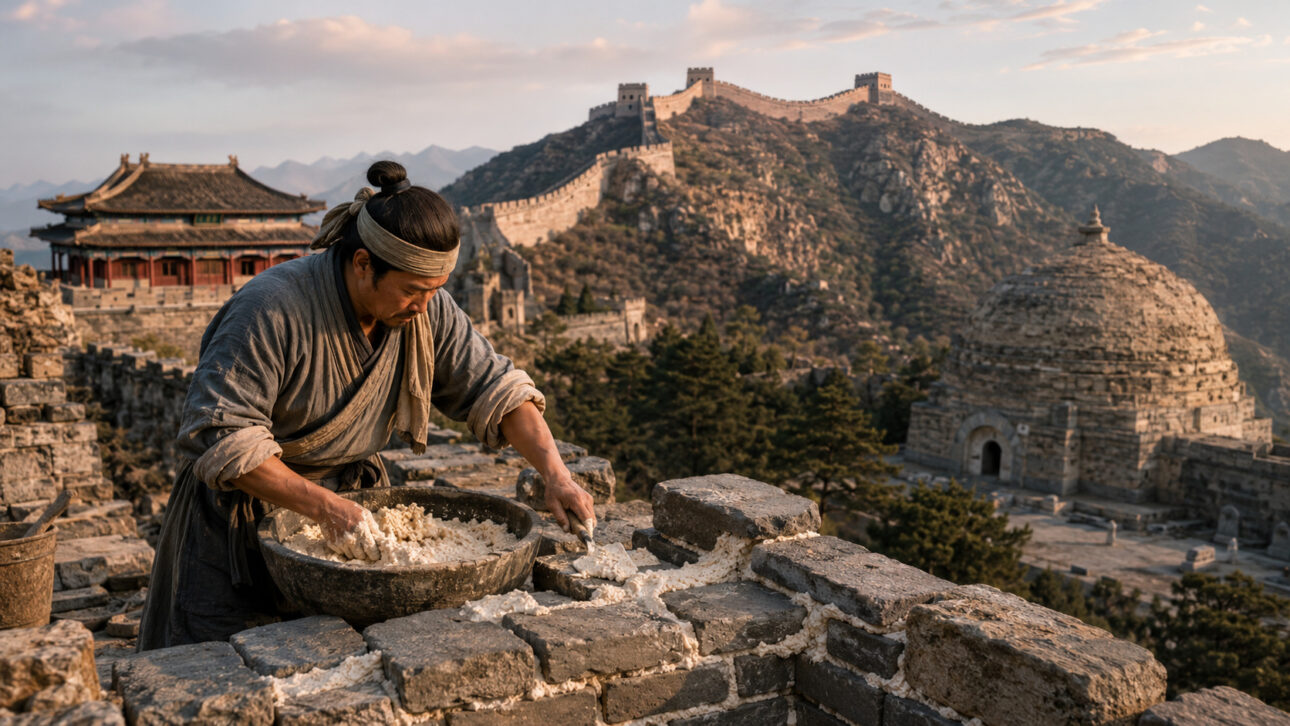
The National Geographic report also records that the material was used in projects preserved for many centuries and even mentions its presence in restoration initiatives, such as the Shouchang Bridge in eastern China.
This body of evidence reinforces that sticky rice was not an occasional ingredient but part of a consolidated construction technology.
Instead of relying solely on common lime, Chinese artisans and builders combined an everyday food with sophisticated empirical knowledge to produce more stable and durable joints.
Sticky rice mortar inspires restoration of historical heritage and debate on sustainable construction
The current interest in this formula goes beyond historical curiosity. The study published by ACS highlights that understanding the exact composition of the ancient mortar helps restorers prepare materials more compatible with historical buildings, avoiding modern interventions that can compromise the original behavior of the masonry.
By revealing how the traditional mixture worked, the research opened the way for more precise restorations and for a more serious understanding of ancient Chinese engineering, which mastered complex chemical processes in practice long before modern science described them in the laboratory.
In the end, the history of sticky rice mortar shows that some of the most effective engineering solutions were born from observation, repetition, and the intelligent use of accessible materials.
Centuries later, this knowledge remains relevant because it helps preserve historical heritage and reignites the debate on more durable construction materials compatible with the built environment.