






 Portuguese
  Spanish


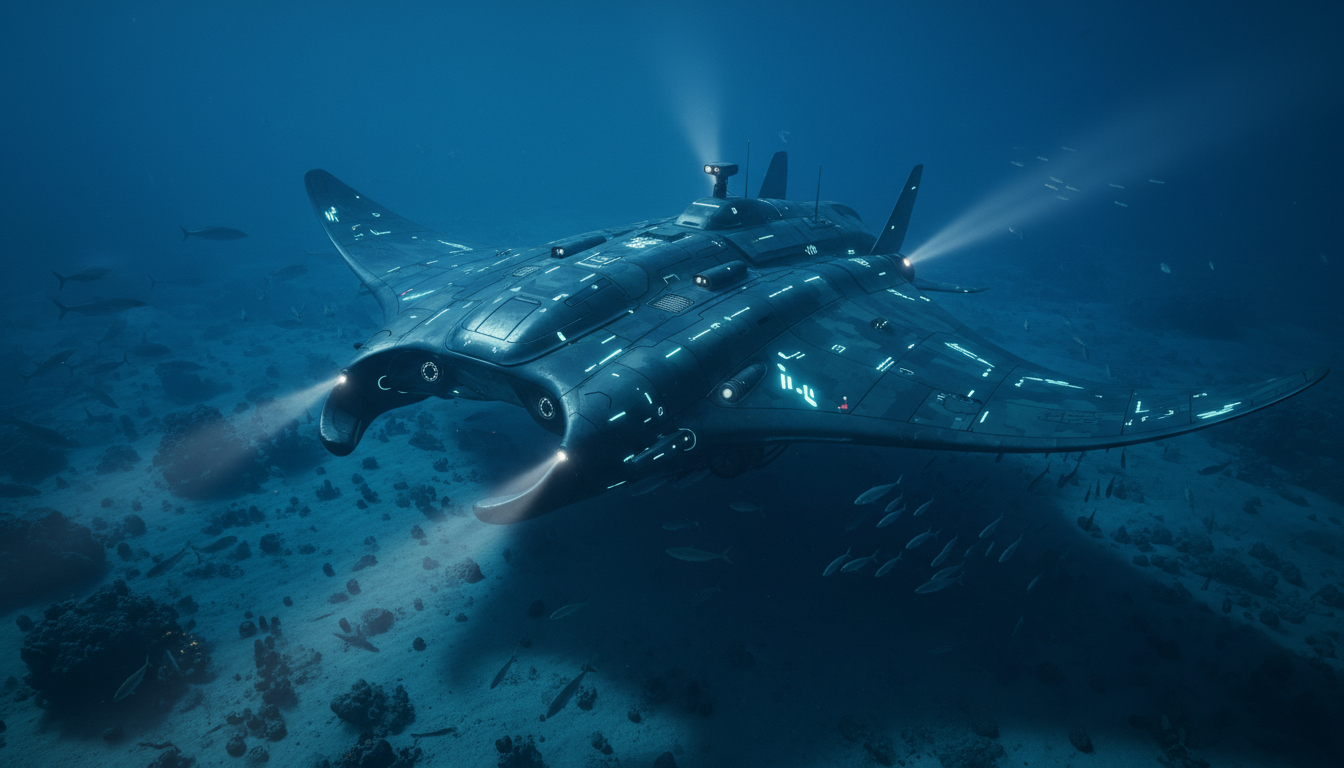
Inspired by the manta ray, the United States’ most secret submarine drone can hibernate alone on the ocean floor for months, anchored to the seabed, and no one knows where it is
It has the silhouette of a giant ray and glides through the ocean depths without making a sound. The Manta Ray is an autonomous submarine drone developed by Northrop Grumman for DARPA — the advanced research agency of the U.S. Department of Defense.
According to an official statement from DARPA, the full-scale prototype successfully completed sea trials between February and March 2024, off the coast of Southern California. The submarine drone demonstrated performance in all propulsion modes — buoyancy, thrusters, and control surfaces.
However, the most impressive thing is not how it moves. It’s how it stops.
-
Trump Signs Orders to Develop Quantum Computer and Bolster U.S. Systems Against Encryption-Breaking Attacks

-
Breakthrough in Clean Energy: Scientists Develop Battery-Free Artificial Photosynthesis Using Only Sunlight to Generate Chemical Energy
-
Revive Old Photos: Gemini’s Little-Known Feature Uses AI to Restore Damaged Images in Seconds with a Professional Six-Step Recovery Process

-
Young Brazilian Inventor Develops Microplastic Filter, Wins Scholarship to Study in China, and Implements Solution to Improve Water Quality in Southern Brazil


The Manta Ray can anchor itself to the seabed and enter hibernation mode. In this state, it consumes minimal energy and remains on the ocean floor for months without needing to return to the surface or receive human support.

Fits in five containers and can be assembled in any port in the world
One of the most surprising features of the Manta Ray submarine drone is its modularity. The entire vehicle fits into five standard shipping containers.
This way, the parts can be transported from anywhere in the world to the launch point. Northrop Grumman demonstrated this capability by shipping subsections from Maryland to California, where the team assembled the prototype in the field.
“The combination of cross-country modular transport, in-field assembly, and subsequent deployment demonstrates an unprecedented capability for an extra-large unmanned underwater vehicle,” stated Dr. Kyle Woerner, DARPA program manager for Manta Ray.
Therefore, unlike traditional submarines that require specialized shipyards and months of preparation, the Manta Ray can be operating in any ocean on the planet in a matter of days.
How a submarine drone hibernates on the seabed for months without being detected
The concept of underwater hibernation differentiates the Manta Ray from any other submarine vehicle ever built.
When not on an active mission, the submarine drone anchors itself to the seabed and enters a low-power state. Multiple buoyancy engines allow it to operate at various depths and travel long distances.
“The Manta Ray Project really came out of a need to understand more about the ocean environment and to have underwater vehicles that last longer than on the order of a few hours or a few days,” explained Dr. Kyle Woerner.
The stated goal is to develop an autonomous underwater vehicle that operates on its own, harvesting energy and completing any mission given to it.
Other submarine drones like the Lamprey, which attaches itself to ships like a lamprey, follow a different philosophy — parasitizing vessels to move. The Manta Ray, on the other hand, is completely independent.

The California tests that validated the full-scale prototype
Assembly of the full-scale prototype was completed on April 9, 2024, in Annapolis, Maryland, by Northrop Grumman.
Subsequently, the vehicle was disassembled into subsections, shipped to the California coast, and reassembled in the field. Open-water tests took place between February and March 2024.
During the demonstrations, the Manta Ray proved its ability to navigate using buoyancy as a glider — sliding through the water like a real ray — and also with traditional thrusters and control surfaces.
“Our successful full-scale tests of Manta Ray validate the vehicle’s readiness to advance to real-world operations,” stated Dr. Kyle Woerner.
Furthermore, DARPA is not the only one investing in underwater autonomy. China has also tested machines capable of operating at 3,500 meters, demonstrating a technological race in the oceans.
Why the manta ray shape is perfect for long-duration missions
The Manta Ray’s design is no coincidence. The real manta ray is one of the most efficient animals in the ocean in terms of movement.
Its wide wings allow it to glide for long distances with minimal energy expenditure. The submarine drone replicates this shape to maximize underwater gliding — moving through the water using only buoyancy variations, without engaging motors.
Northrop Grumman, which has been active in the underwater domain for over 50 years, designed the Manta Ray with payload bays — internal compartments that can be configured for different types of missions.
However, details about what sensors or equipment can be carried remain classified for national security reasons.

It’s still a prototype — and many questions remain unanswered
On the other hand, it is crucial to understand that the Manta Ray is still a technology demonstrator. It is not in mass production, and adoption by the U.S. Department of Defense remains uncertain.
The ability to hibernate for months on the ocean floor is projected but not yet proven in prolonged operation. The 2024 tests focused on hydrodynamics and propulsion, not actual months-long endurance.
Furthermore, there is no public data on the program’s cost or the budget invested. Energy harvesting technologies — which would allow the drone to recharge itself on the seabed — have not been publicly detailed.
Northrop Grumman is also not the only one in the program. PacMar Technologies developed a competing scaled-down prototype, which completed its own tests in September 2023.
Nevertheless, the 2024 demonstration marks a milestone in autonomous underwater warfare. If the Manta Ray fulfills its promises, the oceans will have a new type of sentinel — silent, patient, and invisible.





-

-

4 people reacted to this.