






 Portuguese
  Spanish


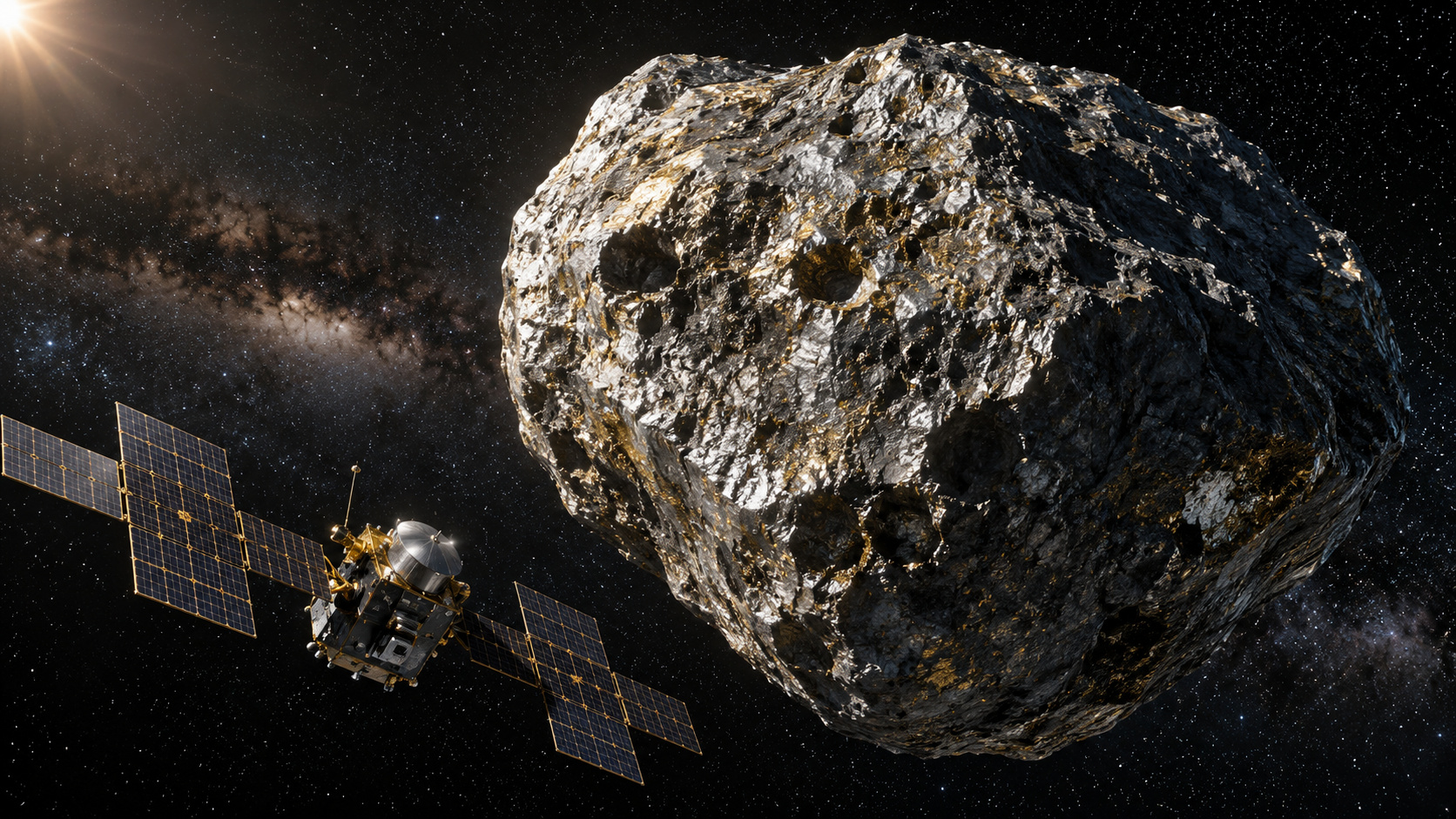

NASA’s Psyche mission is on its way to a metallic asteroid between Mars and Jupiter and could transform the understanding of space mining and planet formation.
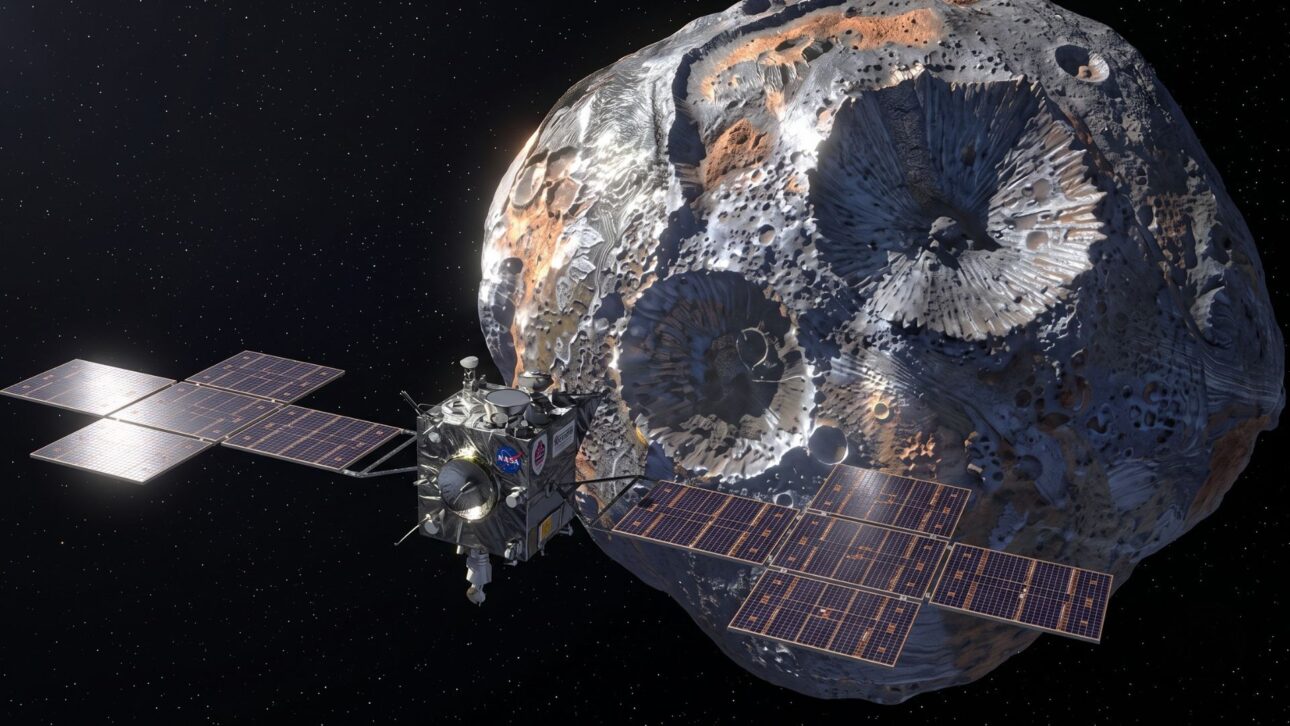
In October 2023, NASA launched the Psyche mission, a probe destined for the asteroid 16 Psyche, one of the most unusual objects ever studied by science. Located in the asteroid belt between Mars and Jupiter, the celestial body is about 280 kilometers at its largest axis and attracts worldwide interest for a simple reason: it appears to contain an extraordinary amount of metals. The spacecraft is expected to arrive in August 2029.
In recent years, the asteroid has made headlines due to estimates suggesting gigantic theoretical values for its mineral resources. However, NASA itself emphasizes that the mission was not created for mining, but to investigate the origin of the metallic cores of rocky planets. Nevertheless, the discoveries could directly influence the future of the space economy.
The asteroid 16 Psyche is unlike almost anything scientists have explored in the Solar System
The asteroid 16 Psyche was discovered in 1852 and belongs to the rare class of so-called metallic asteroids. For decades, scientists believed it could be the exposed core of an ancient protoplanet destroyed by collisions that occurred in the early Solar System.
-
ChatGPT Alerts FBI to Prevent Planned Murder of 8-Year-Old in Brazil’s Espírito Santo

-
Scientists Discover 125-Million-Year-Old “Pregnant Fossil” with Preserved Embryos and Microscopic Larvae Inside Mollusk in England

-
17-Year-Old Justin Bernstein Develops Bacteria to Produce Glass on Arctic Ice to Reflect Sunlight, Wins $50,000 U.S. Scholarship

-
The 19-Meter Rocket-Helicopter: A Private Industry Prototype That Challenged Space Race Logic




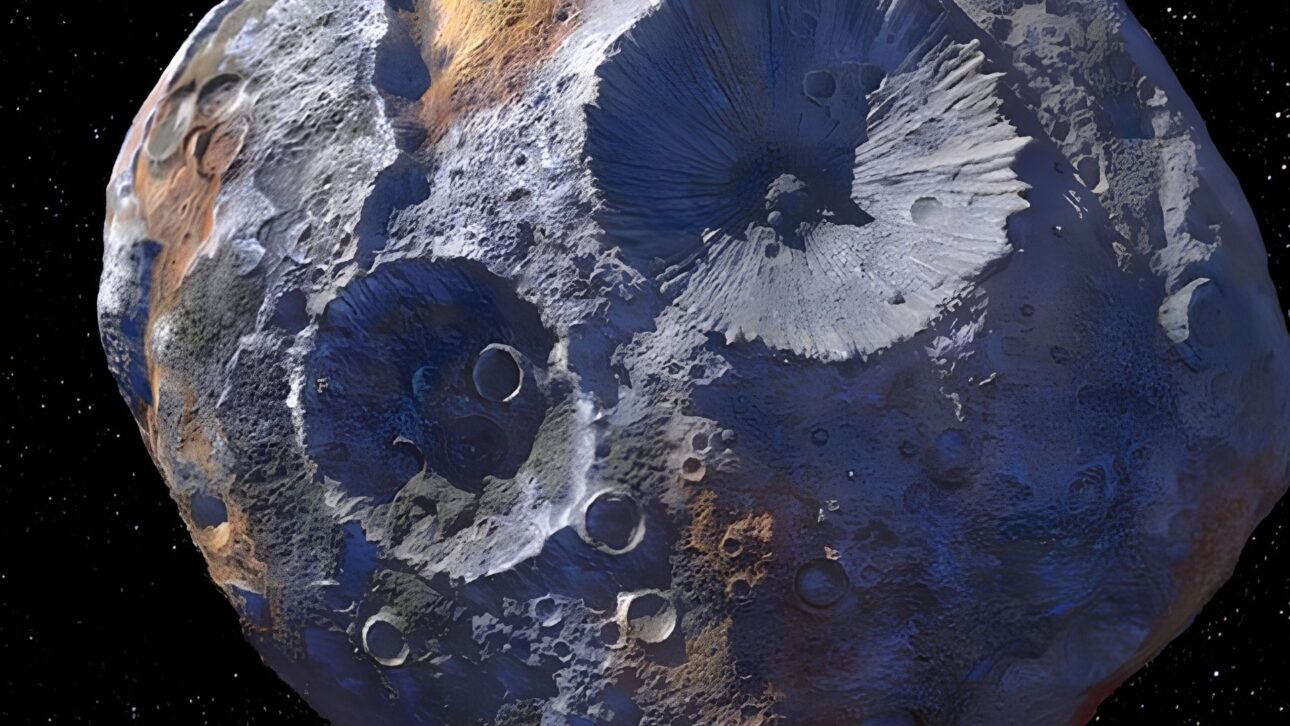
Observations made by telescopes and radars indicate a significant presence of iron and nickel, materials normally found in the cores of planets like Earth. More recent studies, however, suggest that the object might be a complex mixture of metal and rock, rather than a pure metallic sphere as previously imagined.
Currently, NASA’s best estimate indicates that between 30% and 60% of Psyche’s volume may be composed of metal, although its exact composition will only be known when the probe arrives at the site.
The Psyche mission was not created to seek gold, but it may answer questions that fuel the dream of space mining
A common question is whether NASA is going to Psyche to seek gold, platinum, or other precious metals. The answer is no.
The mission was designed to study the formation of planets and understand how the metallic cores of rocky bodies arise. Since Earth’s core is thousands of kilometers deep and cannot be observed directly, Psyche offers a unique opportunity to analyze something similar exposed in space.
Even so, the theme of space mining frequently appears because some researchers consider it possible that metallic asteroids contain not only iron and nickel but also rarer and more valuable elements. The problem is that the actual quantity of these materials has not yet been confirmed.
The value estimates attributed to the asteroid made headlines worldwide
Various theoretical calculations have attempted to estimate how much Psyche would be worth if all its metals could be extracted and brought to Earth.
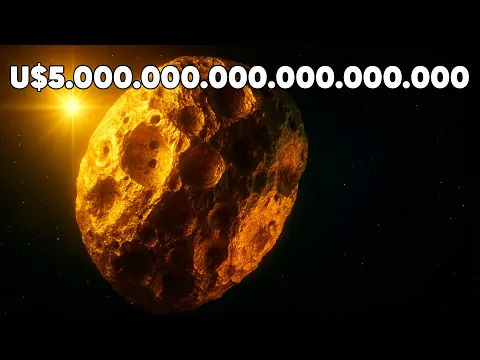
Some popular projections have mentioned numbers in the range of quintillions of dollars, making Psyche one of the most valuable objects ever associated with space mining.

However, experts warn that these numbers are just theoretical exercises.
If a gigantic amount of metals reached the terrestrial market, prices would plummet. Moreover, there is currently no technology capable of economically extracting, processing, and transporting millions or billions of tons of material from the asteroid belt.
Therefore, the supposed “economic value” of the asteroid should be viewed with extreme caution.
The probe’s journey involves a trip of billions of kilometers
The Psyche mission is one of the most ambitious ever undertaken within NASA’s Discovery program. Launched on October 13, 2023, the spacecraft uses solar electric propulsion and recently performed a gravity assist at Mars to gain speed towards its destination.
According to NASA, the probe will arrive at the asteroid in 2029 and will remain orbiting the object for approximately two years, conducting measurements of gravity, magnetism, chemical composition, and geological characteristics.
The expectation is that the first detailed images will reveal a world completely different from anything that has been explored before.
What NASA really expects to discover when it reaches the asteroid
The main scientific question does not involve wealth, but planetary origin. If Psyche is indeed the remnant of the core of an ancient protoplanet, it could show how heavy materials organized themselves during the formation of the early worlds of the Solar System.
Scientists want to know:
- How much metal is actually in Psyche.
- How this metal is distributed.
- If the object shows signs of ancient magnetic activity.
- How its formation occurred.
- What the ratio between metals and silicates is.
These answers can help explain not only the history of Psyche but also the evolution of Mercury, Mars, Earth, and other rocky planets.
Space mining is still distant, but it is no longer just science fiction
Today, there is no operational project capable of economically exploiting an asteroid located between Mars and Jupiter.
The challenges include transportation, energy, automation, industrial processing in space, and returning material to Earth. Even for private companies in the space sector, asteroid mining remains a long-term goal.
On the other hand, many experts believe that space resources could initially be used outside of Earth, supplying lunar bases, space stations, or future missions to Mars, without the need to bring large quantities of material to the planet.
In this scenario, Psyche could become an important reference for understanding the real potential of these resources.
The arrival of the probe in 2029 could completely change what we know about metallic worlds
Today, almost everything known about Psyche has been obtained through observations made millions of kilometers away.
When the probe starts transmitting detailed images and measurements, scientists will finally be able to confirm if the object is indeed a fragment of a planetary core, what its real composition is, and to what extent the estimates about precious metals made sense.
If the discoveries meet expectations, the mission could become one of the most important investigations of the decade for planetary science and the future of economic space exploration.
Do you believe that asteroid mining will become a real industry this century or will it remain just a project for a distant future?


