Portuguese
  Spanish


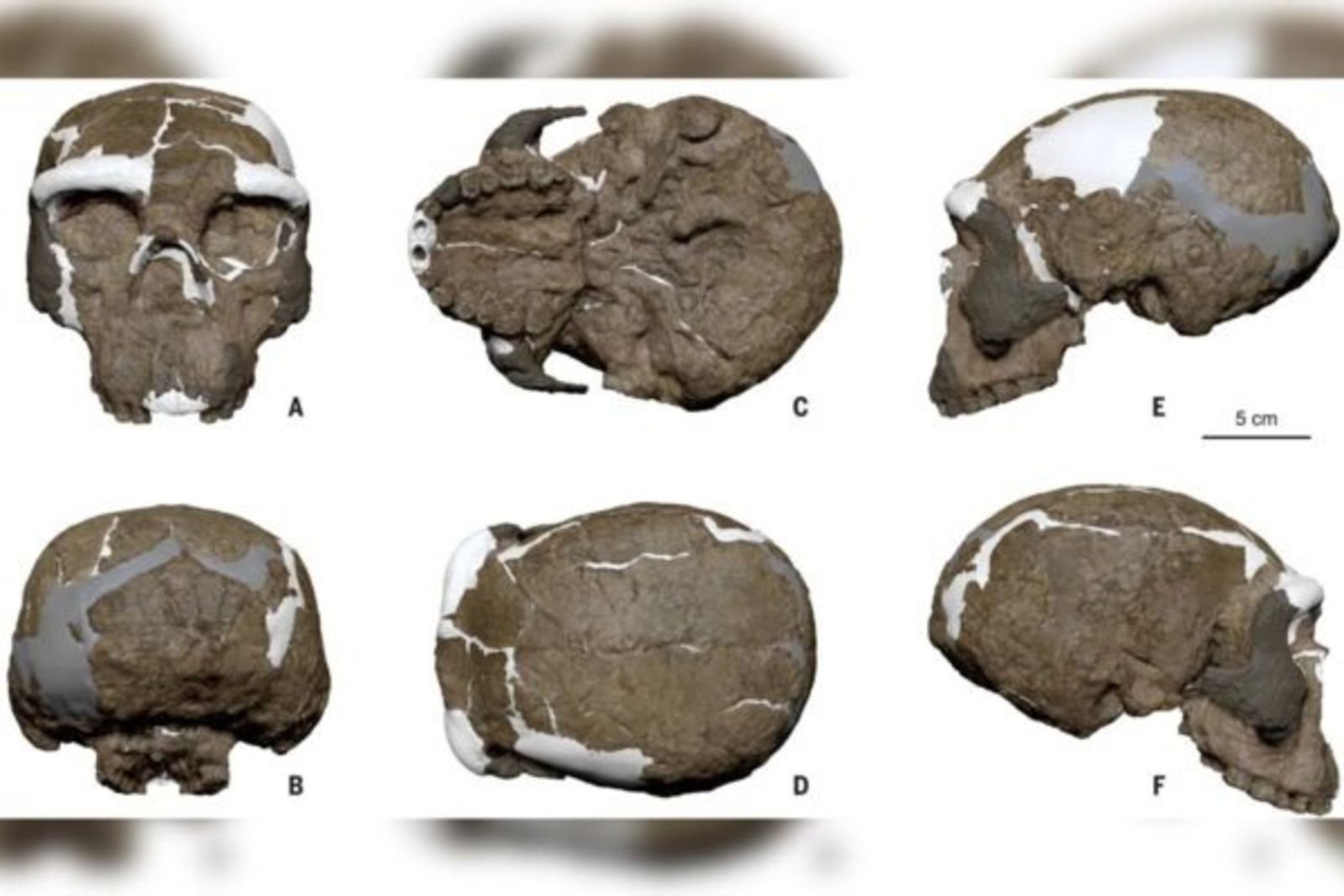


Reconstruction of the Yunxian 2 Skull, 1 Million Years Ago, Reveals Similarities with Homo Longi and Suggests That Human Lineages Coexisted and Separated in Very Short Intervals, Altering the Evolutionary Timeline
After decades of uncertainties, a fossil excavated in China has gained a new interpretation. It is the Yunxian 2 skull, discovered in 1990 in Hubei province, which has now been reconstructed using computed tomography.
The study, published in the journal Science last Thursday (25/9), reignites debates about the trajectory of the human species.
The Re-discovery of the Yunxian 2 Skull
For a long time, it was believed that this skull belonged to a Homo erectus. However, this view was overturned after detailed analysis of the cranial structure.
-
In Brazil’s backyard: Tesla, by Elon Musk, announces official operations in Uruguay, where electric vehicles already make up 20% of new cars but still leaves out the largest market in the region.

-
This Mars rover may finally reveal if life ever existed on Mars.
-
A nearly 70-year-old Chinese inventor has registered 90 patents and created a device that stores water in the roots, helping seedlings survive drought while trying to transform the arid slopes of the Loess Plateau into green areas without relying on heavy irrigation.

-
Researchers want to change the way of producing rare earth magnets, reducing purification steps and making better use of the elements found in Swedish deposits.


The researchers observed a large cranial capacity, a long and low frontal bone, as well as narrow and closely set eye orbits.
This set of traits is closer to Homo longi, known as Dragon Man, related to the Denisovan group.
The new classification suggests that the fossil belongs to a distinct clade, which may have coexisted with other human lineages for longer than previously thought.
The Scientific Impact of the Discovery
According to Chris Stringer, a paleoanthropologist at the Natural History Museum in London, the clade of Homo longi may have persisted for over one million years. This longevity pattern has also been recorded in Neanderthals and Homo sapiens themselves.
Therefore, the discovery reinforces the idea that various lineages evolved in parallel, adapting to different environmental contexts.
The statistical comparison of 57 fossil skulls indicated that the separations between lineages were relatively close in time.
First, the Neanderthals, around 1.38 million years ago. Next, Homo longi, at 1.2 million. And finally, Homo sapiens, approximately 1.02 million years ago.
Lineages in Parallel
The short interval between these divisions shows that multiple human groups emerged almost simultaneously.
Moreover, the scenario reinforces the hypothesis that severe climate changes acted as a driver for rapid adaptation and, in some cases, extinction.
For Xijun Ni, a paleoanthropologist at the Chinese Academy of Sciences, these humans lived in small isolated populations and had to adjust to varied environments.
This would have influenced both their survival and extinction.
Yunxian 2 Skull: What Needs to Be Investigated
Although the reconstruction of Yunxian 2 represents a milestone, it does not end the debate. New studies will be necessary to definitively confirm the position of this fossil in the evolutionary tree.
What is already clear is that the discovery broadens the understanding of human diversity and challenges simplified explanations of our origins.
With information from Metrópoles.