






 Portuguese
  Spanish


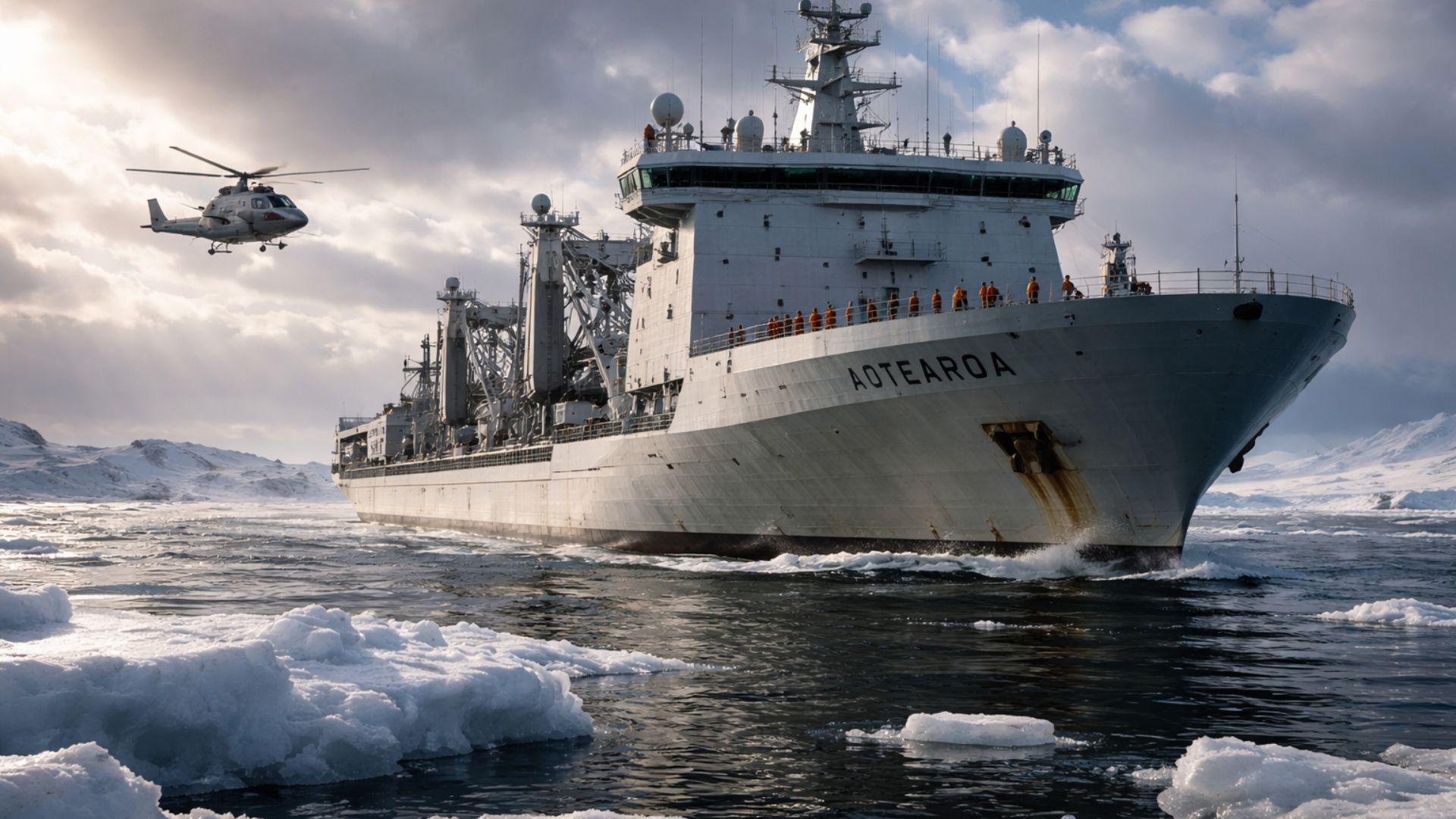

Large military vessel brings logistical capacity, water production, air operation, and action in polar regions, consolidating itself as a central piece for prolonged missions and strategic presence of New Zealand between the South Pacific and Antarctica.
The HMNZS Aotearoa brings together, in a single hull, some of the most sensitive functions for New Zealand’s naval projection.
With a displacement of 26,000 tons, a length of 173.2 meters, and a reinforced structure to operate in cold waters, the vessel was incorporated to expand the logistical reach of the New Zealand navy, sustain prolonged missions, and ensure support for operations in the South Pacific and the Antarctic environment.
It is also the largest ship ever operated by the country’s naval force.
-
Creative Uses for Toilet Paper Rolls That Will Change Your Perspective

-
Crab Trapped in Plastic Bottle for 62 Days Near Okinawa Highlights Little-Known Impact of Marine Pollution on Small Animals
-
Esperanza’s Bamboo Barrier in Oaxaca Redirects River and Reduces Erosion by 85% in Five Years

-
Family Builds Homemade Wind Turbine to Power Off-Grid Home, Video Reaches 555,000 Views on Ngô Thị Huyền’s Channel




Practice shows that its role is not limited to transportation.
The New Zealand Defence Force reports that the main mission of the Aotearoa is to provide global support to maritime, land, and air units of New Zealand itself, coalition forces, and security operations linked to the United Nations.
This includes refueling with naval and aviation fuel, the delivery of water, ammunition, spare parts, and dry cargo, as well as support for groups that remain for long periods away from land bases.
This profile helps explain why ships like the Aotearoa occupy a central position, even without the visibility of more well-known combat means.
In any operation at sea, the ability to keep other platforms operational often defines the duration of stay, the distance that can be covered, and the degree of autonomy of a task force.
In this context, the New Zealand ship functions as a mobile infrastructure, prepared to accompany complex missions in areas where safe harbor, available fuel, and regular supply chains are not always within reach.
Logistical capacity and structure of the HMNZS Aotearoa

The vessel’s numbers show how this function has been expanded.
According to New Zealand, the ship can carry up to 22 twenty-foot containers and has a total net cargo capacity of 9,500 tons.
The main crew is 64 crew members, while the accommodations reach 100 bunks, allowing for additional personnel as per the operation’s profile.
Your mouth is 24.5 meters and the maximum speed reported is 20 knots.
Another noteworthy fact is the generation of fresh water on board.
The onboard plant is capable of producing up to 100,000 liters per day, a relevant resource for extensive missions and for supporting other naval means or deployed contingents.
In long-duration operations, this capacity reduces dependence on land refueling and increases logistical flexibility, especially in remote scenarios or those subject to climatic and operational restrictions.
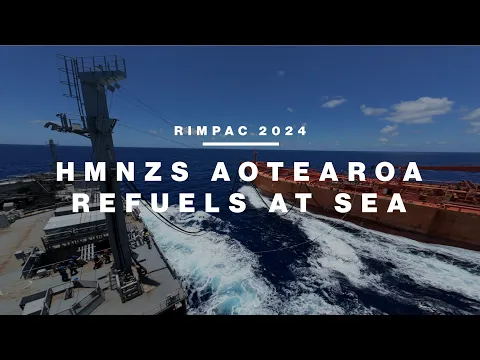
Moreover, the vessel has been equipped to transfer cargo and fuel at sea, without the need to interrupt the movement of the supported group.
The capability package includes self-defense systems, tanks for marine and aviation fuel, as well as the ability to operate SH-2G(I) Seasprite or NH90 helicopters.
With this, the Aotearoa meets not only supply demands but also tasks of liaison, light transport, surveillance, and air logistics support.
Hybrid propulsion and naval energy efficiency
The strategic dimension of the ship is not only in its tonnage.
One of the most distinctive points of the project is the use of Combined Diesel Electric and Diesel propulsion, a combination adopted to reduce consumption and emissions compared to older vessels.
The New Zealand Defense Force itself highlights that this arrangement helps improve operational efficiency.
The design of the bow is also part of this logic.
The Aotearoa uses an “Environship” concept, with a wave-cutting bow developed to reduce hydrodynamic resistance, lower fuel consumption, and improve navigability.
In addition, the ship received a selective catalytic reduction system, employed to reduce harmful nitrogen oxide emissions.
Furthermore, it features integrated onboard control, navigation, and communication systems.
The result is a large platform designed to carry a lot, operate far, and consume less.
This combination reflects a design shift in support military ships.
It is no longer enough to simply transport fuel, water, and cargo in large volumes.
It has also become necessary to reduce operational costs, increase automation, and respond to stricter environmental requirements, without losing robustness in support missions for military operations, training, and humanitarian actions.
Operations in Antarctica and polar capacity
The polar capabilities place the ship in a specific range within the New Zealand navy.
The Aotearoa was built to meet the Polar Code and received structural reinforcement compatible with Polar Class 6, as well as winterisation solutions, such as heating in parts of the upper deck and reinforced submerged components.
This enables its operation in the Southern Ocean and in support operations for New Zealand’s and international presence in Antarctica.
The practical dimension of this capability became evident in the resupply missions linked to Scott Base and McMurdo Station.
In February 2022, the New Zealand Defence Force reported that the inaugural voyage of the Aotearoa to the Antarctic continent marked the resumption of this type of operation after more than 50 years.
Later, Antarctica New Zealand highlighted that the mission demonstrated the ship’s capability, including at-sea refueling and logistical support for scientific and infrastructure programs.
This presence is not episodic.
The New Zealand Ministry of Defence notes that HMNZS Aotearoa conducts resupply missions for Scott Base every two years.
For the country, therefore, the ship’s Antarctic capability does not function as a secondary attribute, but as a permanent part of its operational utility.
Construction, commissioning, and strategic role
The trajectory of the Aotearoa helps to explain the weight that the vessel has assumed in the New Zealand fleet.
The ship was built by Hyundai Heavy Industries in Ulsan, South Korea.
It was launched in April 2019, named in October of the same year, and officially incorporated in July 2020.
Its home port is New Plymouth, in the Taranaki region.
Since entering service, it has been treated by New Zealand itself as a technologically enhanced asset for combat operations, logistical support, training, and humanitarian missions.
By bringing together fuel, water, containers, air operations, at-sea refueling, and preparation for icy environments, HMNZS Aotearoa has established itself as a maritime sustainment platform designed to extend New Zealand’s presence far beyond the coast.
Its size is impressive.
But it is the combination of energy efficiency, logistical versatility, and polar capability that explains why the ship has come to occupy a central place in the country’s naval strategy.


