Portuguese
  Spanish


The World Cup creates a collective behavior capable of appearing on the power grid charts. Understand how consumption changes during halftime, at the end of games, and why this requires technical attention in Brazil.
When Brazil takes the field, it’s not just the country that stops in front of the television. The Brazilian power grid also feels the impact, changes its rhythm, and forces the electric sector to enter a state of alert to monitor a collective behavior that happens almost simultaneously in millions of homes, bars, businesses, and companies.
The phenomenon seems invisible to those concerned with lineup, goals, and results. But behind the turned-on TV, there is a silent operation to prevent the World Cup party from becoming a headache. With each game of the National Team, the national routine changes, and this change appears directly in the electricity consumption.
The country stops and the electrical load changes
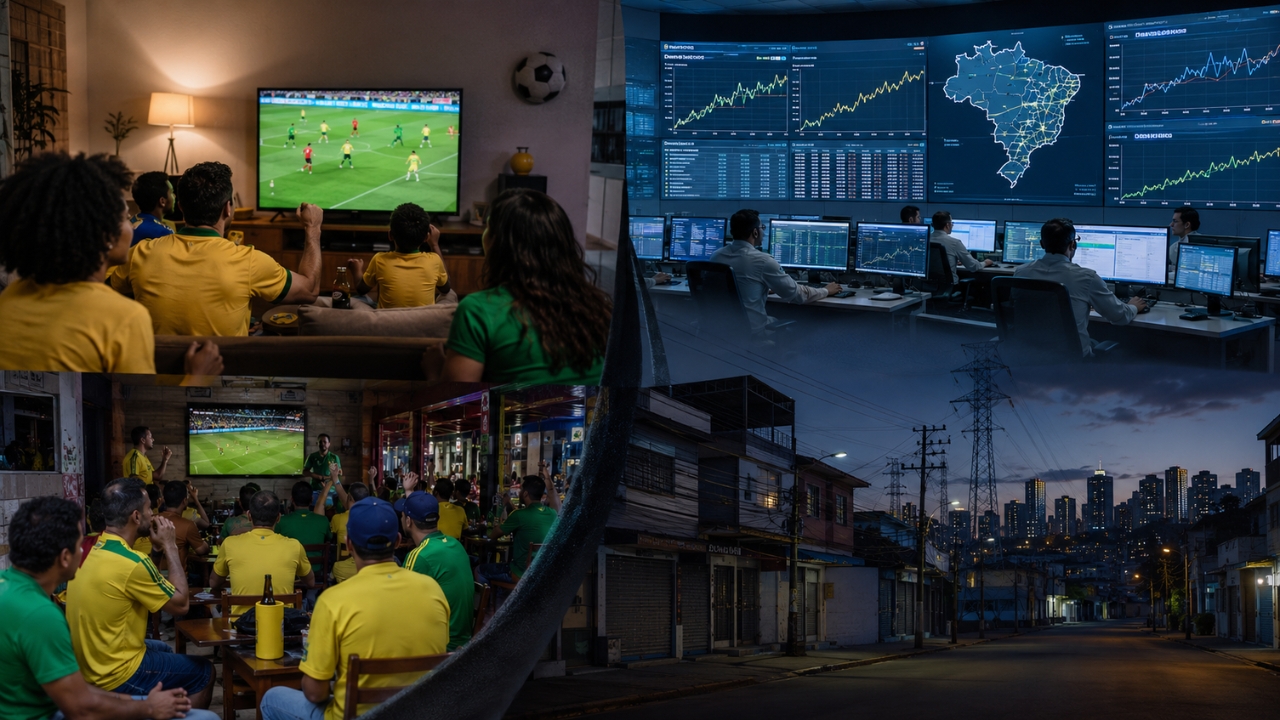
ONS prepared a special operation for the 2026 World Cup because Brazil’s games cause significant changes in the load behavior of the National Interconnected System, the SIN. The logic is simple and impressive: when millions of people stop their activities to watch the same event, consumption stops following the normal daily pattern.
-
New Railway in Mexico Diverted to Preserve 4,000-Year-Old Rock Art Resembling Aztec Rain God

-
Chinese Researchers Discover Largest Whale Graveyard in Indian Ocean: Nearly 500 Skeletons, Some 5.3 Million Years Old, Reveal Ecosystem Insights and Potentially Unknown Species

-
11-Year-Old Takes Truck, Crashes Into Pilgrimage in Thailand, Killing Eight Buddhist Monks

-
Archaeologists Uncover Ancient Ruins and Artifacts in Shiloh, Potentially Shedding Light on the Biblical Ark of the Covenant


Before the match, many people leave work, close businesses, reduce industrial activities, head home, or gather in bars and restaurants. This movement causes a drop ramp in consumption, which starts about two hours before kickoff and can continue until the end of the first half.
The detail that draws attention is that the problem is not just about consuming more or less energy. The challenge lies in the speed of the change. The grid needs to respond quickly to a society that turns off part of its routine, turns on televisions, changes domestic habits, and then starts moving again almost simultaneously.
Halftime becomes a test for the system
The most curious moment happens during halftime. For a few minutes, Brazilians step away from the TV, turn on lights, open the fridge, use microwaves, electric fryers, popcorn makers, freezers, and other appliances. This seemingly trivial behavior can generate a rapid increase in electrical load.
In previous analyses of the World Cup operation, variations of up to 4,000 MW in the interval were observed, a volume compared to the average load of the state of Rio de Janeiro. Before the game, the reduction can reach 13,000 MW compared to the previous level. At the end of the match, the resumption of activities can cause an abrupt ramp-up of up to 12,000 MW.
This final jump is one of the most sensitive points. The return to routine after the final whistle can represent 13% to 16% of the system’s load in just 20 to 30 minutes. For the fan, it’s just the moment to comment on the game, take a shower, prepare food, or leave the house. For the electrical operation, it is a brutal change in a very short time.
2026 World Cup increases the alert
In 2026, Brazil’s group stage matches are scheduled for June 13, June 19, and June 24. The time factor makes the scenario even more relevant because some of the matches occur at night, precisely near the period when consumption tends to be higher in the country.
A study by Safra analyzed the load behavior between 2002 and 2022, considering 33 matches, five subsystems, and more than 52,000 hourly observations. The conclusion reinforces the alert: night matches of the National Team can reduce electricity demand by up to 15%, especially when they coincide with peak hours.
This means that football affects the grid not only because of national emotion but also due to the fit between game time, domestic habits, and company operations. In other words, a group stage match can have a significant electrical impact if it happens at the right time of day.
Special operation tries to avoid failures
To reduce risks, the operation guidelines were sent to agents in the electricity sector and involve generation, transmission, and distribution. The order is to avoid interventions that could cause load shedding or increase the risk of interruption, except in urgent cases.
There is also monitoring of weather conditions, such as storms, wind gusts, and atmospheric discharges. The idea is to anticipate contingencies while the country is focused on the games and with demand changing in very fast blocks.
Additionally, there will be monitoring before, during, and after the matches, with data consolidated in a panel. The proposal is to show how the load behaves in Brazil’s games and in decisive matches, such as semifinals and finals.
Television still rules Brazil
The power of this phenomenon becomes even clearer when observing the behavior of the audience. Data from Kantar indicates that 77% of Brazilian consumers intend to follow the World Cup, and free-to-air TV appears as the main medium chosen by a large part of this audience.
This data explains why the power grid feels the change so much. The World Cup remains a mass event, capable of synchronizing millions of people into the same routine. The country watches, comments, eats, stops, and returns to normal together.
Therefore, the operation is not a technical exaggeration. It is a response to a rare, intense, and predictable national behavior. When Brazil plays, the impact is not limited to the field. It appears in the audience, in commerce, on the streets, at home, and even in the load curve of the country’s largest electrical system.
In the end, the scene is almost symbolic: while the fan watches the ball, technicians monitor graphs, ramps, and variations in real-time. Because, during the World Cup, the entire rhythm of Brazil changes. And the electric energy needs to change along with it.