Portuguese
  Spanish


Student from Sapporo, Japan, Hikaru Kuribayashi, 17, won the top prize at the Regeneron ISEF, the world’s largest science fair, and the $100,000 that comes with it. His origami simulator can help unfold everything from satellite solar sails to emergency shelters.
A 17-year-old teenager turned the art of paper folding into cutting-edge science and left the world’s largest science fair $100,000 richer. Hikaru Kuribayashi, from the city of Sapporo, Japan, won the 2026 edition of the Regeneron ISEF, the International Science and Engineering Fair, with a computer program that predicts how materials fold into complex shapes, like in origami. The achievement was reported by Science News Explores.
The feat draws attention for both the prize and the application. This young inventor’s simulator is not just for understanding folded paper: it can help design things that need to be compacted and then opened, such as satellite solar sails, medical devices, and even emergency shelters. Folding well, it seems, is an engineering problem worth gold.
The top prize at the world’s largest science fair
image
The victory was not in just any competition. The Regeneron ISEF is the world’s largest science fair for high school students, organized by the Society for Science. The 2026 edition took place in May at the Phoenix Convention Center, in Phoenix, Arizona, and brought together more than 1,700 young scientists and inventors from over 67 countries and territories.
-
Brazilian Students Develop Solar-Powered AI Trap for Cotton Pests, Defeating Carnegie Mellon and Cornell in Global Agricultural Robotics Award

-
Brazil’s Bahia Digs Over 1.5 km Deep Vertical Shaft for “Giant Elevators” in Copper Mine to Move 2.2 Million Tons of Rock Annually and Transport 840 Workers Daily in the Vale do Curaçá Complex

-
James Webb Telescope Captures Violent Galactic Wind: Galaxy Ejects Stellar Fuel at Extreme Speed, Could “Die” in 100 Million Years

-
Teen’s Weight Gain and Cushing’s Disease Revealed by Ankle Injury: Doctors Discover Tiny Pituitary Tumor in 113-Kilo Brazilian Adolescent


Among all of them, Hikaru took the top spot. He received the George D. Yancopoulos Innovator Award, the first-place prize, worth $100,000. In total, the fair distributed over $7 million in prizes, but it was the Japanese student’s work on folds that took the biggest prize at the world’s largest science fair.
Winning this prize places the teenager in a select group. The ISEF is a showcase that reveals talents who later make their mark on world science, and reaching first place there, competing with the best students from dozens of countries, is the kind of achievement that changes a trajectory. For a young inventor of 17 years, it’s quite a start.
Who is Hikaru Kuribayashi
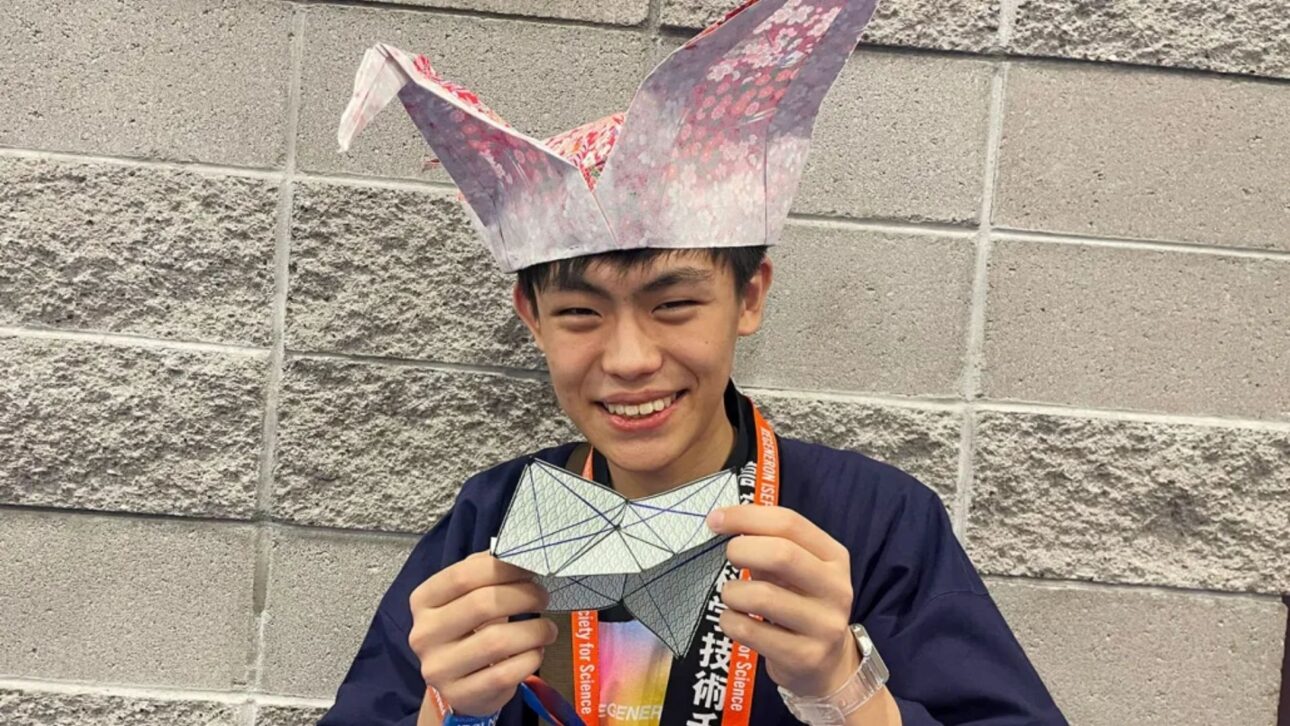
image: KG Carpenter
Behind the award is an ordinary student with an extraordinary mind. Hikaru Kuribayashi is 17 years old and from Sapporo, Japan, a country with a long tradition in both origami and cutting-edge technology. It was in this combination of folding culture and scientific rigor that he found the theme for the project that took him to the podium.
His profile is that of a young inventor driven by curiosity. Instead of treating origami as a hobby, Hikaru viewed folding as a mathematical problem to be solved. The question that guided him is deeper than it seems: how to accurately predict all the ways a material can fold.
This shift in perspective is what separates a good student from a true young inventor. Hikaru didn’t just want to reproduce known folds, he wanted to create a tool capable of anticipating folds that no one had mapped. And it was precisely this ambition that caught the attention of the judges at the world’s largest science fair.
A simulator to understand origami
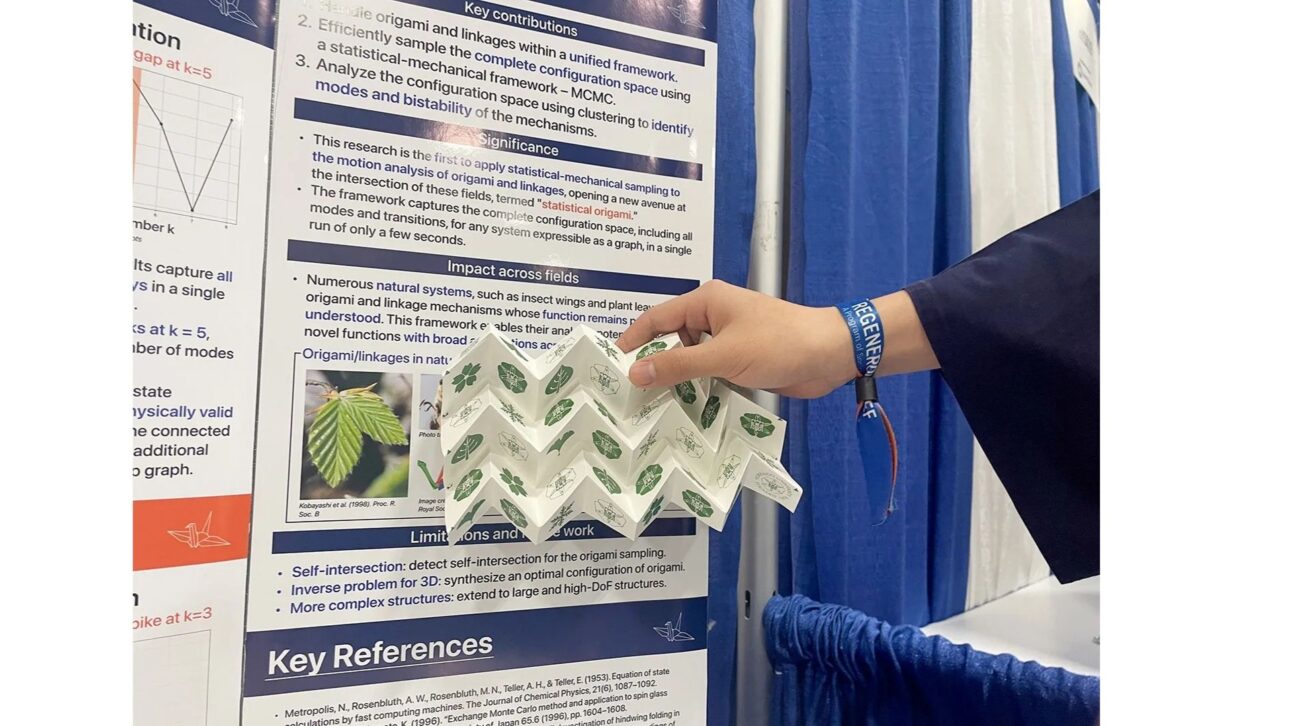
image: KG Carpenter
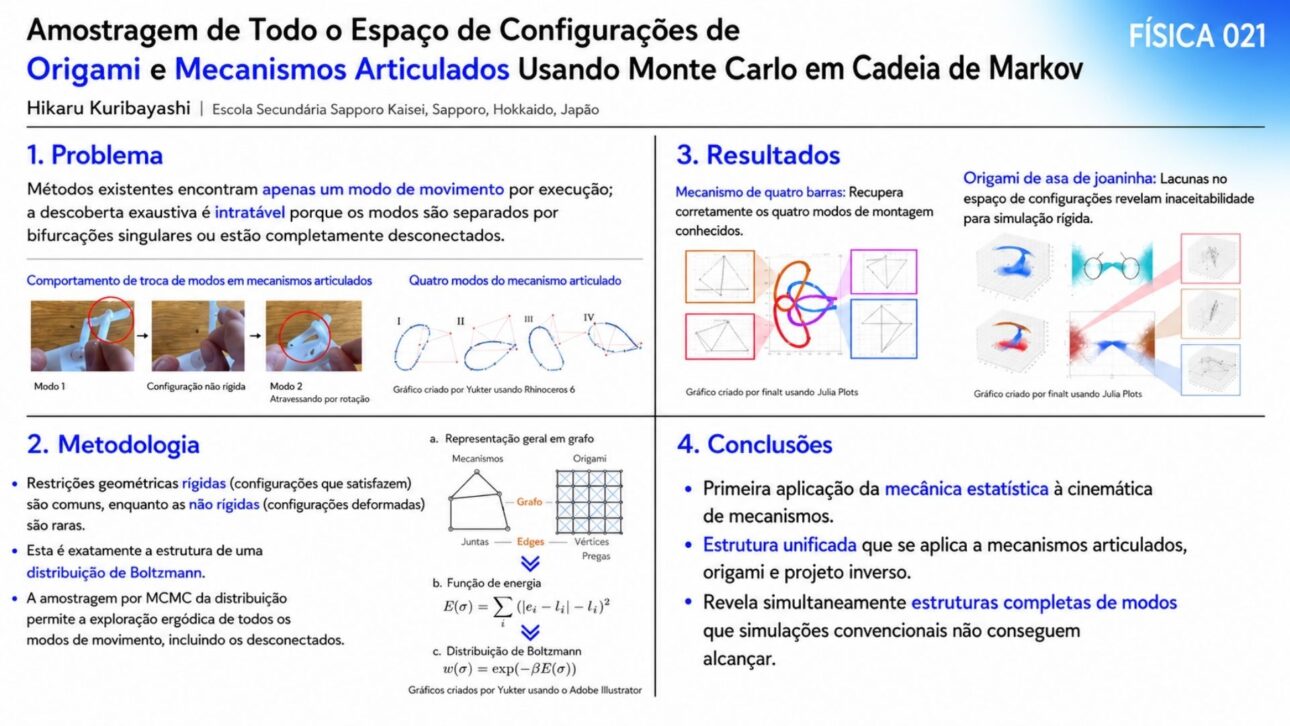
The heart of the project is software. Hikaru created a simulation program that predicts how structures fold in complex ways, whether in paper origami or articulated mechanical parts. Instead of testing fold by fold through trial and error, the program calculates the possible paths.
The ingenuity lies in the method used. The simulator relies on a statistical technique called Markov Chain Monte Carlo, which works by testing many possible scenarios at once and using these patterns to estimate the most likely outcomes. In practice, the program examines a sea of folding possibilities in a single round, instead of going one by one.
This type of calculation is difficult even for specialists. Predicting complex folds involves a gigantic number of combinations, and managing this in a functional simulator is a real breakthrough. Not surprisingly, it was this origami tool that earned first place and the $100,000 prize at the world’s largest science fair.
From Solar Sails to Emergency Shelters


The inevitable question is: what is the use of predicting folds? The answer is what makes the project so valuable. Many technologies need to be compacted to fit into a small space and then opened at the destination, and that’s where Hikaru’s work comes in. Knowing exactly how something folds and unfolds is halfway to designing these systems.
The most cinematic example is in space. Satellite solar sails need to travel folded inside a rocket and open perfectly when they reach orbit, without jamming or tearing. An origami simulator like Hikaru’s helps plan this opening, reducing the risk of failure in equipment that costs fortunes and cannot be repaired up there.
The applications don’t stop at solar sails. The same logic of folding and unfolding applies to medical devices that enter the body small and expand inside, and to emergency shelters that arrive compact and become housing in minutes in a disaster zone. Origami, which seemed like a game, becomes a tool to save lives and missions.
Why Origami Became Cutting-Edge Science
What Hikaru did fits into a larger movement. In recent years, origami has ceased to be just art and has become a serious field of engineering, studied by universities and space agencies. The reason is simple: folding allows large things to fit into tiny spaces, a central problem in rockets, medicine, and robotics.
The obstacle has always been complexity. The more sophisticated the fold, the harder it is to predict how it will behave, and an error in this calculation means equipment stuck at the wrong time. Tools like the simulator by the young Japanese inventor address precisely this bottleneck, giving engineers a way to test folds on the computer before building.
That’s why a project on origami wins the top prize at a global science fair. It elegantly solves a problem that hinders expensive and important applications. Folding, taken seriously, has proven to be one of the keys to packaging the future, from satellite solar sails to shelters that protect people.
A young talent that Brazil also reveals
Hikaru’s story resonates here. Brazil also often shines at the world’s largest science fair, with students who take projects born in public schools and regional fairs to Phoenix. The ISEF is proof that scientific talent has no passport and can appear anywhere, as long as there is opportunity.
The case of the Japanese reinforces the value of encouraging young inventors from an early age. Behind a $100,000 prize are years of curiosity, supportive teachers, and fairs that provide a stage. Investing in this is planting the science and technology that a country will reap decades later, whether in Japan or Brazil.
In the end, Hikaru Kuribayashi’s lesson is twofold. It shows that seemingly simple ideas, like folding paper, can hide powerful science, and that betting on young inventors yields concrete results. From satellite solar sails to classrooms, curiosity remains the most valuable raw material there is.
And you, what would you do with a mind like that?
The victory of Hikaru Kuribayashi, from Japan, at the world’s largest science fair proves that a 17-year-old young inventor can transform origami into technology capable of deploying satellite solar sails, and still earn $100,000 for it. All from a question about how things fold.
And you, what everyday problem do you think deserves the attention of a young and curious mind like Hikaru’s? Share in the comments what invention you would like to see a student create to change the world.