Portuguese
  Spanish


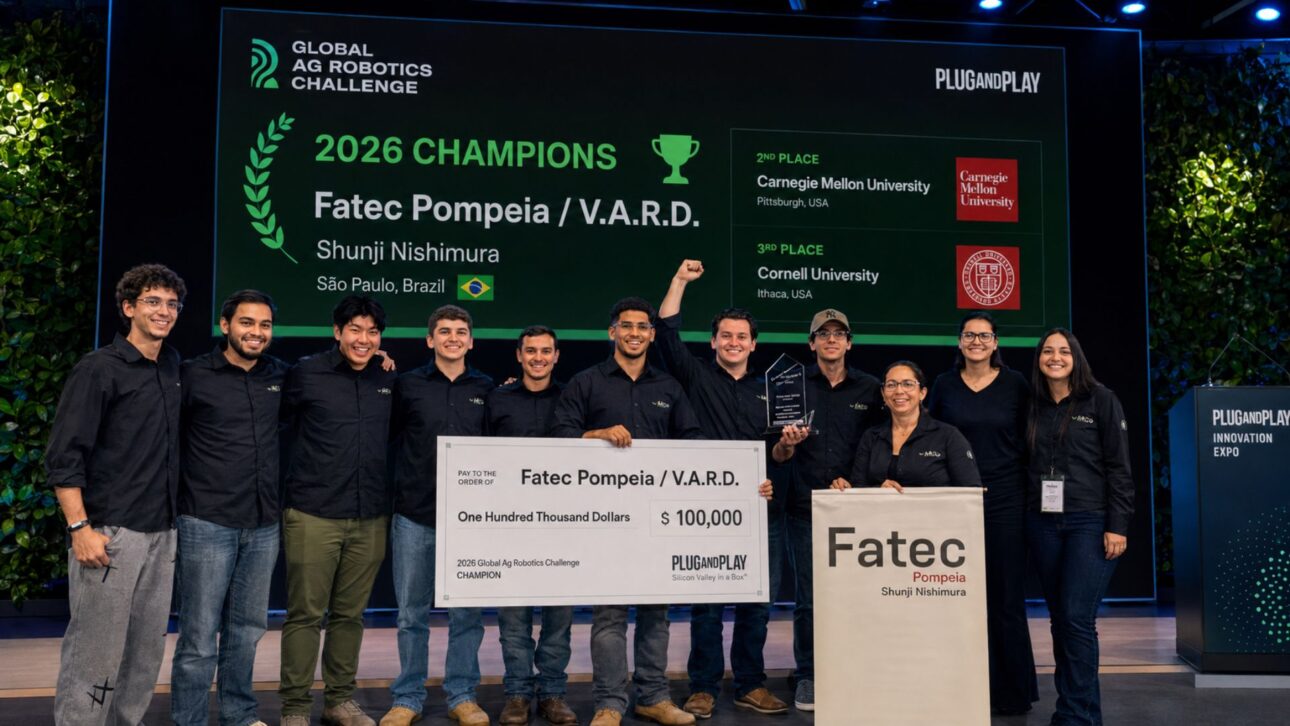
Students from Fatec Pompeia, in the interior of São Paulo, created V.A.R.D., an intelligent trap powered by solar energy that uses artificial intelligence to count cotton pests, and won the AI category of a world agricultural robotics award, surpassing a team that included Carnegie Mellon and Cornell.
There are awards that Brazil doesn’t usually win, and when it does, it’s worth celebrating loudly. A group of students from a public and free college in the interior of São Paulo has just done exactly that. They created an intelligent trap that uses artificial intelligence and solar energy to identify and count cotton pests on its own, and won one of the main prizes in a world agricultural robotics competition, in the heart of Silicon Valley. The project is called V.A.R.D., and it was born at Fatec Pompeia.
The achievement was reported by Canal Rural and has the taste of a turning point. At the Farm Robotics Challenge 2026, which brought together universities from 13 countries and five continents, the Brazilian team won the Excellence in Artificial Intelligence category, competing against giants like Carnegie Mellon, Cornell, and the University of California system. On May 22, 2026, in Silicon Valley, an intelligent cotton pest trap made by students from the interior of São Paulo rose to the top of the world.
The intelligent trap that counts pests on its own
V.A.R.D., an acronym for Agricultural Surveillance for Digital Response, is an intelligent trap that monitors the cotton crop without needing people to watch all the time.
-
Japanese Teen Inventor Wins $100,000 at World’s Largest Science Fair for Origami-Based Solar Sail Simulator

-
Brazil’s Bahia Digs Over 1.5 km Deep Vertical Shaft for “Giant Elevators” in Copper Mine to Move 2.2 Million Tons of Rock Annually and Transport 840 Workers Daily in the Vale do Curaçá Complex

-
James Webb Telescope Captures Violent Galactic Wind: Galaxy Ejects Stellar Fuel at Extreme Speed, Could “Die” in 100 Million Years

-
Teen’s Weight Gain and Cushing’s Disease Revealed by Ankle Injury: Doctors Discover Tiny Pituitary Tumor in 113-Kilo Brazilian Adolescent


It combines adhesive baits, dual high-resolution cameras, and image analysis by artificial intelligence to identify and count insects in real-time.
The operation is ingenious in its simplicity.
The insects get trapped in the baits, the cameras take pictures, and the artificial intelligence recognizes and counts each pest, transforming what was once a manual and time-consuming count into automatic and instant data.
It’s machine-driven pest surveillance, with precision that a tired human eye cannot achieve.
All this goes directly into the hands of the producer.
The smart trap is integrated with a mobile app that delivers the information instantly, allowing the farmer to know what’s happening in the field without leaving home.
The technology takes the producer out of guesswork and puts them in control.
Thrips and Whitefly, the Enemy of Cotton
To understand the value of the invention, it’s necessary to know the problem.
The cotton pests targeted by V.A.R.D. are mainly thrips and whitefly, small insects that cause enormous damage to Brazilian cotton farming.
When they spread, they reduce productivity and fiber quality, causing heavy losses for the producer.
The secret to combating them is timing.
The earlier these cotton pests are detected, the cheaper and more efficient the control, preventing a small infestation from becoming a disaster in the entire field.
Counting the pest early is what separates controlled loss from huge loss.
This is where the smart trap makes a real difference.
By notifying the producer at the start of the infestation, V.A.R.D. allows for quick action with less pesticide, which means saving money and reducing environmental impact.
Monitoring cotton pests well ultimately means producing more while spending less.
Sun and Artificial Intelligence in One Device
One of V.A.R.D.’s advantages is not relying on an outlet.
The entire structure is powered by solar energy, allowing the smart trap to be installed in the middle of the field, far from the power grid, and left working alone all day.
In a cotton field that stretches for hectares, this autonomy is crucial.
Artificial intelligence is the other half of the brain.
The system uses a constantly growing pest image database, and the more photos the artificial intelligence analyzes, the sharper it becomes at recognizing each insect.
It’s a technology that learns and improves over time, rather than stagnating.
The combination of the two is what impresses.
Combining solar energy, cameras, artificial intelligence, and an app in an inexpensive and autonomous field device is the kind of engineering that places the Brazilian solution on par with the best laboratories in the world.
Sun and algorithm working together for the cotton producer.
The victory over Carnegie Mellon and Cornell
The stage for the consecration was significant.
The Fatec Pompeia team competed in the Farm Robotics Challenge 2026, one of the largest global competitions in agricultural robotics and artificial intelligence, with the ceremony held on May 22, 2026, in Silicon Valley, California.
The competition brought together university teams from 13 countries and five continents.
The list of competitors was breathtaking.
Elite institutions such as Carnegie Mellon, Cornell, and several units of the University of California were in the race, along with Auburn, Georgia, and other academic powerhouses, according to the Shunji Nishimura Foundation.
And it was in this field of giants that Fatec Pompeia shone.
The Brazilian team won precisely the Excellence in Artificial Intelligence category, the highest honor of the event related to AI, surpassing the projects of these wealthy universities in their specialty.
Beating Carnegie Mellon and Cornell in the field of artificial intelligence, on their home turf, is an achievement worth gold.
A public and free college at the top of the world
The detail that makes the story even better is the team’s origin.
V.A.R.D. came from Fatec Pompeia, a public and free technology college, linked to the Centro Paula Souza, in the interior of São Paulo, and not from a billion-dollar university abroad.
Students from three different courses, guided by professors from Fatec itself and the Biological Institute, built the project.
The contrast is the message.
On one side, American institutions with gigantic budgets and decades of tradition in robotics. On the other, students from a public college in the Brazilian interior, who won in the most prestigious category of artificial intelligence.
Talent and quality public education beat money and prestige.
The advisors summarize the challenge faced.
“The main challenges brought by the competition were demonstrating the feasibility and usability of the solution to the producer,” explained the team of professors from Fatec Pompeia, making it clear that the award came because the project solves a real problem.
It wasn’t just a pretty theory, it was a solution that works in the field.
Brazilian Agriculture Boosted by Technology
The victory of V.A.R.D. tells a bigger story about Brazil.
The country is an agribusiness powerhouse and a major cotton producer, and seeing cutting-edge Brazilian technology emerging to solve the problems of its own crops is exactly the path that strengthens the sector.
Instead of just importing expensive machinery from abroad, Brazil shows it knows how to create its own agricultural robotics.
This movement has a multiplying effect.
Each artificial intelligence solution designed for the reality of the Brazilian countryside, like cotton pest counting, can become a product, company, and job, keeping the value of innovation within the country.
National agtech is the future that has already begun.
And there is pride in training good people at home.
When a free public university puts its students to compete and win in Silicon Valley, it proves that Brazil has plenty of brains, only lacking opportunity and investment for this talent to flourish.
V.A.R.D. is the living proof of this potential.
What V.A.R.D. Shows
The biggest lesson is about the size of Brazilian talent.
Students from a public university in the countryside proved that it is possible to create a world-class smart trap and beat the best universities on the planet in their own backyard, in artificial intelligence.
It was competence, creativity, and quality public education, not luck.
Of course, it’s important to stay grounded.
V.A.R.D. won the artificial intelligence category of the competition, not the overall prize, and it is still an academic project that needs more development to become a large-scale commercial product.
It is a brilliant and promising prototype, not a device already on the shelves of agricultural stores.
Even so, the achievement is enormous.
Showing that a smart cotton pest trap, made with sun and artificial intelligence by Brazilian students, can surpass Carnegie Mellon and Cornell in their specialty is the kind of news that renews pride and hope.
From the interior of São Paulo to the top of the global agricultural robotics, V.A.R.D. showed that Brazil has a lot to say in field technology.
And you, did you imagine that a pest trap powered by solar energy and artificial intelligence, created at a public university in the countryside, could beat Carnegie Mellon and Cornell in a global award? Tell us in the comments what you think about the potential of Brazilian technology in agriculture.