






 Portuguese
  Spanish


Data from the James Webb telescope records a violent galactic wind that empties gas from systems shortly after the Big Bang, interrupting new stars.
An immense plume containing about 1.5 billion solar masses of gas is being launched into deep space at hundreds of kilometers per second. This impressive phenomenon of matter movement was detected by the James Webb telescope in partnership with the ALMA radio telescope, located in Chile, while monitoring the CRISTAL-02 system about 1 billion years after the Big Bang.
The study, published on June 10, 2026, in the prestigious journal Monthly Notices of the Royal Astronomical Society, helps solve one of the great enigmas of the primitive Universe: why some ancient galaxies simply stopped producing new stars abruptly.
The imbalance in the CRISTAL-02 system
Observations of the CRISTAL-02 structure indicate that the system is going through a critical phase of consuming resources necessary for star formation. Although it is still incorporating smaller galaxies during its merger process, the amount of available gas is decreasing faster than it can be replenished.
-
Teen’s Weight Gain and Cushing’s Disease Revealed by Ankle Injury: Doctors Discover Tiny Pituitary Tumor in 113-Kilo Brazilian Adolescent

-
19-Year-Old Develops Fishing Game on Roblox from a Trailer in Canada, Now Earning $400,000 Monthly with Lego and Walmart Advertising on Digital Rods

-
University of Sydney Student Creates Artificial Cosmic Dust in Lab to Help Uncover the Origins of Life

-
Table Salt Sodium Emerges as Billion-Dollar Bet for Cheaper Electric Vehicle and Energy Storage Batteries


Measurements show that the galaxy can produce approximately 260 stars with mass similar to the Sun’s each year. However, in the same period, more than 500 solar masses of gas — the main fuel for the birth of new stars — are launched into space, rapidly reducing its reserves.
With a mass equivalent to about 10 billion suns and in an advanced stage of galactic collision, CRISTAL-02 presents an imbalance between the consumption and loss of raw material.
This mismatch reveals a scenario where the system eliminates gas much more quickly than it can transform it into new stars, compromising the continuity of this process over time.
The study leader, Rebecca Davies, from Swinburne University of Technology, Australia, detailed the overwhelming proportion of this phenomenon: “The galaxy has a powerful wind that ejects material twice as fast as the galaxy forms stars.”
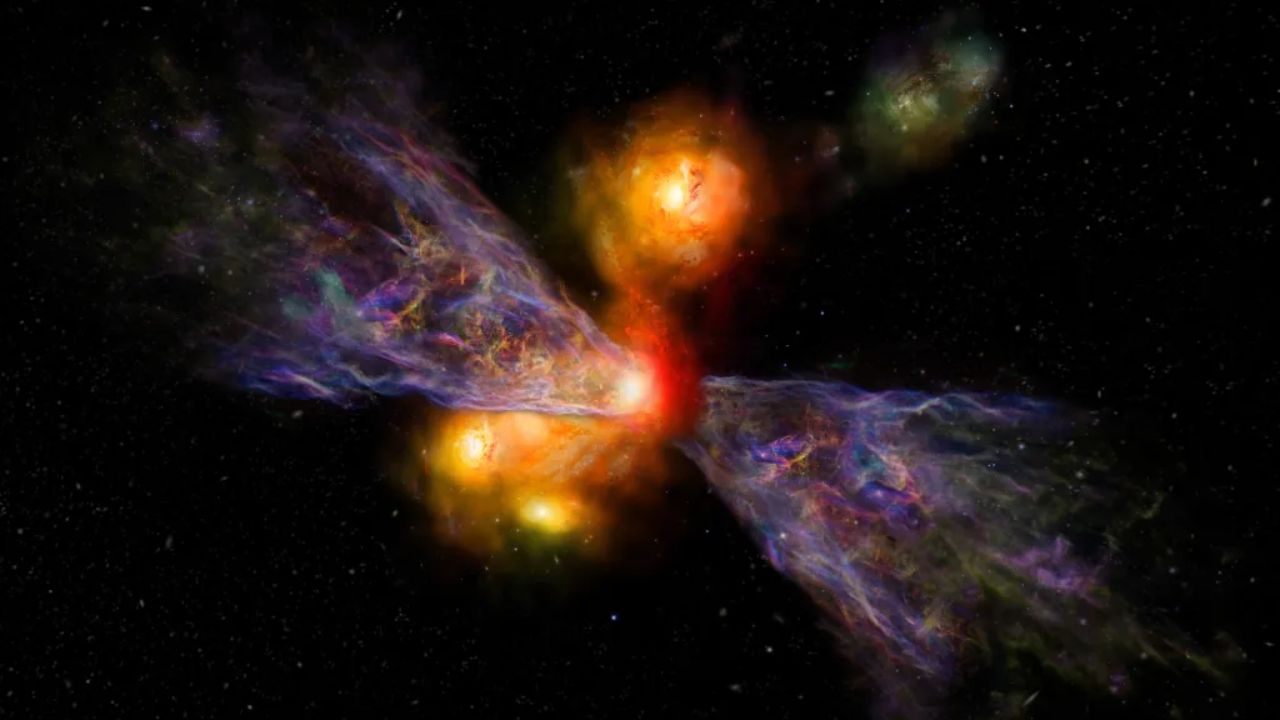
The violent dynamics of collisions and supernovas
This drastic process does not arise smoothly, being directly connected to the chaotic environment of galactic mergers. When two celestial structures collide in deep space, there is an initial and intense burst of star formation in a short period of time.
However, this hyperactivity comes at a high cost: the most massive stars die quickly and explode as supernovas. This constant ebb and flow of energy accumulates enough force to push the remaining gas out of the system, causing the galaxy to permanently lose the ability to continue generating celestial bodies.
Future risks and the stability of cosmic feedback
Researchers warn that if this fuel ejection flow continues at the same pace, the CRISTAL-02 system could be completely out of gas in less than 100 million years — an extremely short time interval within the cosmic scale.
Furthermore, the scientific community hypothesizes that part of these destructive winds may also originate from active black holes, which would make the dispersion effect even more enduring. The advancement of this study was celebrated by Andreas Faisst, a researcher at Caltech, in an interview with Live Science:
“We don’t know much about how the first galaxies stopped forming stars. This work directly shows this process in action.” To complete the scenario, the international team compared CRISTAL-02 with 99 other similar cases observed over 12 billion years.
The result drew attention by showing that this type of “galactic feedback” maintains a relatively stable and regular efficiency throughout the history of the Universe, even with galaxies completely changing structure over the ages.
With information from Olhar Digital


