Portuguese
  Spanish


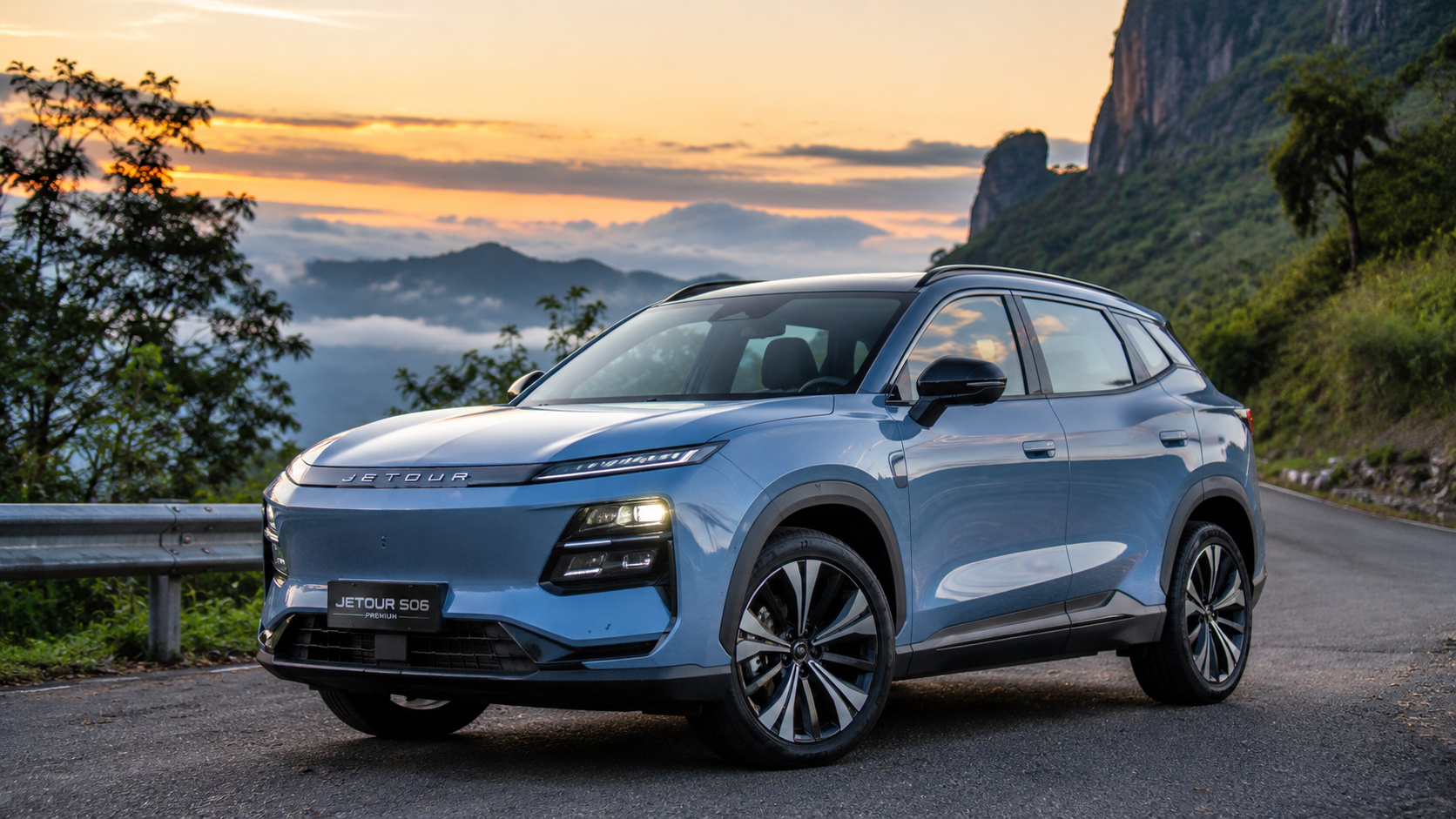

New plug-in hybrid SUV from Jetour debuts in the Brazilian market with competitive pricing, announced range of 1,200 km, complete technology package, and efficient performance, but some details still prevent the model from surpassing already established rivals.
The Brazilian SUV market has gained another strong competitor in plug-in hybrids. Jetour, a brand belonging to the Chery Group, officially launched the Jetour S06, a sports utility vehicle that bets on competitive pricing, good range, a wide list of equipment, and electrified powertrain to compete with well-known models like BYD Song Plus, GWM Haval H6 PHEV19, Jaecoo 7, Leapmotor C10, GAC GS4, and Geely EX5.
The information was released by Quatro Rodas magazine, which conducted a complete test with the new plug-in hybrid SUV and analyzed its performance, finish, consumption, equipment, dynamic behavior, and cost-benefit. The test shows that the S06 gathers several interesting attributes but also highlights points that still need to evolve to compete equally with the main rivals in the segment.
In recent years, it has become common to see Chinese manufacturers debuting in Brazil precisely through the segment of electrified medium SUVs. The strategy has worked for several brands and is now also being followed by Jetour. Although the manufacturer states that it intends to focus its efforts on hybrid SUVs with an off-road profile, the S06 adopts a clearly urban proposal, closely approaching the competitors already available in the national market.
-
Electric and Hybrid Cars Set to Transform Brazilian Streets: A New Era Begins

-
Chinese Giant Invests $1.3 Billion in Brazil to Produce 50,000 Cars Annually, Create Jobs, Develop Local Suppliers, and Manufacture Electric, Hybrid, and Combustion Models by 2027

-
Unprecedented achievement in India: a colossal 650-ton, nearly 3,000 hp excavator is transformed into 100% electric, marking a new phase in heavy mining.
-
Frightened by the speed of Chinese manufacturers, Renault decided to mimic the pace, made the new electric Twingo in just 21 months, wants to repeat the feat with 36 models by 2030, and along the way, will cut up to 2,400 engineering positions.



Jetour S06 bets on competitive pricing and complete equipment
One of the biggest attractions of the Jetour S06 is its market positioning. The top-of-the-line Premium version arrives in Brazil for R$ 229,900, a price lower than that practiced by the main direct competitors.
Currently, the BYD Song Plus costs R$ 249,990, while the GWM Haval H6 PHEV19 starts at R$ 249,000. Meanwhile, the Jaecoo 7 Luxury, belonging to the same Chery Group, is sold for R$ 234,990.
Even when compared to domestic SUVs, the new model remains competitive. The Jeep Compass Série S costs R$ 233,990, while the Volkswagen Taos Highline is marketed for R$ 214,490 and the Toyota Corolla Cross XRX Hybrid goes for R$ 222,690. However, unlike the Jetour S06, the latter two do not use plug-in hybrid engines.
Besides the price, the model draws attention for its exclusive design. While the SUVs T1 and T2 feature straight lines and a robust appearance, inspired by the off-road universe, the S06 bets on a more fluid, urban, and modern design.
The front has its own identity and will hardly be confused with another vehicle in the category. The silhouette features a descending roofline, creating the sensation of a coupe SUV, even though the manufacturer does not officially use this classification.
Another highlight is the LED taillights with sequential animation, a feature that enhances the vehicle’s technological aspect.
Modern cabin delivers comfort and a lot of technology
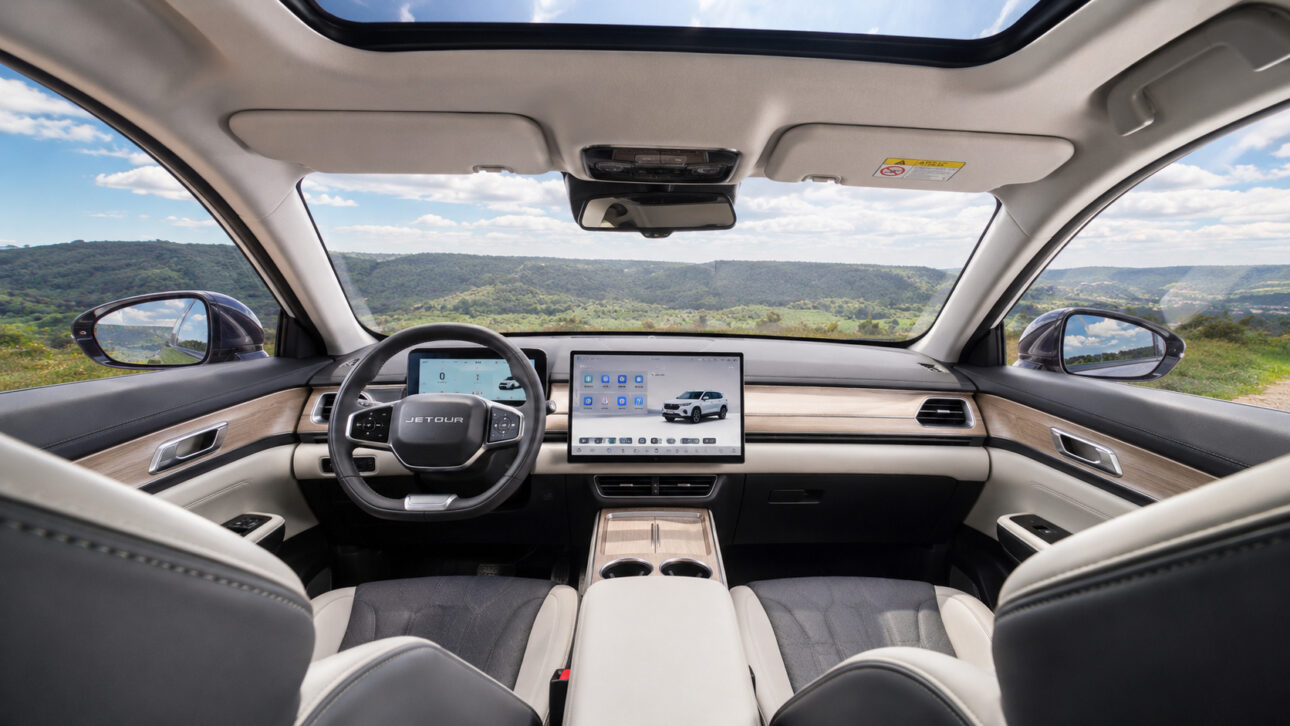
Upon entering the Jetour S06, the influence of recently launched Chinese models is evident. The interior bets on a minimalist style, with few physical buttons and great integration between digital systems.
The finish uses materials that convey a good sense of quality. The dashboard features details that mimic wood, while seats and steering wheel use coverings that simulate leather. Additionally, a large part of the surfaces receives rubberized plastic, increasing the perception of sophistication.
The unit evaluated by Quatro Rodas used a finish in gray and cream colors. However, Jetour also offers a combination in gray and blue, intended for consumers who prefer a more discreet cabin.
The fully digital instrument panel is 9.2 inches and presents good definition of information. Although it offers few customization features, it displays complete data on consumption, range, energy flow, and hybrid system operation.
The multimedia center deserves attention. In the Premium version, it uses a 15.6-inch screen, while the entry-level Advance version receives a 12-inch display.
The interface is quite reminiscent of those used by models from Geely and Leapmotor, offering quick navigation, good resolution, and compatibility with Apple CarPlay and Android Auto.
Despite the good technological experience, there is one point that may bother some drivers. As is the case with many current Chinese cars, practically all vehicle functions depend on the multimedia center.
Adjustments to the external mirrors, for example, require access to the screen menu before being controlled by the steering wheel’s rotary controls. Fortunately, Jetour has maintained a small row of physical buttons dedicated to the air conditioning, located just above the induction smartphone charger.
Equipment list places the S06 among the most complete in the category
When it comes to equipment, the Jetour S06 follows exactly the trend of premium Chinese SUVs.
From the Premium version, the model offers:
- panoramic sunroof;
- wireless phone charger of 50 W with dedicated air outlet;
- 360° camera;
- electronic parking brake;
- front and rear parking sensors;
- dual-zone digital air conditioning with rear seat outlet;
- automatic headlights;
- rain sensor;
- front seats with electric adjustments;
- six airbags;
- Full LED headlights.
Additionally, the top-of-the-line version receives a complete package of driving assistants (ADAS), including:
- adaptive cruise control;
- lane keeping assist;
- blind spot alert;
- automatic emergency braking.
This set allows for semi-autonomous driving in various driving situations, making the SUV competitive against the main rivals in the segment.
Another positive point is the vehicle’s dimensions. With 4.62 meters in length, 2.72 meters wheelbase, and a spacious cabin, the S06 provides good space for the driver and passengers.
In the front, comfort is not lacking. In the second row, there is good space for the head, legs, and shoulders. However, Quatro Rodas’ evaluation points out that the rear seat has a relatively short cushion and high inclination, factors that leave the occupants’ knees higher during long trips. Additionally, those occupying the central position need to accommodate their legs around the rear console.
The trunk has a 416-liter capacity. Although it offers enough space for everyday use, it loses part of the internal volume due to the positioning of the auxiliary 12 V battery and the power inverter below the floor.
Hybrid engine delivers 315 hp, but performance falls below main rivals
Under the hood, the Jetour S06 uses exactly the same mechanical set present in other models of the Chery Group, such as Jaecoo 7 and Omoda 7.
The system combines a 1.5 turbo gasoline engine, with 135 hp and 20.4 kgfm of torque, with an electric motor that delivers 204 hp and 31.6 kgfm. Together, they develop a combined power of 315 hp and 52 kgfm of torque.
On paper, the numbers are impressive. However, during tests conducted by Quatro Rodas, the performance was below expectations.
The manufacturer reports acceleration from 0 to 100 km/h in 7.8 seconds. However, the SUV needed 9.2 seconds to complete the test on the proving ground, falling 1.4 seconds above the official result.
When compared to the main competitors, the performance also disappoints. The BYD Song Plus achieved the acceleration in 8.4 seconds, while the GWM Haval H6 PHEV19 completed the same course in just 7.2 seconds. Even the Jaecoo 7, which uses practically the same hybrid set, recorded 7.4 seconds.
Despite this, the operation of the hybrid system pleases with its smoothness. The transition between the engines happens almost imperceptibly, providing comfortable driving both in the city and on the highway.
Fuel consumption and energy recovery are the main highlights of the Jetour S06
If the performance does not impress, energy efficiency stands out as one of the model’s main differentials.
During the tests, the Jetour S06 recorded 14.5 km/l in the city and 13.6 km/l on the highway.
Although highway consumption is within the segment’s average, the urban result was surprisingly positive. The SUV consumed approximately 1 km/l less fuel than the BYD Song Plus and showed an advantage of about 2.5 km/l compared to the GWM Haval H6 PHEV19.
Another point highly praised by the Quatro Rodas team was the efficiency of the energy regeneration system.
The SUV can quickly regain charge just by taking advantage of the vehicle’s movement. In some situations, the regeneration power exceeds 20 kW, a performance superior to that provided by several residential wallbox chargers.
In practice, this allows the driver to use the fully electric mode during urban commutes and reserve the hybrid operation for highway trips.
This strategy significantly improves the efficiency of the system and helps achieve the total range announced by the manufacturer.
According to Jetour, the S06 can reach up to 1,200 kilometers of range, provided the driver knows how to properly manage the driving modes and takes advantage of the regenerative system during braking and deceleration.
Suspension still needs adaptation for Brazilian roads
Although it presents good structural construction, the dynamic behavior is still far from being one of the S06’s strong points.
According to Quatro Rodas’ evaluation, Jetour has not yet carried out a tropicalization process similar to that executed by other Chery Group brands that have been operating in Brazil for a longer time.
The suspension uses relatively long-travel shock absorbers. This configuration avoids harsh impacts when passing through potholes, gutters, and asphalt imperfections.
However, greater control of the body’s movements is lacking.
During curves, braking, and quick direction changes, the SUV shows oscillations greater than those observed in some competitors. The same behavior appears even on regular surfaces, reducing the sense of precision at the wheel.
Even so, the setup favors occupant comfort, a characteristic highly valued by consumers in this segment.
Warranty enhances the model’s competitiveness
Another aspect that favors the Jetour S06 is the after-sales package.
The manufacturer offers 7 years of warranty for the vehicle. Additionally, the high-voltage battery and electric motor have 8 years of coverage.
Another important differential is the fixed-price maintenance program for 10 years or 100,000 kilometers, offering greater cost predictability for the owner.
In an increasingly competitive segment, this type of benefit can be a decisive factor for consumers who still have doubts about the maintenance of plug-in hybrid vehicles.
Verdict: competitive price is the main argument of the Jetour S06
The Jetour S06 enters the Brazilian market with enough attributes to compete among the best-selling plug-in hybrid SUVs in the country.
Your biggest differentiator remains the price. Costing R$ 229,900, it manages to stay below important competitors, such as BYD Song Plus, GWM Haval H6 PHEV19, and Jaecoo 7, without giving up a wide list of equipment.
On the other hand, the test shows that there are still points that can evolve. The performance was below expectations for a set of 315 hp, while the suspension needs a more suitable adjustment to the conditions of Brazilian streets and highways.
Even so, the S06 demonstrates potential to attract consumers looking for a complete, technological, efficient plug-in hybrid SUV with an excellent balance between price and equipment, especially as it is Jetour’s entry point into the national market.
Technical specifications of the Jetour S06 Premium
The Jetour S06 uses a plug-in hybrid set consisting of a 1.5 turbo gasoline engine, with 4 inline cylinders, installed in the front transverse position, equipped with direct injection. The combustion engine delivers 135 hp of power and 20.4 kgfm of torque.
The system works in conjunction with an electric motor of 204 hp and 31.6 kgfm, reaching 315 hp of combined power and 52 kgfm of combined torque.
The transmission is single-speed automatic, while the lithium-ion battery (LFP) has a capacity of 19.4 kWh. The recharge supports up to 6.6 kW in alternating current (AC) and 40 kW in direct current (DC).
The SUV uses electric steering, McPherson suspension at the front, and multilink at the rear. The brakes are ventilated disc at the front and solid disc at the rear.
The tires have a measurement of 225/55 R18.
In terms of dimensions, the model presents:
- Length: 4.616 meters
- Width: 1.91 meter
- Height: 1.69 meter
- Wheelbase: 2.72 meters
- Trunk: 416 liters
- Weight: 1,746 kg
- Fuel tank: 60 liters
Test results conducted by Quatro Rodas
During the instrumented tests, the Jetour S06 recorded the following numbers:
Acceleration
- 0 to 100 km/h: 9.2 seconds
- 0 to 1,000 meters: 29.7 seconds, reaching 180.4 km/h
- Maximum speed: 180 km/h (factory data)
Acceleration
- 40 to 80 km/h: 4.6 seconds
- 60 to 100 km/h: 5.6 seconds
- 80 to 120 km/h: 6.2 seconds
Braking
- 60 km/h to 0: 15.2 meters
- 80 km/h to 0: 27.4 meters
- 120 km/h to 0: 61.6 meters
Fuel consumption
- City: 14.5 km/l
- Highway: 13.6 km/l
Internal noise
- 80 km/h: 65 dBA
- 120 km/h: 69.8 dBA
Measurements
- Actual speed when the speedometer reads 100 km/h: 98 km/h
- Engine RPM at 100 km/h: 2,300 rpm
- Steering wheel turns: 2.5
The tests were conducted at the ZF Test Track, under conditions of 660 meters altitude, 30 °C temperature, 57% relative humidity, and 756 mmHg atmospheric pressure.
Jetour S06 Evaluation
Construction and finish: the SUV features a solid structure, well-executed assembly, and good quality materials.
Technology: offers a modern and comprehensive multimedia center, although it concentrates almost all vehicle controls on the screen.
Onboard experience: the interior space is pleasing both in the front and rear. However, the rear seat could offer better ergonomics, while the trunk loses capacity due to the battery positioned under the floor.
Performance: stands out for energy efficiency and excellent charge recovery. On the other hand, acceleration and performance fall below the main competitors.
Dynamic behavior: prioritizes comfort, but the suspension still needs better calibration for Brazilian roads.
Safety: the Premium version delivers a very complete ADAS package, with enough features to provide semi-autonomous driving in various situations.
Your wallet: the competitive price makes the Jetour S06 one of the most interesting options for those looking for a well-equipped plug-in hybrid SUV.
If you were to invest around R$ 230,000 in a plug-in hybrid SUV, would you choose the Jetour S06 for its cost-benefit or do you still prefer models like BYD Song Plus and Haval H6? Share your opinion in the comments.