Portuguese
  Spanish


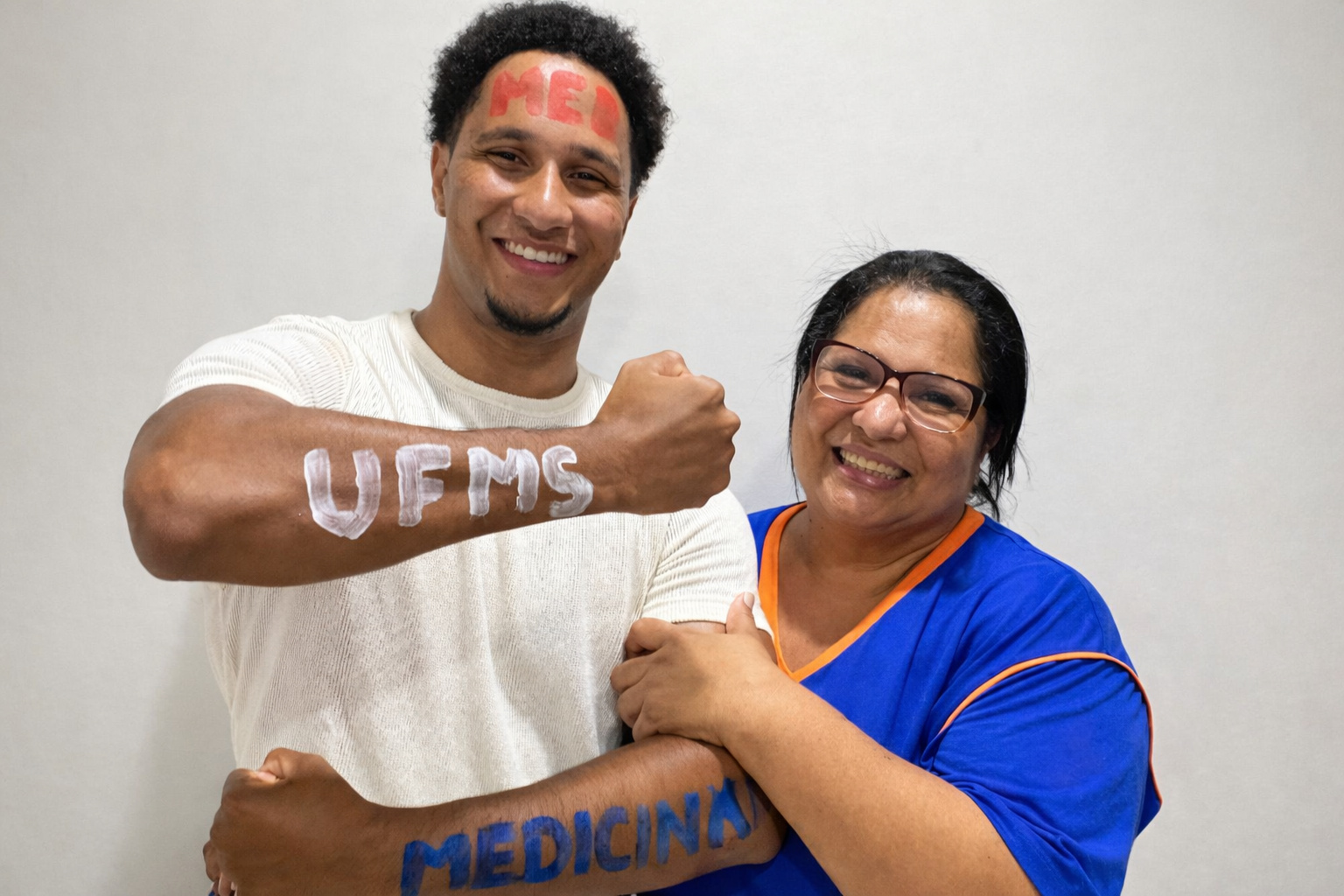

Young man from Campo Grande who worked as a weeder, waiter, and seller at a fair conquered a place in Medicine at UFMS, embraced his cleaning lady mother, and made his dream of being a doctor a reality after years of studying at night.
Some stories don’t need exaggeration to captivate the reader. João Vitor Santos de Souza’s story is already compelling: a young man, living in the outskirts of Campo Grande, son of a cleaning lady, working since early on, and accepted into Medicine at UFMS after years of squeezing study time between exhaustion, odd jobs, and late nights. The dream of being a doctor, which seems too distant for many, became a reality against all odds.
The approval gained even more strength because it did not come surrounded by comfort, expensive preparatory courses, or a tranquil routine.
João Vitor completed high school in a public school in 2016, in the Zé Pereira neighborhood, and spent years helping to support his household while insisting on his goal of entering Medicine.
-
Artesian Well Becomes Lifeline for Small Brazilian Farm: Drilling Reaches 60 Meters, Finds Marble, Navigates Rock Fissures, and Strikes Fresh Water

-
Street Cleaner in Brazil Finds Discarded Books That Helped His Wife Pass Civil Service Exam and Become Police Captain
-
July’s Night Sky to Feature Planetary Alignments, New Moon, Venus at Sunset, Buck Moon, and Two Meteor Showers

-
Fisherman Catches 18kg Catfish Near Brazil’s Itaipu Lake, Among Largest Recorded in Recent Years



The final result of the 2025 UFMS entrance exam was published on January 28, and he began to live this new chapter in early March.
From the hoe to Medicine without shortcuts
Before the acceptance, there were heavy jobs. João Vitor weeded lots, sold at fairs, painted walls, worked in convenience stores, did odd jobs at car washes, and also worked as a waiter.
In one of the most symbolic episodes of this journey, he served as a waiter at a graduation party for a Medicine class just weeks before the entrance exam results were released.
The study routine was far from the idealized image of someone preparing for one of the most competitive courses in the country.
He studied at night, even used his lunch break to review content, and crossed the city by bicycle, which left his body exhausted even before his shift ended.
Without money for a preparatory course, he set up his own preparation with the internet, borrowed materials, and the help of people who believed in his determination.
Even so, his performance showed up when it mattered most. João Vitor said he usually studied two to three hours a day and placed a strong bet on the essay, where he scored 800.
It was with this result that he secured one of the seven spots reserved for black candidates and graduates from public schools from low-income families in the UFMS entrance exam.
The cleaning lady mother became a symbol of a victory that moves the country
The image of the young man accepted into Medicine next to his cleaning lady mother is moving for a reason. It encapsulates the real weight of this achievement.
Meire Santos, mentioned in the report as a cleaning lady and general services assistant, was direct when talking about her son: the merit was his. But the family’s own journey helps explain the strength of this story.
João Vitor’s father also faced difficulties, studying Nursing at 45 years old and now works as an elderly caregiver.
It’s not just about passing an entrance exam. It’s about breaking a heavy social barrier, leaving a routine marked by informal work, and making space in a course historically associated with high costs of preparation and maintenance.
That’s why the young man’s approval goes beyond the classroom and becomes a story of identification for many who also try to change their lives through education.
The dream of being a doctor began, but the hardest part comes now
Getting in was huge. Staying may be even more difficult. The Medicine course at UFMS is in-person and full-time, with activities spread across morning, afternoon, and evening, which practically eliminates the possibility of balancing the degree with a heavy work routine.
This is precisely where the victory gains another layer: the young man passed the exam, but now he needs to overcome the costs of staying in the program.
The university itself maintains support mechanisms that show how concrete this challenge is. In February 2026, UFMS reported that medical students in situations of socioeconomic vulnerability can compete for the Permanence Scholarship of the Mais Médicos Program, with a monthly aid of R$ 700.
The institution opened 10 spots for the Medicine course in Campo Grande, emphasizing that this type of support can be decisive in preventing dropout in a program with a high workload.
The beginning of the academic journey has also shown the size of the path ahead. On March 9, 2026, the new medical students at UFMS participated in a welcome event at Humap-UFMS, with a guided tour of the university hospital and direct contact with the environment where they will develop an important part of their training.
It is proof that the dream of being a doctor has come to life, but now it demands breath, structure, and resilience to last until the end.
In the end, João Vitor’s story doesn’t go viral just because it is moving. It grows because it shows, with name, face, and real effort, the magnitude of the distance that many Brazilians need to cross to secure a spot in Medicine.
And when this crossing ends in an embrace with his cleaning lady mother, the whole country understands that it was not just an approval: it was a turning point in destiny.
Comment on what you think about this story and share this post with those who believe in the power of education to change lives.