Portuguese
  Spanish


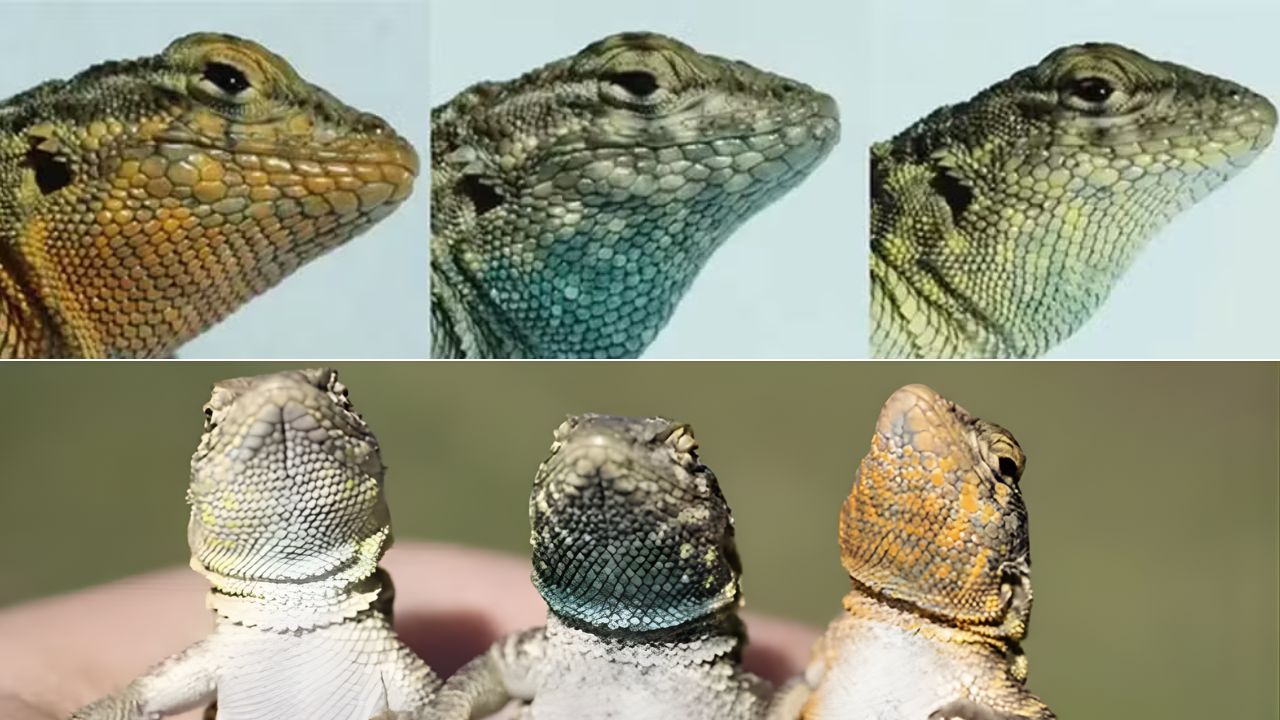


Study Reveals That Side-Blotched Lizards Follow a System Similar to “Rock, Paper, Scissors,” Based on Genetics, Color, and Reproductive Behavior.
Survival and reproduction in nature do not always follow the rule of the strongest. In the case of the side-blotched lizards (Uta stansburiana), reproductive success depends on a surprising system reminiscent of the game “rock, paper, scissors.”
The discovery was made by American scientists and detailed in a study published in the journal Science, revealing how colors, genes, and behavior combine to determine who leaves more offspring over generations.
These lizards primarily live in arid regions of the western United States and northern Mexico.
-
The Trap of Modern Technology: How Screen Overload and Digital Connections Can Impact Your Mental Health and Well-being

-
Wyoming Couple Grows Tropical Fruits Year-Round in -40°C Using Geothermal Greenhouse, Demonstrating Earth’s Heat Can Produce Oranges and Lemons in Snow Without Traditional Heating

-
Ship Returns from Brazilian Coast with Thirty Newly Discovered Life Forms
-
Nigerian Professor Invents Electricity-Free Refrigerator Using Clay Pots and Wet Sand, Extending Shelf Life of Vegetables to 27 Days; 7,000 Units Distributed in Energy-Deprived Villages



During the mating season, males display distinct colors on their throats, and these visual differences define completely different reproductive strategies.
Side-Blotched Lizards: An Enigma Observed for Decades
The phenomenon began to attract scientific attention about 30 years ago when biologist Barry Sinervo from the University of California, Santa Cruz, started studying populations of side-blotched lizards in the hills near Merced, California.
Over years of field observation, he noticed that males divided into three well-defined groups, identified by throat colors orange, blue, and yellow.
Each color represented a specific reproductive lifestyle. Orange-throated males are the most aggressive.
They occupy large territories and control multiple females at the same time, using force to fend off rivals.
Blue males follow a different logic. They defend smaller areas, usually remain faithful to one or two females, and invest more in cooperation than in direct confrontation.
On the other hand, yellow males adopt an opportunistic strategy. Without a fixed territory, they silently infiltrate areas dominated by other males to attempt mating without being noticed.
Why This Seems Like Rock, Paper, Scissors?
The interesting thing is that none of these strategies is permanently superior.
Orange males dominate blue ones by strength. Blue males can drive out yellow ones thanks to constant vigilance.
Yellow males, on the other hand, have an advantage over oranges by exploiting their large territories without drawing attention.
This cycle creates a dynamic balance. When one strategy becomes too common, another becomes more advantageous, causing the population to fluctuate over time.
From Behavior to Genetic Code
For many years, scientists suspected that this system was linked to genetics but could not prove it.
It was only more than a decade later that biologist Ammon Corl from the University of California, Berkeley, managed to advance this question.

As side-blotched lizards do not develop typical colors in captivity, the team needed to capture individuals in the wild.
The researchers collected blood samples, recorded behavior, and sequenced the animals’ genomes.
A Small Change with a Big Impact
Genetic analysis showed that a minimal variation in DNA is sufficient to differentiate orange males from blue ones.
The orange coloration is recessive and only appears when the lizard inherits two copies of this variant.
This change affects the production of the SPR protein, linked to both coloration and neurotransmitter activity, directly connecting physical appearance and aggressive behavior.
“Potentially, this single gene could link changes in coloration to changes in behavior,” Corl told The New York Times.
“It’s amazing that something like this can work.”
The Mystery of Yellow Males
Yellow males posed an additional challenge for scientists. Genetically, they are almost identical to blue ones, with no clear differences in DNA.
This suggests that environmental and social factors influence the expression of this strategy. In other words, not everything is written in the genes: context also shapes behavior.
The study shows that evolution is not a linear race toward absolute dominance.
In the case of the side-blotched lizards, diversity persists precisely because no strategy wins forever.
This natural “game” helps explain how multiple behaviors can coexist for long periods, offering a new perspective on balance, adaptation, and survival in nature.
With information from Revista Galileu.