Portuguese
  Spanish


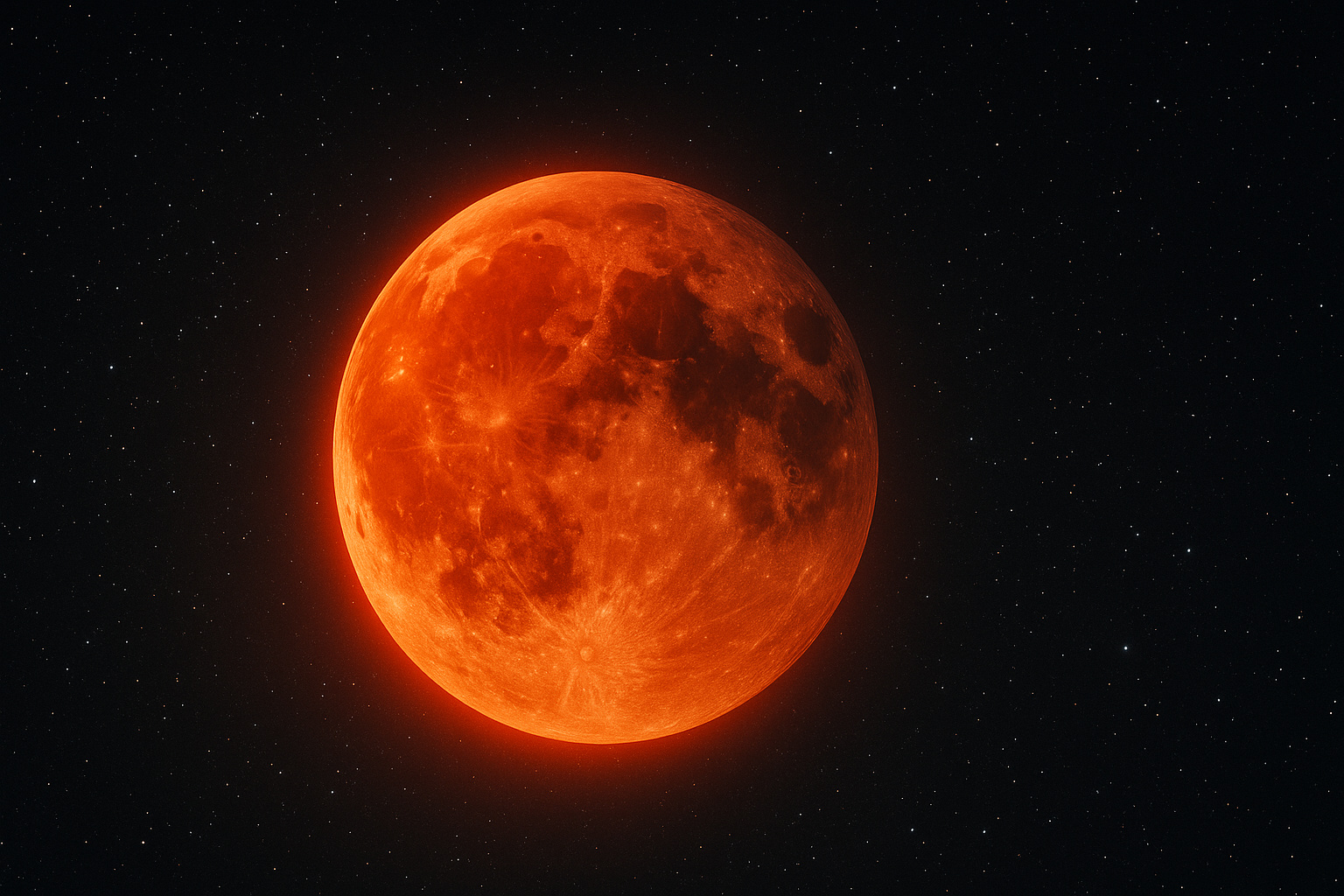


Rare Astronomical Phenomenon Will Turn the Moon into an Intense Reddish Hue on the Night of September 7 to 8, 2025, Being Visible in Various Parts of the World, with Guaranteed Broadcast for the Brazilian Public
The total lunar eclipse of the night of September 7 to 8, 2025 promises to be one of the major astronomical events of the century according to the Diario do litoral. The Moon will be completely covered by the Earth’s shadow for 82 minutes, a duration that classifies it as the longest eclipse in recent history. During this period, the natural satellite will gain the characteristic reddish hue, popularly known as Blood Moon.
According to specialists, the peak of the phenomenon will occur between 5:30 PM and 6:52 PM GMT (2:30 PM and 3:52 PM Brasília time). During this interval, the Moon will present a color that may vary from orange to deep red, depending on atmospheric conditions.
In Brazil, the eclipse cannot be observed with the naked eye, but real-time broadcasts will be available on digital platforms, including the official channel of the National Observatory on YouTube.
-
Pennsylvania Mine Creates Ice in Summer Heat and Melts in Winter, Turning a Mountain Crevice into a Reverse Natural Refrigerator

-
China Accelerates Global Expansion of Robotics: From Smart Vacuums to Industrial and Humanoid Machines, Millions Exported to Over 150 Markets
-
Polar Air Mass to Hit Brazil: Temperatures to Plummet in Nine States, Near Freezing in the South with Frost Risk Until Monday
-
Chinese “dark factories” produce electric cars 24/7 with minimal human intervention, as Zeekr assembles 800 units daily, raising concerns in Brazil.





Where the Eclipse Can Be Seen
The event will be fully visible from Europe, Africa, eastern Australia, and New Zealand. In these locations, observers will have more than an hour to watch the red-tinted Moon in the night sky. In other regions, only partial phases of the eclipse will be visible.
Astronomers advise those interested to start observing about 75 minutes before the peak, ensuring the viewing of all stages: entrance into the penumbra, totality, and exit from the shadow.
As reported by the portal EarthSky.org, eclipses of this magnitude are rare. The last occurrence of similar duration happened over a decade ago, but with less totality time.
What Makes the Moon Red
During a total lunar eclipse, the Earth positions itself between the Sun and the Moon, blocking direct sunlight. Despite this, the Moon does not disappear from the sky. The Earth’s atmosphere acts as a filter, scattering shorter wavelength colors, such as blue and green, and allowing reddish tones to reach the lunar surface.
This scattering effect, known as Rayleigh Scattering, is the same responsible for the reddish colors of sunset. Factors such as pollution and suspended particles can intensify or soften the observed hue.
How to Watch from Brazil
Although the phenomenon is not directly visible in Brazilian territory, the public will have access to various live broadcasts. The National Observatory, for example, confirmed real-time coverage on YouTube, allowing interested individuals to follow all phases of the eclipse.
Other astronomy channels and international observatories are also expected to provide live images, expanding possibilities for those who wish to observe the event without leaving home.
A Special Show in 2025
Total lunar eclipses occur, on average, every two years, but one with over 80 minutes of totality is considered extremely rare. Therefore, the phenomenon of September 2025 is expected to be added to the list of great astronomical milestones of the 21st century.
In addition to its scientific nature, the event arouses great public curiosity, uniting astronomy enthusiasts and casual observers around a unique experience.
Summary of the Phenomenon
- Date: Night of September 7 to 8, 2025
- Type: Total Lunar Eclipse
- Duration of Totality: 82 Minutes
- Phenomenon: Blood Moon, with intense reddish coloration
- Visibility: Europe, Africa, eastern Australia, and New Zealand
- Time of the Most Intense Phase: 5:30 PM to 6:52 PM GMT (2:30 PM to 3:52 PM in Brasília)
- Brazil: Will not be visible to the naked eye; broadcasts will be available on YouTube
- Observation Recommendation: Start 75 minutes earlier to follow all phases
According to the portal Earth.com, total lunar eclipses of this duration represent a rare opportunity for both astronomical studies and public enjoyment of the sky.