Portuguese
  Spanish


Developed by researchers from the Max Planck Institute for Intelligent Systems and the University of Stuttgart, the Floaty controls the airflow through four movable fins, recovers from wind disturbances, and can operate in locations with updrafts, reducing reliance on engines and energy consumption.
A bird-inspired flying robot has managed to remain stable in the air without using propellers. Named Floaty, the equipment was developed by scientists from the Max Planck Institute for Intelligent Systems and the University of Stuttgart.
The work, published in the journal npj Robotics, presents an alternative to the current aerial vehicle dilemma. Drones with propellers can hover and perform quick maneuvers but consume a lot of energy. Airplanes fly efficiently, but do not remain suspended in the same spot.
Robot adjusts fins to control the air
The Floaty was designed to combine efficiency and stability. Instead of generating propulsion with engines, the robot uses the upward airflow and modifies four movable fins installed on its upper part.
-
Australia Dumps Hundreds of Thousands of Tons of Gravel into Rivers to Restore Natural Barriers and Reverse 150 Years of Erosion

-
Eight Artists Secretly Lived in a Hidden 70m² Apartment Inside a Shopping Mall in Brazil for Four Years
-
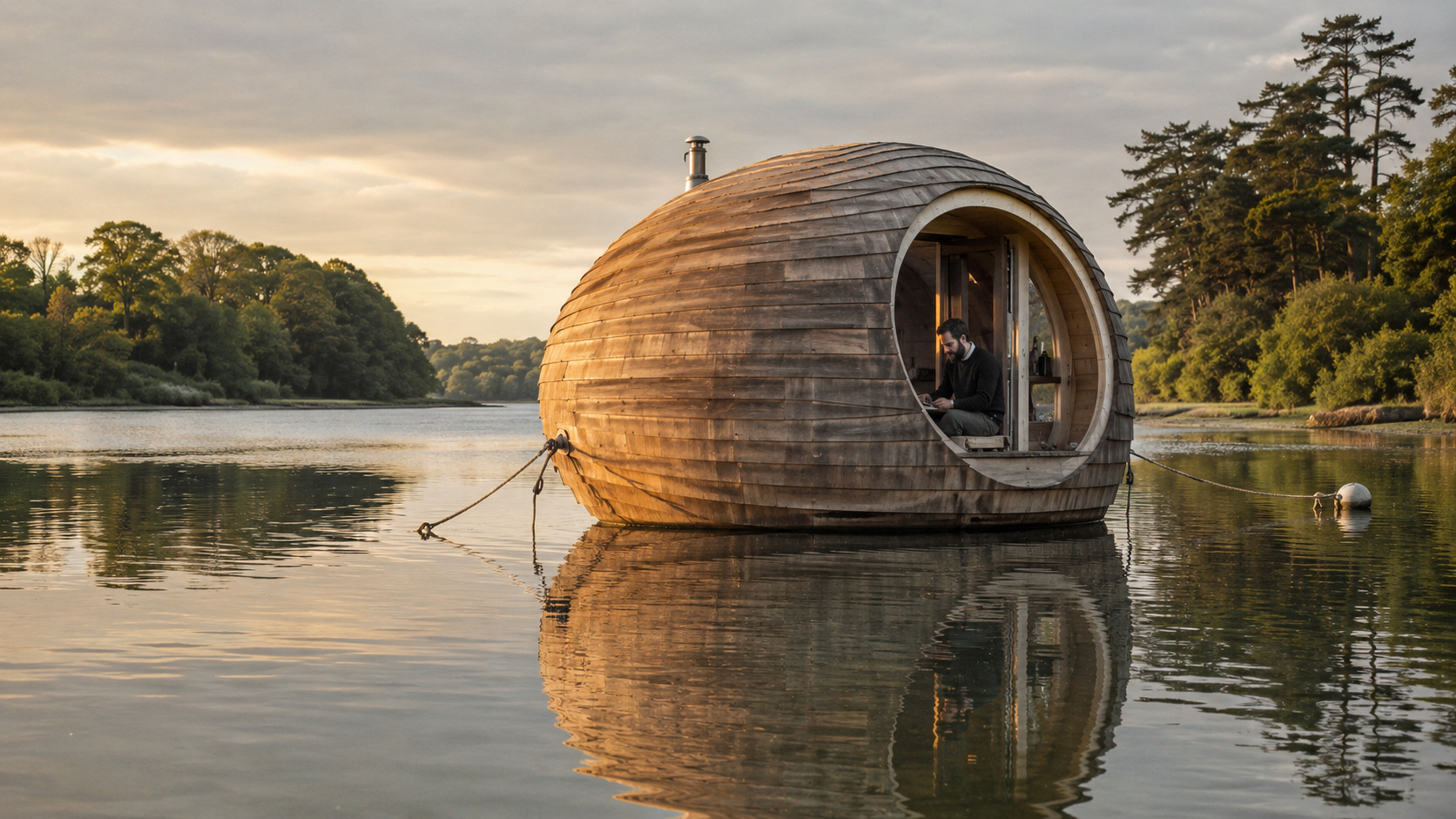
Artist Lives in Giant Wooden Egg Over a UK River to Observe Tides and Environmental Changes
-
Over 20 Metal Drums Repurposed into School Transport Train Boost Attendance in Australian Aboriginal Community



By rotating these structures, the equipment alters the flow around the body and controls air resistance. In tests conducted in a wind tunnel, the Floaty flew at speeds of up to 10 meters per second.
The system maintained balance when receiving lateral pushes or facing wind disturbances. To achieve this, it uses an aerodynamic model developed from experiments, allowing precise corrections during flight.
Design changes prevented tipping
The initial tests revealed a problem. The original flat shape caused the robot to tip to the sides, instead of naturally returning to a stable position.
The team lowered the center of gravity and redesigned the rigid flaps, adding a specific curvature. With these changes, the Floaty began to automatically correct its own balance, without relying on active propulsion.
Ghadeer Elmkaiel, the first author of the publication and a PhD student at MPI-IS, stated that the project opens possibilities for more efficient and sustainable flying robots, capable of harnessing the wind and reducing energy consumption.
Technology can operate in updrafts
Michael Mühlebach, the leader of the group involved in the study, mentioned possible applications in locations with upward airflow. Among them are inspections in industrial chimneys, where the robot could operate with few modifications.
Similar technologies could also assist in controlling rockets during atmospheric reentry or in guiding weather balloons. In all cases, the goal would be to harness air currents to save energy without losing stability.
What do you think of the Floaty proposal? In your opinion, can a robot that uses the wind to stay aloft transform industrial inspections, scientific missions, and other aerial operations? Share your assessment in the comments and say which application seems most promising.