






 Portuguese
  Spanish
  3 min of reading
  0 comments


Antarctic Lula Filmed Alive for the First Time Over 2,000 Meters Deep During Scientific Expedition in the Antarctic Ocean
For the first time, scientists have filmed a live squid of the species Gonatus antarcticus in its natural habitat. The recording took place in December, about 2,133 meters deep, in the icy waters of the Antarctic Ocean.
The squid, nearly one meter long, was recorded by a remotely operated vehicle during a scientific expedition.
Unexpected Discovery
The team of scientists was aboard the research vessel R/V Falkor (also), from the Schmidt Ocean Institute. They intended to explore the Powell Basin, but ice conditions prevented them from reaching the desired location.
-
Invisible Induction Technology Enables Wireless Power for Blenders, Coffee Makers, and Air Fryers, Reducing Countertop Cables

-
Smart Outdoor Lighting Transforms Gardens into Living Spaces with Weather Resistance and App-Controlled Scenes

-
Green dot on top of smartphone intrigues users, signals privacy alert in Android 12 that experts say shouldn’t be ignored.
-
Humanoid Robot Climbs 6,263-Meter Volcano in Ecuador, Sets Sights on Everest Challenge




Therefore, they decided to deploy the SuBastian vehicle in a different area. It was during this change of plans that they captured the unprecedented footage.
“It was a beautiful squid,” commented Andrew Thurber, a marine scientist at the University of California, Santa Barbara, who participated in the mission.
The video was later analyzed by Kat Bolstad, a cephalopod specialist at Auckland University of Technology in New Zealand. She confirmed the identification: it was indeed an Antarctic gonate squid.
A Century Without Live Records
Although it has been known for over 100 years, this squid had never been seen alive. The species was first described in 1898 by Swedish zoologist Einar Lönnberg, based on specimens collected during an expedition in Tierra del Fuego, an archipelago at the southern tip of South America.
Since then, the only records of the species came from dead specimens caught in nets or from remains found in the stomachs of predators. “In the depths of the sea, there’s always a good chance you’ll see something for the first time,” said Bolstad.
Details of the Encounter with the Squid
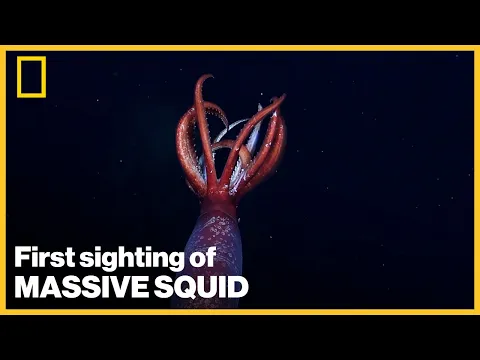

When SuBastian approached the squid, the animal released a cloud of greenish ink, probably in reaction to the approach.
The scientists were able to measure the squid with lasers from the vehicle before it disappeared into the darkness of the so-called midnight zone — between 1,000 and 4,000 meters deep, where sunlight does not reach.
Although it was not possible to identify the squid’s sex or age, researchers observed two large hooks on its tentacles, used for capturing prey.
They were also able to see scars on the animal’s body, including marks from suckers and scratches. The origin of these marks is uncertain, but scientists suspect a possible fight with a young colossal squid.
Scientific Relevance
Videos like this are valuable for science. “They can be really informative about how they live at great depths,” stated Linsey Sala from the Scripps Institution of Oceanography, who did not participate in the mission.
The capture of the squid occurred during the “Perpetual Planet” expedition, an initiative led by National Geographic in partnership with Rolex. The project aims to study the impact of climate and environmental changes on important and fragile ecosystems worldwide.
Other Discoveries of SuBastian in the Deep Sea
The SuBastian vehicle has already helped in other important discoveries. In a previous expedition, it captured the first image of a live colossal squid (Mesonychoteuthis hamiltoni) in its habitat.
The animal, measuring 30 centimeters, was seen swimming at 600 meters deep in the South Atlantic, near the South Sandwich Islands.
In 2020, the same vehicle filmed a ram’s horn squid (Spirula spirula) for the first time in nature at 850 meters deep, north of the Great Barrier Reef.
It also found worms and snails living under the Pacific Ocean floor — the first evidence of animal life in the oceanic crust.
Additionally, SuBastian helped in the identification of four new octopus species in Costa Rica and revealed a hidden ecosystem beneath an iceberg in Antarctica.
The recording of the Antarctic gonate squid represents a breakthrough for understanding life in deep waters.
Until now, knowledge about the species was limited to dead specimens. Now, with the unprecedented footage, scientists have the opportunity to study the behavior of this rare animal in its natural environment — an unprecedented achievement in over 120 years since its discovery.
With information from Smithsonian Mag.



-

2 people reacted to this.