Portuguese
  Spanish


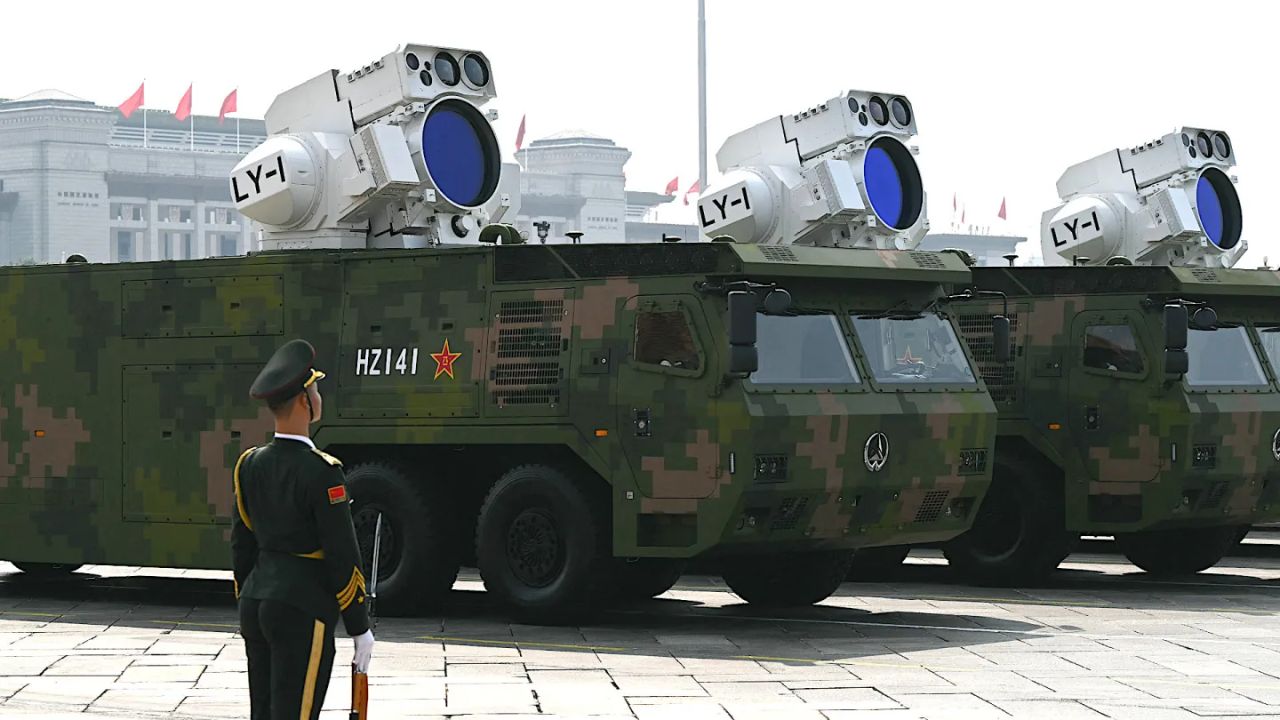


LY-1, China’s Naval Laser, Shines in Military Parade and Showcases Technological Advancements While Challenging US Military Technology.
The China recently announced the development of the LY-1, an advanced naval laser with an estimated power between 180 and 250 kilowatts. The system is designed to protect ships against drones and missiles, enhancing the defense capabilities of the Chinese Navy.
Experts point out that the initiative is part of a larger strategy by Beijing to challenge American military supremacy in the Indo-Pacific and demonstrate cutting-edge technology.
Naval Laser LY-1: Innovative System for Ship Protection
The LY-1 was conceived as a complementary defense tool, functioning alongside existing short, medium, and long-range missile systems.
-
U.S. Navy’s Ticonderoga-class Cruiser Becomes a 9,800-Ton Missile Fortress with Advanced Aegis System Capable of Tracking Hundreds of Targets

-
France’s Charles de Gaulle: The Sole Nuclear-Powered Aircraft Carrier Outside the US, Weighing 42,500 Tons and Equipped with Two Atomic Reactors

-
The military spaceplane that almost took the Cold War into orbit: Boeing X-20 Dyna-Soar was designed to re-enter above Mach 20, fly for up to 40 hours, land like a plane, and transform Titan rockets into a gateway to a new era of orbital warfare.
-
FAB bets on national drones and increases investments to strengthen the Brazilian aerospace industry





The weapon is modular, allowing its power to be increased with the addition of new modules, ensuring flexibility and rapid upgrades.
Beijing claims that the system can neutralize high-speed threats, providing immediate protection for critical vessels.
Comparison with the American HELIOS
In the United States, the HELIOS system has already been tested and used in naval exercises, including the destruction of drones.
With a power of 60 kW, it combines attack, surveillance, and interference functions against enemy sensors.
China asserts that the LY-1 surpasses HELIOS in power and accuracy, but there is still no public evidence demonstrating its performance in real combat, making it, for now, more of a demonstration of technological capability.
Display of Force in Military Parade
The launch of the LY-1 was held during a military parade in Beijing, celebrating the 80th anniversary of China’s victory over Japan.
In addition to the laser, the presentation included remotely operated tanks and long-range missiles.
The event had a strong symbolic character, signaling to the world that China is investing in advanced technology and seeking to reinforce its military influence on an international level.
Strategic Implications of the LY-1
Experts highlight that laser systems like the LY-1 can reduce operational costs and rapidly respond to emerging threats, valuable characteristics in modern warfare scenarios.
China, like the United States, United Kingdom, and India, is investing in directed energy weapons to prepare for future conflicts, protect maritime routes, and maintain a strategic advantage in critical regions.
Limits and Questioning
Despite official statements, there is still no public evidence of successful tests of the LY-1 under real combat conditions.
Limited transparency contrasts with American practices, which disclose results of experiments with HELIOS.
Therefore, although the system represents a technological advance, its effective functioning remains uncertain, also serving as a political symbol of Chinese ambition.
Laser weapons are becoming increasingly central to modern naval strategies due to their almost instantaneous speed and low cost per shot. For China, the LY-1 is a bet on technological innovation, projecting power and consolidating the country’s presence in geopolitical disputes.
Source: Olhar Digital