Portuguese
  Spanish


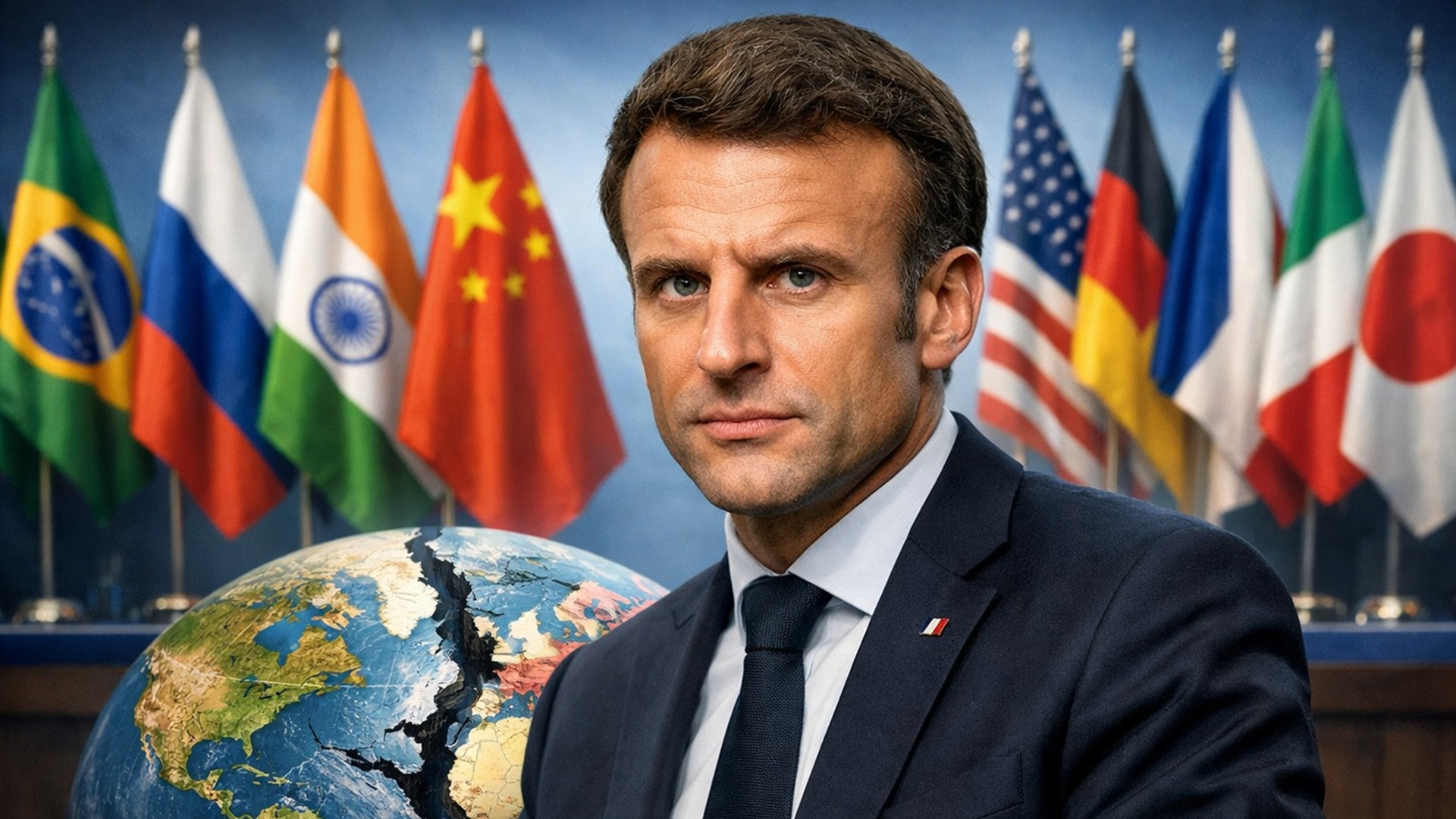


In An Era Of Increasing Geopolitical Tension, The French President Warns Against The Transformation Of The G7 And BRICS Into Rival Blocs, Criticizes American Isolationism And Points To The Risks Of A New Imperialism That Threatens Global Governance And The Sovereignty Of Nations
On Thursday, at the Élysée Palace in Paris, President Emmanuel Macron spoke to French ambassadors criticizing the U.S. for abandoning allies and rules, while outlining the diplomatic agenda for 2026 focused on European sovereignty and the prevention of global fragmentation.
Central Criticisms Of The United States And The Global Order
In his annual speech to ambassadors, the French president outlined France’s foreign policy priorities with direct criticisms of Washington. According to a press release issued by the Élysée Palace, Macron stated that the United States is gradually distancing itself from some of its allies.
The president highlighted that, although it is an established power, the American nation is freeing itself from the international rules it promoted until recently. He rejected what he described as “new colonialism and new imperialism” in a global landscape dominated by great powers.
-
Chinese Nuclear Submarine Launches Simulated Warhead Missile in Pacific, Heightening Regional Tensions Amid Naval Drills with Russia Near Qingdao; New Zealand and Papua New Guinea Warn of Persistent Chinese Military Presence

-
Ayatollah Ali Khamenei’s Funeral Draws 15 to 20 Million in Tehran, Calls for Revenge Against Trump After Joint Israel-U.S. Attack

-
U.S. Establishes Permanent Embassy in Jerusalem, Reigniting International Debate Over Israel’s Capital
-
The world has nearly 12,000 nuclear warheads, with the majority held by the United States and Russia; see the figures for China, France, and the United Kingdom.


Macron warned that we live in a world with a real temptation for division. He explicitly acknowledged that multilateral institutions are functioning less and less effectively in the current geopolitical context.
The French leader insisted that “global governance” is crucial at this moment. He illustrated the severity of the situation by mentioning that ordinary people are wondering if Greenland will be invaded or if Canada will face the threat of becoming the 51st state.
According to the president, this is the right moment to fully reinvest in the United Nations. He noted, however, that the largest shareholder of the organization no longer believes in it, implicitly referring to the recent American stance.
A report from Politico EU noted that Macron used the speech to paint a picture of predatory global powers. These powers would be seeking to divide the world into spheres of influence, with the U.S. dominating the Western Hemisphere under the so-called Monroe Doctrine.
Geopolitical Context And Reactions To Washington’s Actions
A report from AFP noted that Macron’s remarks on Thursday represent some of his strongest criticisms of Washington’s policies under Donald Trump. The speech took place at a critical moment for European powers.
The nations of Europe were struggling to present a coordinated response to the forced apprehension of Venezuelan leader Nicolas Maduro. Additionally, there were concerns about the U.S. president’s designs on Greenland’s territory.
The Politico EU report noted that the French president did not specifically mention Venezuela in his speech. However, the situations in Caracas and Greenland are currently Paris’s main concerns.
France is helping to craft a European response to Trump’s threats against the autonomous Danish territory. Cui Hongjian, a professor at the Academy of Regional and Global Governance at Beijing Foreign Studies University, analyzed the situation for Global Times on Friday.
Cui observed that Macron’s criticisms appear to be primarily directed at the U.S. following a series of Washington’s actions. He stated that the recent U.S. rhetoric regarding Greenland has destroyed Europe’s remaining belief that Washington would treat its allies differently.
For France and Europe, U.S. policy is increasingly adopting a hierarchy centered on Americans. Cui added that this stance contradicts the principle of sovereign equality among nations.
Previously, the French political class had widely condemned Maduro’s forced apprehension by U.S. armed forces. However, Macron did not denounce either the method or the intervention itself on that occasion.
In a post on X on January 4, the president stated that the Venezuelan people should “rejoice.” Leftist parties in France criticized his comments, labeling them as a “shame,” according to a report from RFI.
The annual meetings of French envoys have become a critical stage for Macron to articulate his worldview. The speech reflects lessons drawn from a series of recent shocks, from Venezuela to Greenland.
Strategic Positioning On Russia, China And G7
In Thursday’s speech, the French president also criticized Russia, labeling it a “destabilizing power.” He cited actions regarding Ukraine and other regions, along with information interference and other activities.
Macron also made complaints about China, specifically regarding trade. A Chinese expert noted that although the tone on China differed from his visit to Beijing, the claims echoed the familiar economic rhetoric of the EU.
The French president addressed the management of global imbalances dealt with by the G7. He emphasized that it is essential to do everything possible to avoid the fragmentation of the world into antagonistic blocs.
He specifically warned against transforming the G7 into an anti-China club or a club of global division. Likewise, he advocated against making the G7 an anti-BRICS club and allowing BRICS to become an anti-G7 club.
Future Diplomatic Agenda And Expert Analysis
Macron presided over three thematic working sessions during the Conference of Ambassadors. These sessions will help shape France’s diplomatic agenda for the year 2026.
The themes focused on European sovereignty and France’s presidency of the G7. Africa was also a central focus, preceding the Africa-France Summit to be held in Nairobi.
Cui Hongjian pointed out that Macron’s speech highlighted Europe’s strategic dilemma caught between great powers. The speech reflects Europe’s broader frustration and the constraints it faces in the current landscape.
The expert highlighted that France’s and the EU’s ability to shape global affairs continues to suffer erosion. The bloc is burdened by internal divisions and institutional constraints, possessing limited leverage abroad.
The EU struggles to keep pace with China or the U.S. amid rapid competition. Cui stated that Europe faces a growing sense of strategic insecurity, unable to compete effectively or to retreat.
Europe’s warnings about a new era of rivalry among great powers reflect this vulnerability. This comes as the U.S., Russia, and China accelerate competition in areas of their respective strengths.