






 Portuguese
  Spanish
  4 min of reading
  1 comment


In The Heart Of The Atacama Desert, In One Of The Most Inhospitable Places On Earth, A Silent Revolution Is About To Happen.
Science has never been closer to unraveling the mysteries of the universe than now, with the construction of the largest optical telescope in the world. But what makes this project so special? And what can it reveal to us about the deepest secrets of the cosmos?
The Extremely Large Telescope (ELT), which is being built by the European Southern Observatory (ESO), is more than just an engineering giant.
Scheduled to begin operations in 2028, the ELT promises to transform our understanding of the universe, allowing us to see farther and clearer than ever before. The choice of name may seem simple, but the grandeur of the project reveals itself in every technical and scientific detail.
-
Science still debates how to measure the intelligence of someone who may be one of the most brilliant Brazilians of today, with an IQ of 188 recorded in a specific test, 55 cited qualifications, and membership in high IQ societies.

-
ALMA and James Webb telescopes reveal star-forming gas in ancient galaxies, and discovery shows a rare piece of cosmic history

-
OpenAI wants to transform ChatGPT into a powerful super app with AI agents, enhanced Codex, and tools for businesses before a potential billion-dollar IPO.
-
Alibaba launches artificial intelligence for robots in China and reveals why big techs now want machines that do much more than just talk





A Masterpiece Of Optical Engineering
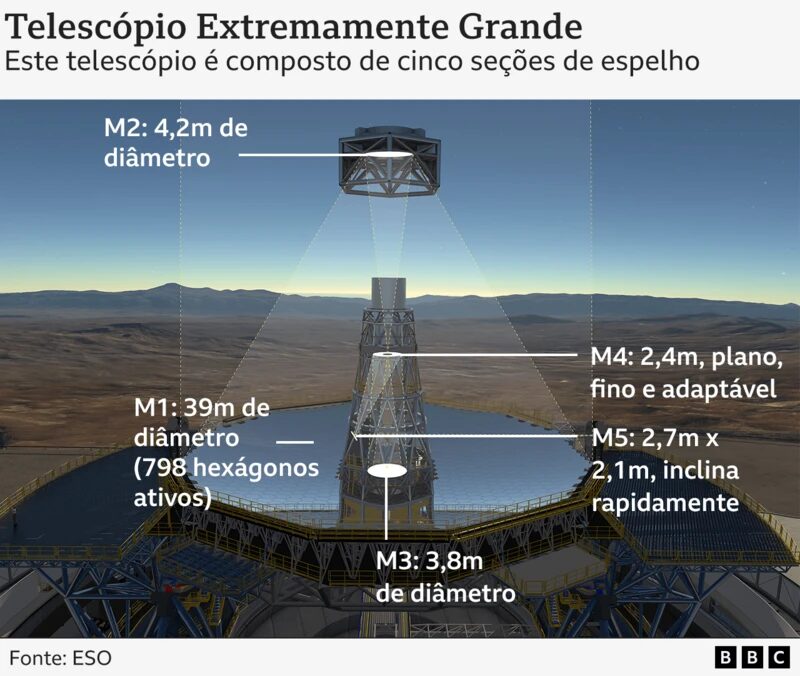
Each mirror of the ELT represents a feat in optical design. The primary mirror, known as M1, is the largest ever manufactured, with an impressive diameter of 39 meters.
Composed of 798 hexagonal segments, this mirror captures 100 million times more light than the human eye and maintains its shape with a precision 10,000 times greater than the thickness of a human hair.
According to Elise Vernet, an adaptive optics specialist at ESO, M1 is the heart of the telescope. “This mirror will allow the ELT to reveal details of the cosmos never seen before,” says Vernet. But M1 is not the only mirror to impress.
The secondary mirror, M2, with a diameter of 4.25 meters, is described as a true work of art, while M4, the largest deformable mirror ever created, can adjust its shape 1,000 times per second to correct distortions caused by the atmosphere.
These giant mirrors, which are being finalized in Europe, will soon be shipped to Chile, where they will begin capturing light from the cosmos. The precision of these mirrors is such that they can reveal details as small as a golf ball seen from the Moon.
The Quantum Mirror And The Technological Revolution
While the ELT represents a milestone in astronomical observation, advancements in other areas of science are also changing our relationship with light and optics.
In 2020, a team from the Max Planck Institute for Quantum Optics in Germany succeeded in creating a quantum mirror made up of only 200 aligned atoms.
This mirror, invisible to the naked eye, reflects light in ways that could revolutionize quantum technologies, such as hacker-proof communication networks.
Pascal Weckesser, a researcher at the institute, explains that this quantum mirror can control the direction of reflected light, opening doors to new technological applications.
In 2023, the team was able to take a step further, creating a quantum switch that can determine whether the atoms reflect or transmit light. This advancement could have significant implications in areas such as quantum computing and data security.
Ultrathin Mirrors And The Race For More Powerful Chips
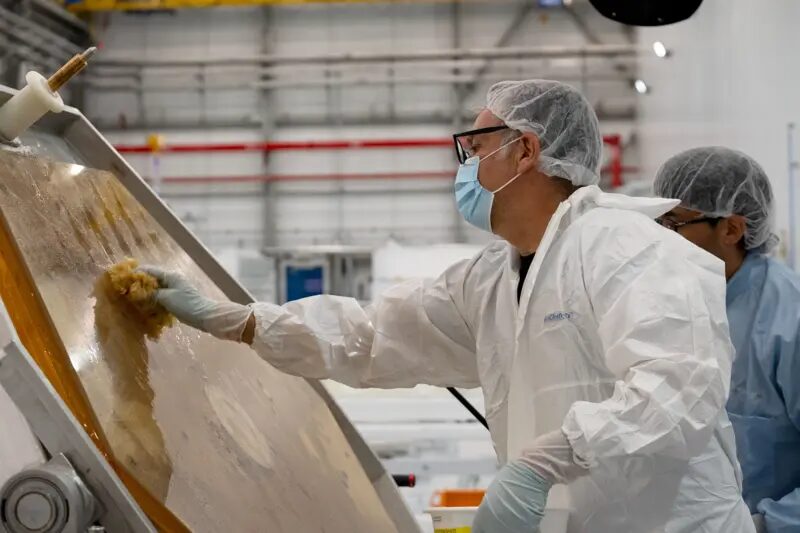
The quest for perfection in mirror manufacturing is not limited to astronomy and quantum physics. In Germany, the company Zeiss is at the forefront of producing ultrathin mirrors, essential for extreme ultraviolet lithography (EUV).
These mirrors, used in the manufacture of computer chips, are so flat that, if scaled up to the size of Germany, the largest height variation would be just 0.1 mm.
Frank Rohmund, president of Zeiss’s semiconductor manufacturing department, compares this precision to reflecting light from a mirror on Earth and identifying a golf ball on the Moon.
“These mirrors are crucial for the next generation of microchips, enabling the development of even more advanced technologies,” says Rohmund.
Zeiss has ambitious plans for the future. By 2030, the company expects its ultrathin mirrors to help create chips with a trillion transistors, paving the way for advances that today seem straight out of science fiction movies.
The Future Of Science And Technology: A Journey Guided By Light
What these developments have in common is the ability to transform light into a powerful tool for exploring, creating, and innovating.
What awaits us in the next ten years is uncertain, but one thing is clear: mirrors, in their many forms, will continue to be central in the technologies that will define our future.
With science advancing by leaps and bounds, it is no exaggeration to say that we are entering a new era of discoveries, guided by the light reflected by these extraordinary mirrors.
Do you think the Extremely Large Telescope and advancements in optical technology can reveal secrets of the universe that will change our understanding of the cosmos? Comment below!






Sensacional, Pura Tecnologia !
https://www.lugarcertoimoveis.com.br/imovel/arte-design-residencial/