Portuguese
  Spanish


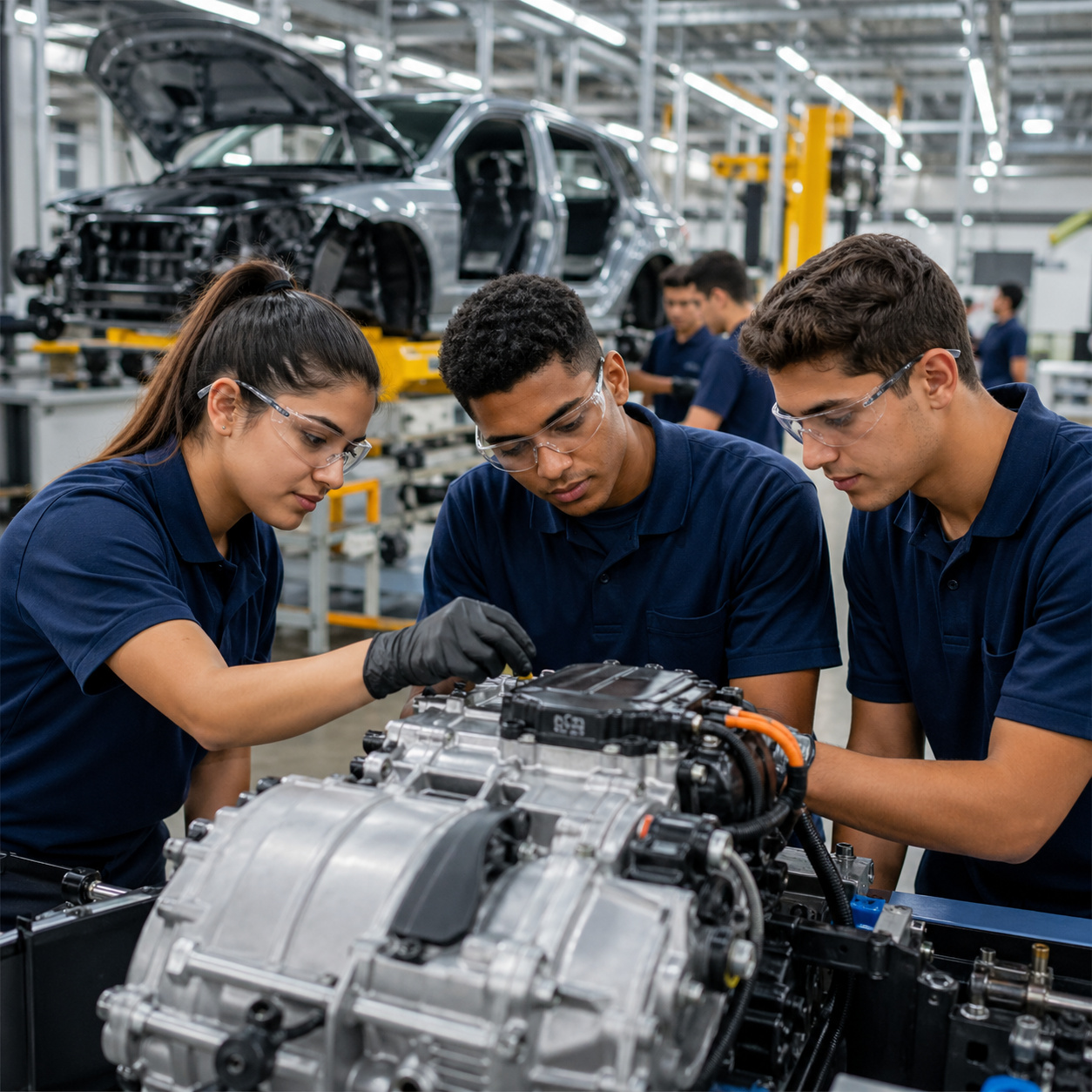

Partnership between SENAI, CN-SESI, and Volkswagen strengthens professional training for the automotive industry and technological innovation.
The union between SENAI, CN-SESI, and Volkswagen represents a strategic move to strengthen the **training of professionals** geared towards the new demands of the **automotive industry**. The agreement was signed at the automaker’s global headquarters in Wolfsburg, Germany, and comes at a decisive moment for the industrial sector, marked by profound technological transformations.
The initiative aims to prepare workers to deal with advancements such as automation, digitalization, and vehicle electrification. By uniting education and industry, the project seeks to reduce the gap between what the market needs and what professionals currently offer.
SENAI, CN-SESI, and Volkswagen advance in professional training for the modern automotive industry
The partnership between **SENAI**, **CN-SESI**, and **Volkswagen** was designed to meet the real demands of the **automotive industry**, which is undergoing an accelerated transition. The focus is on creating educational programs connected to future competencies, with an emphasis on technology and innovation.
-
Half of Brazilians Prefer Lower Taxes with Private Health and Education, While 44% Opt for Higher Taxes for State-Provided Services, Datafolha Survey Reveals

-
Brazil’s Most Expensive Toll Rises to R$ 40.60 on Route from São Paulo to the Coast, Nearly Matching Bus Fare to Santos

-
As Brazil Expands Social Welfare, Survey Reveals 40% Blame Poverty on Laziness, While 58% Cite Lack of Opportunities

-
China Tightens Control on Antimony, Driving Prices from $22,000 to Nearly $40,000 per Ton as U.S. Rushes to Bolster Strategic Reserves



The agreement includes practical actions that go beyond traditional training. Key points include:
- Development of courses aligned with industrial needs
- Incentive for research, development, and innovation
- Creation of more technological learning environments
- Expansion of access to quality professional education
This integrated approach reinforces the role of **SENAI** and **CN-SESI** as pillars of industrial qualification in Brazil, now with the direct support of one of the world’s largest automakers.


Transformations in the automotive industry demand a new generation of qualified professionals
The **automotive industry** is experiencing a scenario of technological disruption. The transition to electric, hybrid, and connected vehicles is redefining production processes and demanding new **professional training**.
In this context, leaders involved in the agreement highlighted the urgency of qualification. Ricardo Alban, president of the National Confederation of Industry, emphasized that the partnership expands an already consolidated relationship and strengthens the technological development of Brazilian workers.
Fausto Augusto Junior, head of the SESI council, emphasized that qualification needs to keep pace with industrial changes, also including aspects related to health and well-being in the workplace.
This transformation is not just technical. It also involves behavioral and cognitive changes, requiring more adaptable professionals prepared for continuous learning.
History between SENAI and Volkswagen reinforces impact on professional training
The collaboration between **SENAI** and **Volkswagen** has lasted over **53 years**, consolidating itself as one of the most relevant partnerships in **professional training** for the Brazilian **automotive industry**.
Over this period, more than **7,000 students** have been trained, contributing directly to the sector’s development. This history demonstrates that the integration between education and industry generates concrete results.
Another important point is the pioneering role in the inclusion of women in the industry, expanding diversity and promoting greater equity in the industrial environment.
The modernization of teaching spaces is also part of this trajectory. An example is the structure installed within the Volkswagen Anchieta unit in São Paulo, which allows for more practical training aligned with the reality of factories.
SENAI, CN-SESI, and Volkswagen bet on technology and innovation in the automotive industry
The new phase of the partnership between SENAI, CN-SESI, and Volkswagen expands its focus on innovation. The training of professionals now includes strategic areas that are shaping the future of the automotive industry.
Among the main topics covered are:
- Vehicle electrification
- Advanced industrial automation
- Digitalization of production processes
- Application of artificial intelligence
Alexander Seitz, Volkswagen executive for South America, highlighted that the industry is undergoing a significant transformation and that understanding these new fields is essential to ensure sustainable growth.
This vision reinforces the importance of preparing workers not only for the present but also for future challenges.
Business mission and international cooperation expand industrial opportunities
The agreement was signed during a Brazilian business mission to Germany, which brought together more than 260 industry representatives. The delegation participated in Hannover Messe, considered the world’s largest industrial technology fair.
In addition, the group was present at the 42nd Brazil-Germany Economic Meeting, one of the main bilateral forums for the productive sector. The event was attended by President Luiz Inácio Lula da Silva and then-German Prime Minister Friedrich Merz.
The expectation is that this international rapprochement will contribute to expanding trade between the countries, which currently stands at around 20 billion dollars, with the potential to reach 40 billion dollars in up to 5 years, according to projections presented during the mission.
Direct impacts of the partnership on professional training and the job market
The partnership between SENAI, CN-SESI, and Volkswagen is expected to generate significant effects on the job market, especially in the automotive industry.
Among the main expected impacts are:
- Greater employability for qualified professionals
- Reduction of skilled labor shortages
- Increase in industrial productivity
- Strengthening of Brazilian competitiveness
Luiz Ricardo de Medeiros Santiago, representative of Volkswagen do Brasil, highlighted that professional qualification is essential to keep up with the modernization of the industrial park, which is undergoing a true technological transformation.
This movement reinforces the idea that investing in technical education is one of the most effective paths to economic development.
Professional training gains a central role in the future of the automotive industry
The training of professionals is consolidating as one of the main pillars for the advancement of the automotive industry. Without qualified workers, the adoption of new technologies becomes limited and less efficient.
The partnership between SENAI, CN-SESI, and Volkswagen aims precisely to avoid this scenario, promoting education more aligned with the real demands of the industry.
Among the strategic objectives of the agreement are:
- Expand access to professional education
- Modernize learning environments
- Integrate education, technology, and innovation
- Prepare professionals for emerging roles
This training model tends to generate long-term benefits, both for workers and for companies.
What this partnership reveals about the future of industry and professional qualification
The union between SENAI, CN-SESI, and Volkswagen signals an important shift in how professional qualification is viewed in Brazil. More than teaching technical skills, the focus is now on preparing complete professionals, capable of adapting to an environment in constant transformation.
The automotive industry, which has historically always been one of the pillars of the economy, increasingly demands technological knowledge and innovation capacity. In this scenario, the training of professionals ceases to be merely a necessity and becomes an essential strategy.
With a solid foundation built over decades and an eye towards the future, the partnership has the potential to directly impact the country’s industrial development, expanding opportunities, strengthening the economy, and positioning Brazil more competitively on the global stage.
With information from Portal da Indústria.