Portuguese
  Spanish


In Brazil, opening a McDonald’s store can require up to R$ 4.5 million, extensive training, payment of royalties, advertising, and rent. The franchisee operates under strict rules, delivers part of the revenue, and may end up without the location they helped to enhance after years of contract in a risky operation.
McDonald’s is seen by many entrepreneurs as one of the strongest brands in the world, but the path to opening a unit in Brazil involves a million-dollar investment, strict contracts, and costs that go beyond the burger. The model described in the source shows how franchisees can take on risk, operation, and daily management within a controlled structure.
In a video released by the channel Economia Oculta, on June 10, 2026, the discussion takes place in the Brazilian franchise market, when entrepreneurs try to enter a network associated with high sales volume, extreme standardization, and strong brand presence. According to the source, the investment can range from R$ 2.5 million to R$ 4.5 million, with training, royalties, advertising, rent, and long-term contracts.
The burger appears in the showcase, but the backstage involves the property
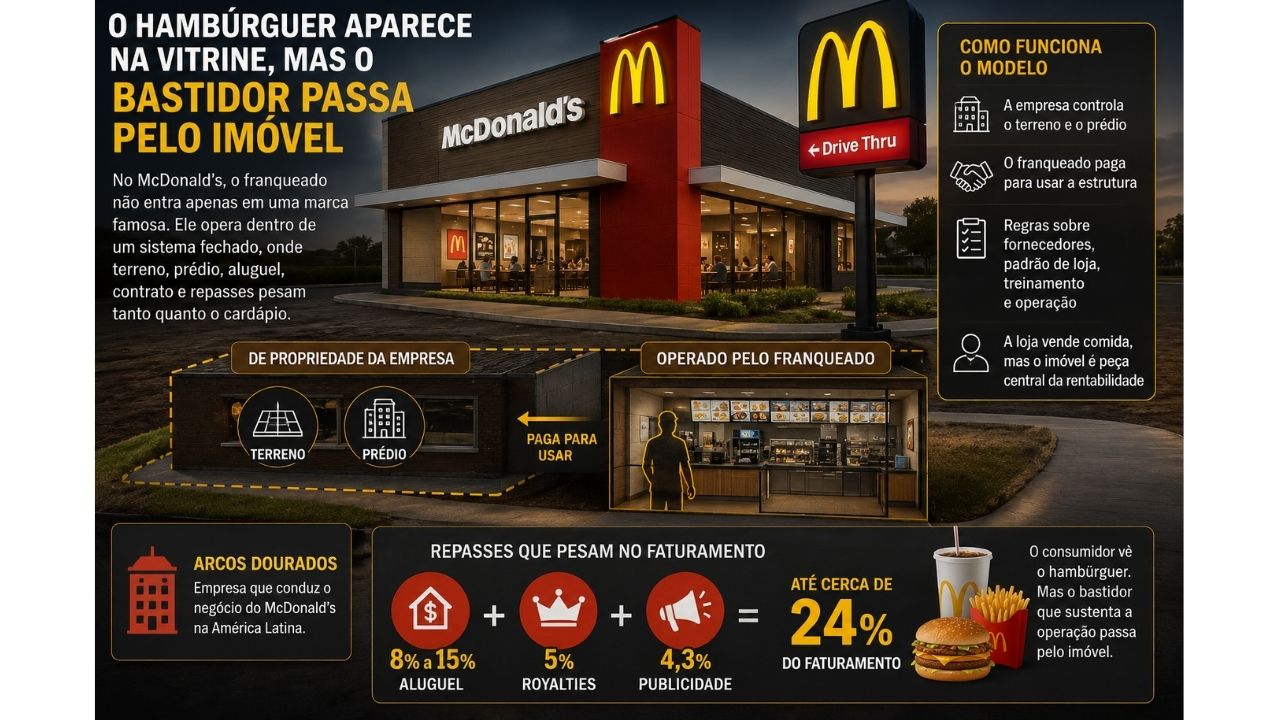
McDonald’s seems, to the average consumer, a network driven by sandwiches, fries, and soft drinks. However, the source describes a more complex backstage, where land, building, rent, and contract play a central role in the franchisee’s operation.
-
YouTuber Discovers Surreal Collection in 400-Year-Old Italian Fortress Near Florence: 419 Anvils, Giant Walruses, Ancient Church, and WWII Tunnels

-
Creative Uses for Toilet Paper Rolls That Will Change Your Perspective
-
Crab Trapped in Plastic Bottle for 62 Days Near Okinawa Highlights Little-Known Impact of Marine Pollution on Small Animals
-
Esperanza’s Bamboo Barrier in Oaxaca Redirects River and Reduces Erosion by 85% in Five Years



In Brazil, the operation is associated with Arcos Dourados, a company that appears in the source as responsible for conducting the business in Latin America. The franchisee does not just enter a well-known snack bar; they start operating within a closed system, with rules on suppliers, store standards, training, and transfers.
The most sensitive point is in the control of physical space. According to the source, the company controls the land and the building, while the franchisee pays to use the structure. This changes the business logic: the store sells food, but the property also becomes a central piece of profitability.
This model helps explain why rent weighs so much. The source cites rent between 8% and 15% of revenue, in addition to 5% royalties and 4.3% allocated to advertising. Combined, these transfers can reach close to a quarter of everything the unit sells before other expenses.
Million-dollar investment does not guarantee automatic entry
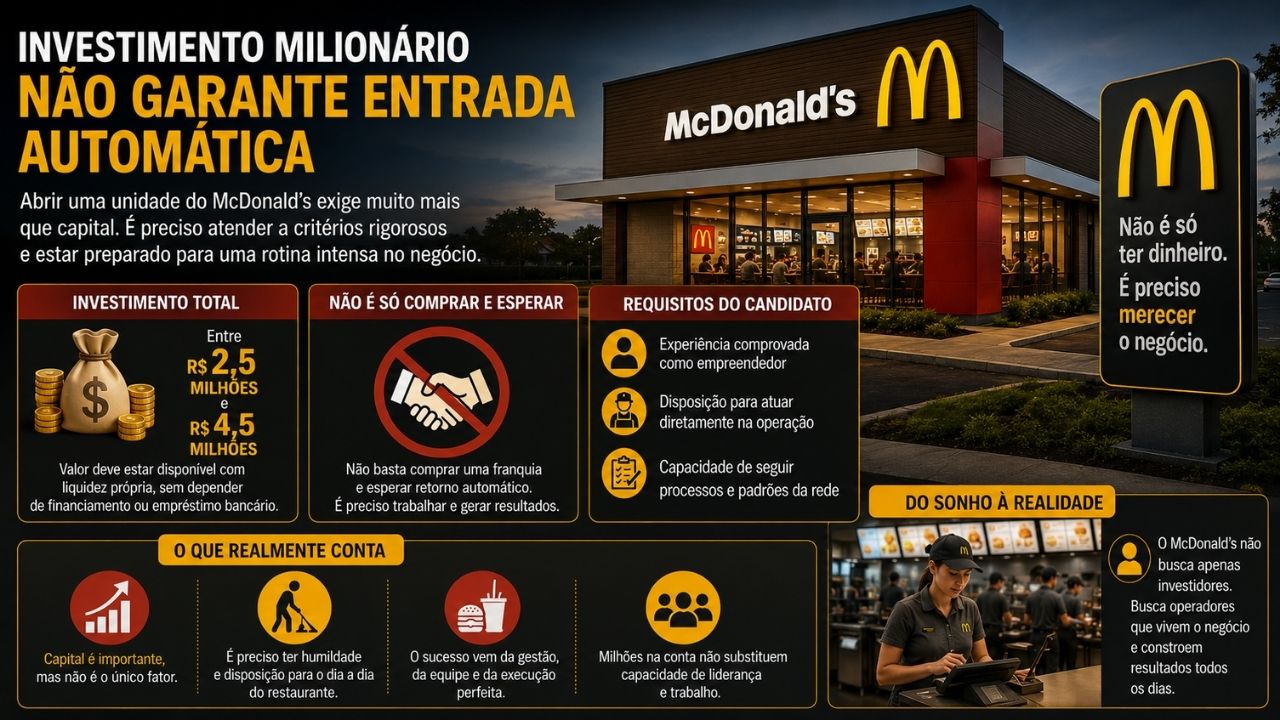
Opening a McDonald’s unit does not depend solely on having money. According to the source, the total investment can range from R$ 2.5 million to R$ 4.5 million, but this amount needs to be available with its own liquidity, without relying on financing or bank loans.
This filter already eliminates a good portion of those interested. Even entrepreneurs with capital need to meet additional requirements, such as proven experience as entrepreneurs and willingness to work directly in the operation, not just as passive investors.
The source states that it is not enough to buy a franchise and expect automatic returns. The candidate needs to accept an intense routine, follow processes, and prove that they can handle the operational base of the business.
This is where the brand’s glamour meets the reality of the shop floor. The interested party may have millions in the account, but still needs to demonstrate humility and management capability in the restaurant’s practical tasks.
9-month training tests more than knowledge
One of the most striking points described in the source is the training. The candidate for a McDonald’s franchisee may undergo at least 9 months of preparation, without receiving a salary during this period.
The proposal, according to the source, is to test whether the entrepreneur understands the operation from end to end. This includes functions that go far beyond analyzing spreadsheets, such as cleaning, customer service, kitchen, store routine, and standard control.
The training also functions as a behavioral filter. The network wants someone willing to follow processes and get hands-on, not just an investor who delegates everything and monitors the results from afar.
The risk is that the candidate spends months in the process and can still be rejected. For those looking from the outside, it seems like just a famous franchise; for those trying to get in, it can be almost like a high-cost emotional and financial business entrance exam.
Royalties, advertising, and rent bite into the revenue
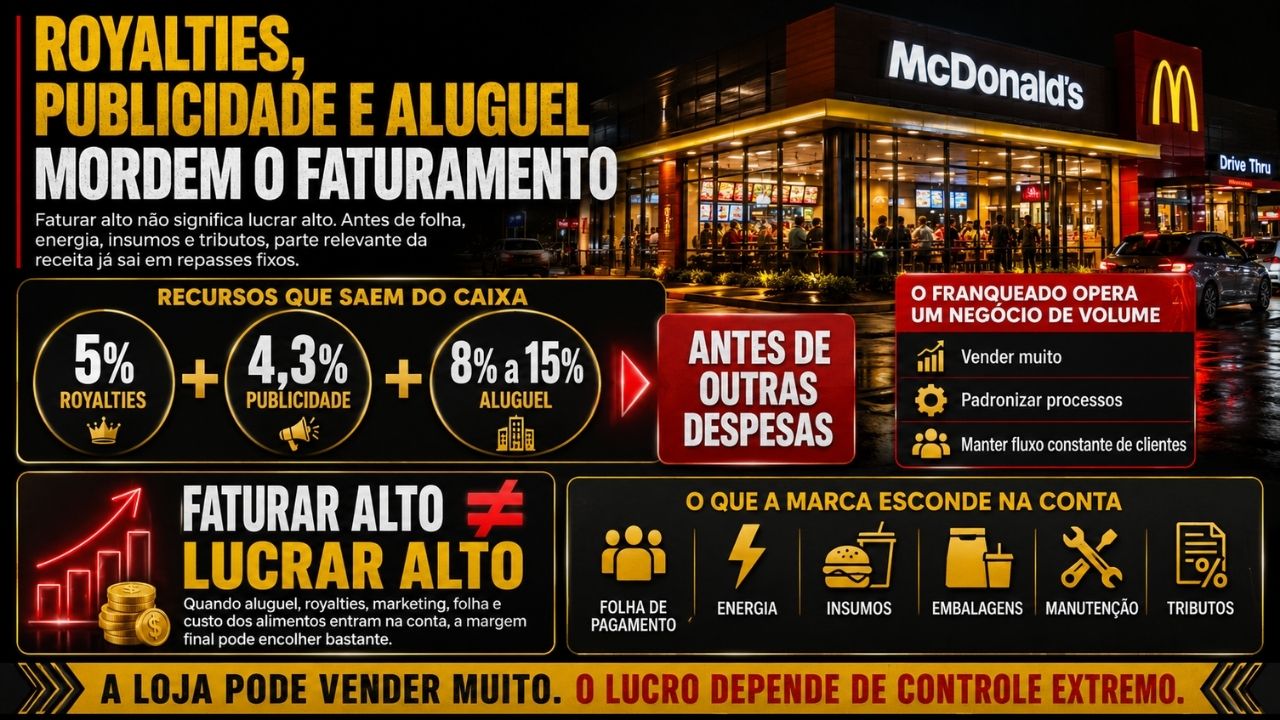
Once accepted, the franchisee does not keep all the money that enters the cash register. The source points out that McDonald’s charges 5% in royalties and 4.3% for advertising, in addition to rent which can vary from 8% to 15%.
This means that a significant portion of the revenue leaves even before expenses such as payroll, energy, supplies, packaging, maintenance, and taxes. The unit can sell a lot, but the final margin depends on extreme control.
The source presents the idea that the franchisee operates a volume business, not a high-margin one. In other words, the result depends on selling a lot, standardizing processes, and maintaining a constant flow of customers.
The problem is that high revenue does not mean high profit. When royalties, marketing, rent, payroll, and food costs are factored in, the net value can be much lower than the brand’s image suggests.
The store can generate high revenue and still require patience
The source cites different unit scenarios. A basic operation in the countryside could generate R$ 400,000 and leave about R$ 32,000 in the pocket, with a return on investment around 7 years. Meanwhile, a standard unit in a medium-sized mall could generate a higher monthly surplus and return in just over 4 years.
At the top, premium units in airports or luxury malls could exceed R$ 1 million in monthly revenue, with higher profit and faster return. But, in this case, the cost to enter also tends to be higher.
McDonald’s appears, therefore, as an operation that can be robust but not simple. The franchisee needs to accept a long term, high immobilized capital, and intense management to try to recover the investment.
The brand reduces part of the commercial risk, but does not eliminate the effort. The entrepreneur buys access to a recognized system but assumes costs, team, routine, goals, and pressure for standards.
Autonomy is limited within the system
When opening a McDonald’s unit, the franchisee enters a highly standardized model. The source points out that they cannot change ingredients, freely choose suppliers, alter lighting, or run the store as an independent restaurant.
This lack of autonomy is part of what sustains the network’s identity. Consumers expect to find a similar standard in different cities, and this requires strict control over the menu, process, delivery, and visuals.
On the other hand, this control reduces the entrepreneur’s freedom. They invest millions but end up executing a pre-designed model, with little room to test their own ideas.
In practice, the franchisee stops being a restaurant creator and becomes a system operator. For some, this is an advantage because it reduces improvisation. For others, it’s an expensive prison with a famous sign.
Delivery, kiosks, and efficiency help protect margin
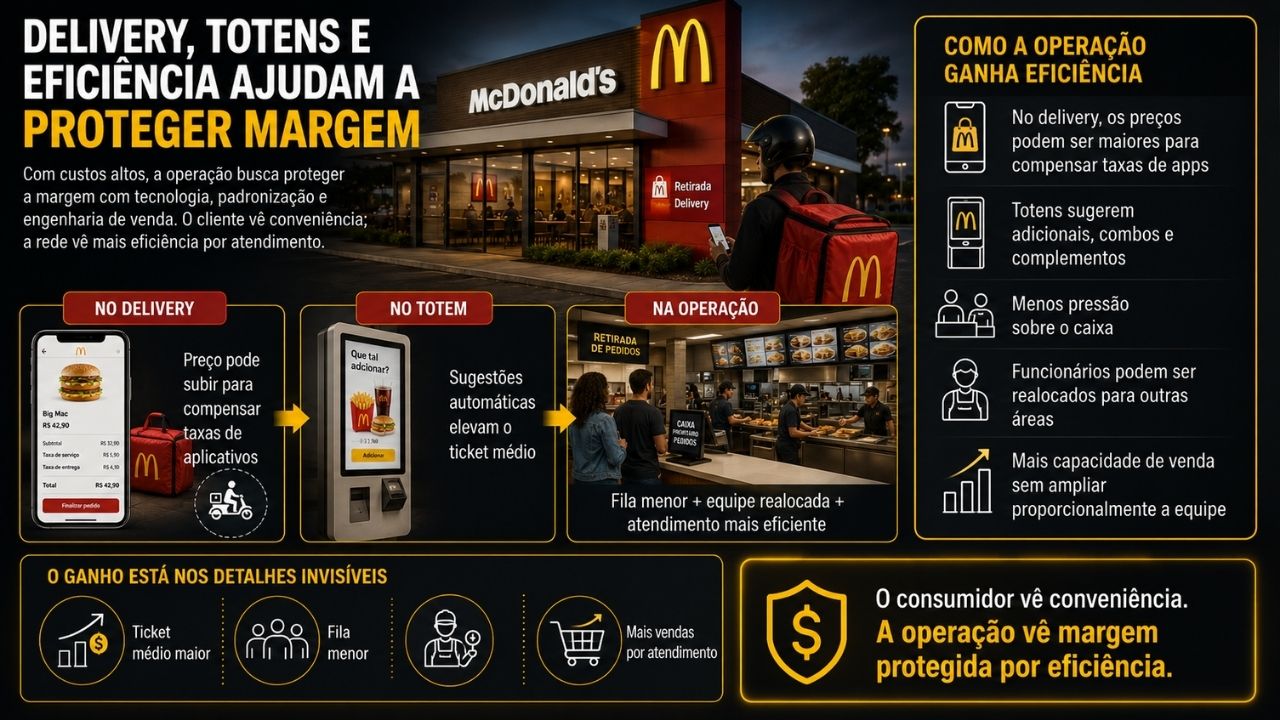
The source also highlights how McDonald’s tries to protect the operation in the face of high costs. In delivery, for example, prices may be higher than at the counter to compensate for app fees, like iFood’s.
Another important element is the self-service kiosk. According to the source, it increases the average ticket by suggesting add-ons, combos, and extras, as well as reducing pressure on the cash register and reallocating employees to other areas of the store.
These tools show that the network does not rely solely on brand strength. It uses technology, standardization, and sales engineering to try to extract more efficiency from each service.
The gain is in the details invisible to the customer. The consumer sees convenience; the operation sees an increase in average order, shorter lines, reallocated workforce, and more sales capacity without proportionally expanding the team.
Employees, scale, and processes also weigh on the risk
Managing a McDonald’s unit is not just about selling snacks. The source describes operations with dozens of employees, in a sector marked by turnover, constant training, and labor risks.
A standard store may require management of team, scale, kitchen, service, cleaning, stock, suppliers, quality control, and pressure for speed. Any operational failure can affect margin, reputation, and customer experience.
Additionally, commodity costs, such as meat and oil, can pressure profitability. The source points out that if prices rise, the margin can be squeezed, especially since the franchisee does not have full freedom to change values without authorization.
This is the least visible part of the business. The public sees the line, the sandwich, and the counter; the franchisee faces payroll, scheduling, inventory, training, auditing, standards, and legal risk.
The end of the contract can become the hardest part


The most delicate point from the source is at the end of the contract. After 10 or 20 years, renewal would not be automatic. If the unit is healthy and the location has become strategic, the franchisor may choose not to renew, according to the presented report.
In this scenario, the franchisee does not keep the land or the building. They may leave the operation and receive only for the equipment according to the stipulated rules, with value reduced by use over the years.
That’s why the source uses the image of the “luxury tenant.” The entrepreneur helps consolidate the store, works to enhance the location, builds customer flow, and in the end, may not control the future of that address.
The emotional risk is there: creating a strong business in a space that was never really yours. The brand continues, the location continues, the consumer continues, but the franchisee may leave the game.
The business may be worth it, but it is not for every profile
Even with risks, McDonald’s can attract entrepreneurs due to the brand’s weight, customer flow, and the strength of the system. For those willing to operate under strict rules and seeking predictability in a global network, the model can make sense.
But it is not an investment for those who desire total freedom, menu creation, autonomy over suppliers, or passive income. The source makes it clear that the candidate needs to work, adhere to standards, and endure an intense routine.
The business requires capital, time, discipline, and acceptance of limits. In return, it offers access to one of the most recognized brands on the planet, with tested processes and high consumer attraction power.
The question is not just if it makes money. The question is whether the entrepreneur accepts the operational, financial, and psychological cost of entering this system.
Would you have the courage to invest millions to operate a McDonald’s store with such strict rules, or would you prefer to use that money in a business with more freedom? Leave your opinion in the comments.