






 Portuguese
  Spanish
  2 min of reading
  0 comments


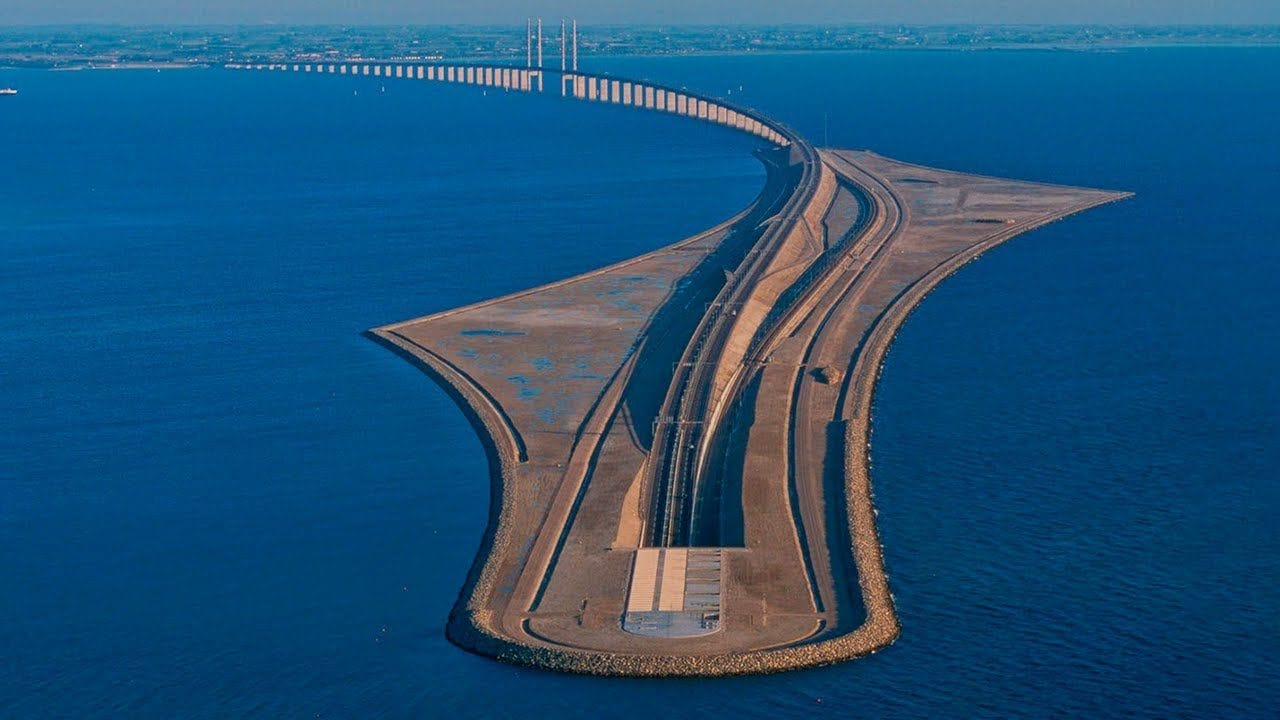
From Impossible Challenge to Impressive Reality, Discover the Story and Details of the Bridge-Tunnel That Revolutionized Europe
A megaproject that seems like something out of a Tarantino movie, but is pure reality: the Öresund Bridge, this engineering marvel that connects Denmark and Sweden. Denmark, known for its breathtaking landscapes and delicious chocolate, and Sweden, with its cold climate and rich culture, decided to unite in an audacious project.
And It Worked! The Öresund Bridge is One of the Most Innovative and Successful Constructions in Modern Engineering
This beauty has a 8 km length, including a roadway and railway that dives into a 3.5 km underwater tunnel. In total, there are 12 km connecting the two nations, and that’s not all: the bridge has one of the largest spans in the world, measuring 490 m, and a pillar height of 204 m. Is that easy or do you want more?
The idea of connecting Denmark and Sweden across the Øresund Strait had been studied for some time. In 1991, the governments of both countries hammered out the details and decided it was time to make this dream a reality, choosing Copenhagen and Malmö, the two largest cities in the region, as the connection points.
-
Without a mansion, without high investment, and without a traditional classroom, a teacher living in a 22 m² house taught students to build a 9 m² studio apartment with the equivalent of R$10,000.

-
Largest bridge in São Paulo reaches 75% completion and is expected to strengthen strategic connection in the interior of São Paulo.

-
Without her own home and pressured by rent, a 25-year-old bought a small 15-meter boat, gradually renovated the interior by herself, transformed the interior with paint, new flooring, a larger bathroom, and started living on the canals, paying much less per month.
-
Tired of seeing families sleeping on the street, São Paulo delivered 18 m² furnished microhouses and took 888 people off the streets: Vila Reencontro became the model social housing for the homeless population.


The Challenges of the Megaproject
Dubbed “the impossible bridge,” the construction began in 1995 and was a true puzzle. The engineers had to get creative to overcome the obstacles of this megaproject, such as the need for a structure that allowed large ships to pass and the proximity to Copenhagen Airport.
One of the big tricks was the creation of an artificial island, Peberholm, which served as the starting point for the tunnel. This island was built with dredged materials from the sea floor. Seriously, isn’t it an engineering masterpiece?


Before Deadline and Within Budget
The bridge was completed six months ahead of schedule and respected the budget of $4.5 billion. This shows that, with planning and teamwork, it’s possible to achieve wonders.
Today, the bridge not only makes life easier for those traveling between Copenhagen and Malmö, but it has also become a tourist attraction. Moreover, it is an example of how large projects can be successful with planning and cooperation.
Here in Brazil, we are keeping an eye on a similar megaproject to connect Santos and Guarujá. If all goes well, who knows, we might have our own “impossible bridge”?


Be the first to react!