Portuguese
  Spanish


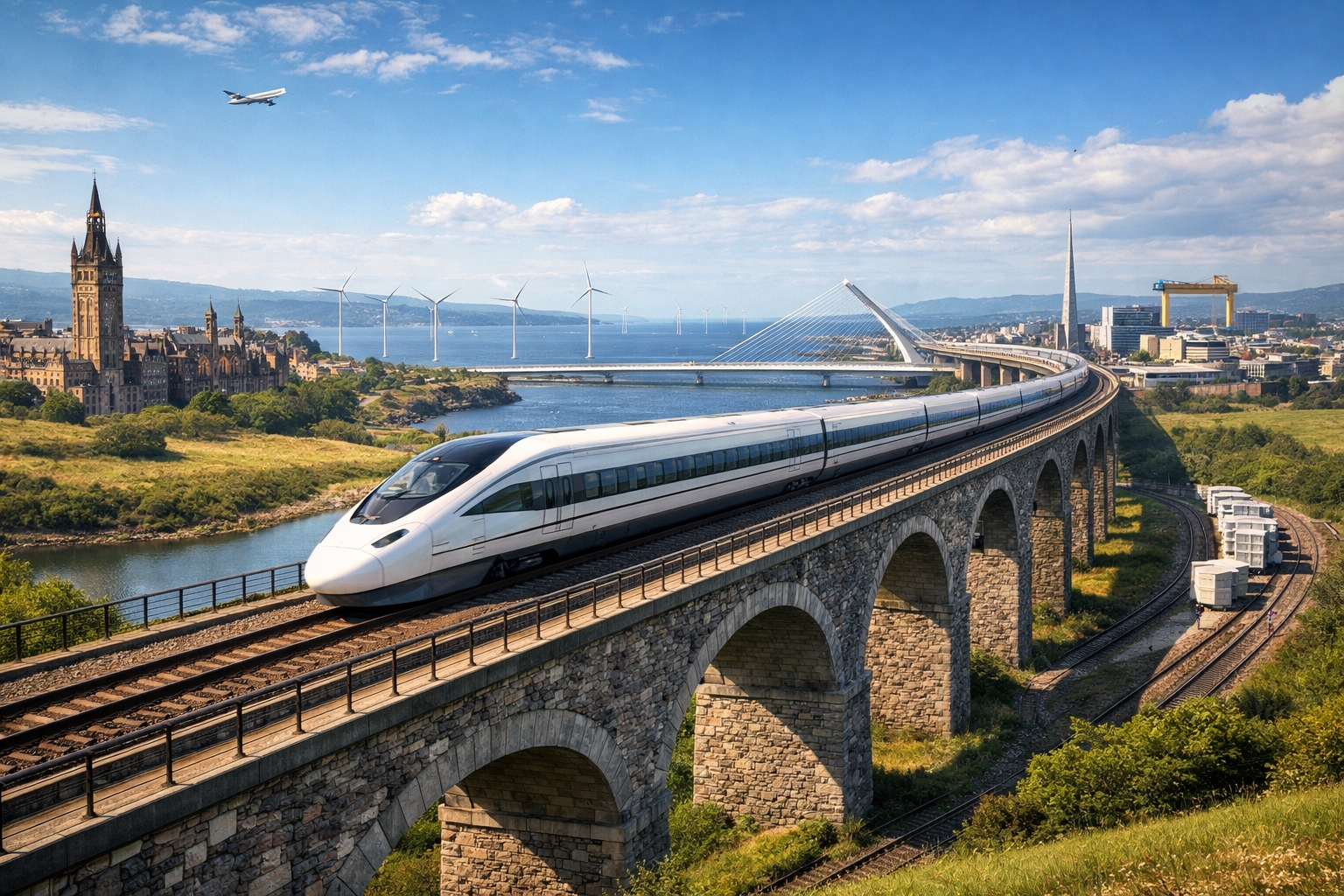


In Great Britain and Ireland, Chris Williamson Presented a Megaproject for High-Speed Rail Connecting 9 Cities, Trains Every 5 Minutes, and Speeds of Up to 480 km/h to Increase Connectivity, Provoking Economic Impact and Drawing Attention from Authorities and the Infrastructure Sector.
The idea is the kind that makes you stop to imagine the map in your head. A high-speed rail megaproject, in the form of a ring, connecting nine urban centers of Great Britain and Ireland into a single system.
The plan was put into circulation by Chris Williamson, president of RIBA. The proposal goes by the name of Northern Loop, which can be translated as a northern ring, and it starts from a very direct point: instead of cities competing for public money as isolated islands, the priority should be connectivity and collaboration.
The visual detail that stands out the most is the way the tracks would appear in the territory. Instead of large cuts into the landscape, the line would be elevated by arches made of locally sourced stone, creating flat and straight sections, exactly the type of geometry that high speed demands.
-
Brazilian Farmer Turns to Artisan Baked Goods After Poultry Venture Fails in Rural Bahia

-
Japanese Botanist Akira Miyawaki Plants 30,000 Trees on a Tennis Court-Sized Plot, Intentionally Sacrificing Many to Accelerate Forest Growth; Miyawaki Method Has Spread Over 40 Million Trees Across 15 Countries

-
Couple Converts Retired U.S. Navy Research Barge into Off-Grid Floating Home on Idaho Lake with DIY 3-Stage Water Filtration System Using UV Light
-
Brazilian Military Police Officer Turns Family Farm into Internationally Certified Guava Producer, Eyes Exports to UK, Portugal, and Canada After Cooperative Boosts Sales by 580%




What Is the Northern Loop and Why Did the Proposal Become a Topic in the British Isles?
The Northern Loop was presented as a high-speed rail megaproject that would connect Glasgow, Edinburgh, Newcastle, Leeds, Manchester, Liverpool, Bangor, Dublin, and Belfast. Nine cities, one continuous line, a design intended to reduce distances and change the logic of commuting in the region.
Williamson describes the project as the foundation of a global city “dispersed but connected,” with about 10 million inhabitants. The idea is for these urban centers to function as an integrated ecosystem, with a constant circulation of people, work, and specialization.
According to him, the inspiration came from the scale and ambition of the project The LINE in Saudi Arabia, where he worked on high-speed stations linked to a linear city of 170 kilometers.
Nine Cities on the Route, Trains Every 5 Minutes, and Speeds of Up to 480 km/h
The proposal puts large numbers on the table. The plan foresees trains running every five minutes and reaching speeds of up to 300 miles per hour, equivalent to about 480 kilometers per hour.
The practical effect of this is the kind of comparison that helps anyone understand the scale. The documentation states that a journey from Edinburgh to Manchester could take less time than crossing Los Angeles. The phrase works as both provocation and message: the intention is to reduce commuting times to an unusual level for those who live the current rail routine.
And there is one point that weighs in the debate: Williamson confirmed on February 8 that the proposal was submitted for the 2026 summer exhibition at the Royal Academy, which puts the project on the public and institutional radar, even though it is still just a proposal.
Stone Arches Elevating the Tracks and the Engineering Behind the Route
The project does not just sell speed. It tries to sell visual and territorial viability. The proposed solution is to elevate the tracks above the landscape using arches made of locally sourced stone, reducing direct interference with the terrain and creating the kind of straight, flat path that a high-speed line needs to function properly.
This type of choice also resonates with social acceptance. Elevated tracks can reduce barriers on the ground, decrease crossings, and prevent extensive cuts into the landscape, although the text does not detail licensing, expropriations, or environmental impact with firm numbers.
The engineering consultancy Elliott Wood has been involved in the proposals from the beginning, reinforcing that this is not just a conceptual design without technical support.
The Plan That Uses the Rail Corridor to Distribute Energy, Beyond People
Here comes a layer that tends to give infrastructure projects another significance: energy. The copies of the proposals indicate that alongside the rail system, there would be a continuous infrastructure capable of collecting and redistributing energy from onshore and offshore wind sources, in addition to small modular reactors positioned at strategic nodes.
This changes the tone of the project. It shifts from being just about transportation to becoming a corridor for services, with the potential to integrate energy production and distribution into a single axis, something that, in theory, could strengthen energy security and support a more robust network.
The documentation also points out that connecting centers of specialization in these nine cities would further amplify the economic impact. The logic is simple: when knowledge circulates with less friction, business and innovation tend to spread more quickly.
How Much Would It Cost, What Does It Promise to Deliver, and Why Does the Ghost of HS2 Return to the Conversation?
Williamson suggests that the Northern Loop would cost £130 billion to build and would generate £12 billion per year in economic benefits.
It is a figure that grabs attention but inevitably pulls comparisons with what the UK is already experiencing today with its second high-speed line.
The country is constructing phase one of High Speed Two, known as HS2, which is expected to connect Old Oak Common in London to Birmingham. The British government has already classified HS2 as a “terrible mess,” and the project does not have a defined completion date. The latest estimates suggest costs of up to £80 billion just for this first phase.
This is where the debate intensifies. On one side, the idea of a vision that inspires and reorganizes the economy. On the other, the recent history of budget overruns and indefinite timelines in railway megaprojects.
Amid this, the detail that sets the tone of the discourse is the appeal for ambition. Williamson says that Great Britain needs a vision capable of regenerating the economy and restoring confidence, recalling the time when architects published manifestos and floated grand ideas, even when they didn’t get everything right.
At its core, the Northern Loop emerges as a proposal that seeks to reposition the north of the British Isles within a network logic, with high-speed transport, elevated infrastructure, and even energy distribution within the same corridor.
And after all, does a rail ring with trains every five minutes and 480 km/h seem like a vision for the future or just a project that collides with the budgetary realities of the present? What caught your attention the most about this megaproject? Share your opinion with us in the comments.