Portuguese
  Spanish


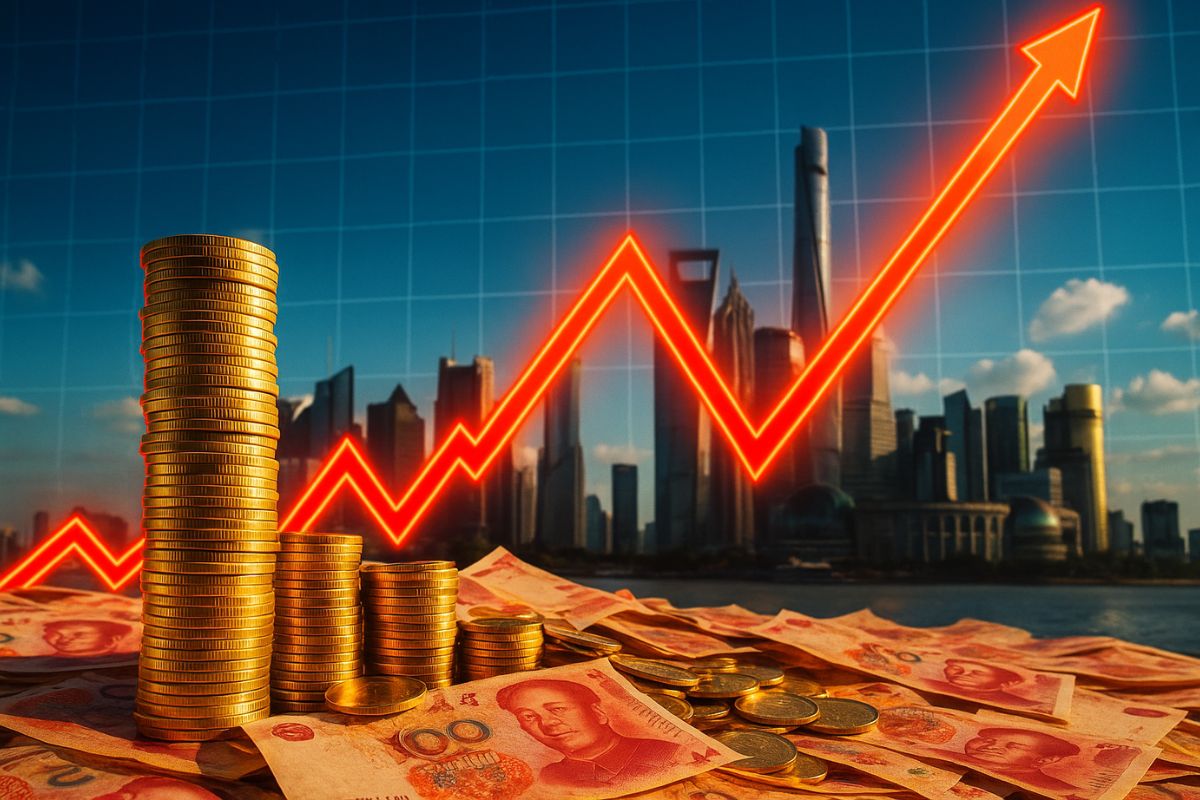

China’s Stock Market Surpasses 100 Trillion Yuans and Reaches New Historical Milestone. With Rising Indices and Influx of Individual Investors, China’s Stock Market Reaches a Capitalization of US$ 14 Trillion.
The China’s stock market surpassed, on August 18, the mark of 100 trillion yuans (approximately US$ 14 trillion), according to data released by Poder360. The increase reflects more active trading, greater investor confidence, and a continuous flow of foreign and domestic capital.
The milestone is considered strategic for Beijing, which seeks to consolidate the role of the Chinese stock exchange as one of the largest in the world. Experts point out that the combination of economic reforms, interest rate cuts, and government stimulus has been crucial in attracting new investors and sustaining the appreciation.
Indices on the Rise and Historical Records
The Shanghai Composite Index, the main benchmark of the Chinese market, rose 0.85%, reaching 3,741 points, the highest level in ten years. Meanwhile, the BSE 50 Index, aimed at innovative small and medium-sized enterprises listed in Beijing, recorded an increase of 6.79%, closing at a historic high.
-
Tesla injected an additional $250 million into the German factory, doubled the battery cell target, and opened its own production line for startups.

-
A 180-meter ship with a deck the size of a football field was christened to carry 25,000 tons of giant energy modules around the world.
-
To erect the “Baleia” building on the richest avenue in Brazil, he bought 35 houses, paying with trips to Disney, a truck, and even an apartment, waited over 20 years, and today the complex is valued at R$ 2.5 billion.
-
The land belonged to her great-great-grandfather and was worth R$ 25 per square meter during the pandemic; the couple sold 250,000 m² for the nearly R$ 30 billion project that is transforming the “neighbor of Jericoacoara,” and today a house in the region goes for R$ 4.2 million.


According to analysts, the performance shows that there is room for the continuation of the rise, especially with the expansion of reforms that strengthen returns for investors and with the international environment more favorable to the Chinese economy.
The Role of Reforms and the Central Bank
According to the People’s Bank of China (PBOC), there has been progress in the role of the capital market as a source of financing for the real economy. The share of direct financing that includes stocks, corporate bonds, and government bonds rose from 26.7% in 2018 to 31.1% in June 2025.
This change reinforces Beijing’s goal to reduce dependence on bank credit and create a more dynamic market for companies and investors.
Individual Investors and Foreign Capital
Another factor driving the market is the strong influx of individual investors. In July alone, the number of new stock accounts opened grew by 71% compared to the previous year. Additionally, there was a 39% increase in the monthly volume of funds invested by individuals, according to data from Sinolink Securities.
Foreign institutions and long-term funds have also increased their participation, reinforcing the perception that Chinese assets offer good return opportunities amid the country’s economic transformation.
Global Impact of the Appreciation
The advancement of the China’s stock market reinforces the country’s weight in global financial geopolitics. With greater liquidity, regulatory reforms, and growth in the number of investors, Beijing consolidates its stock exchange as a competitive alternative against markets like Wall Street and Europe.
Experts assert that if the trend continues, China could enhance its capacity to attract international investments and reduce external vulnerabilities in strategic sectors.
The surpassing of the 100 trillion yuan mark demonstrates the strength of China’s capital market in the global arena. With more investors coming in and the government reinforcing stimulus measures, the sector is expected to continue growing in the coming months.
And you, do you believe that the strengthening of China’s stock market could alter the global economic balance? Leave your opinion in the comments – we want to hear from those closely monitoring the impacts of this transformation.