






 Portuguese
  Spanish


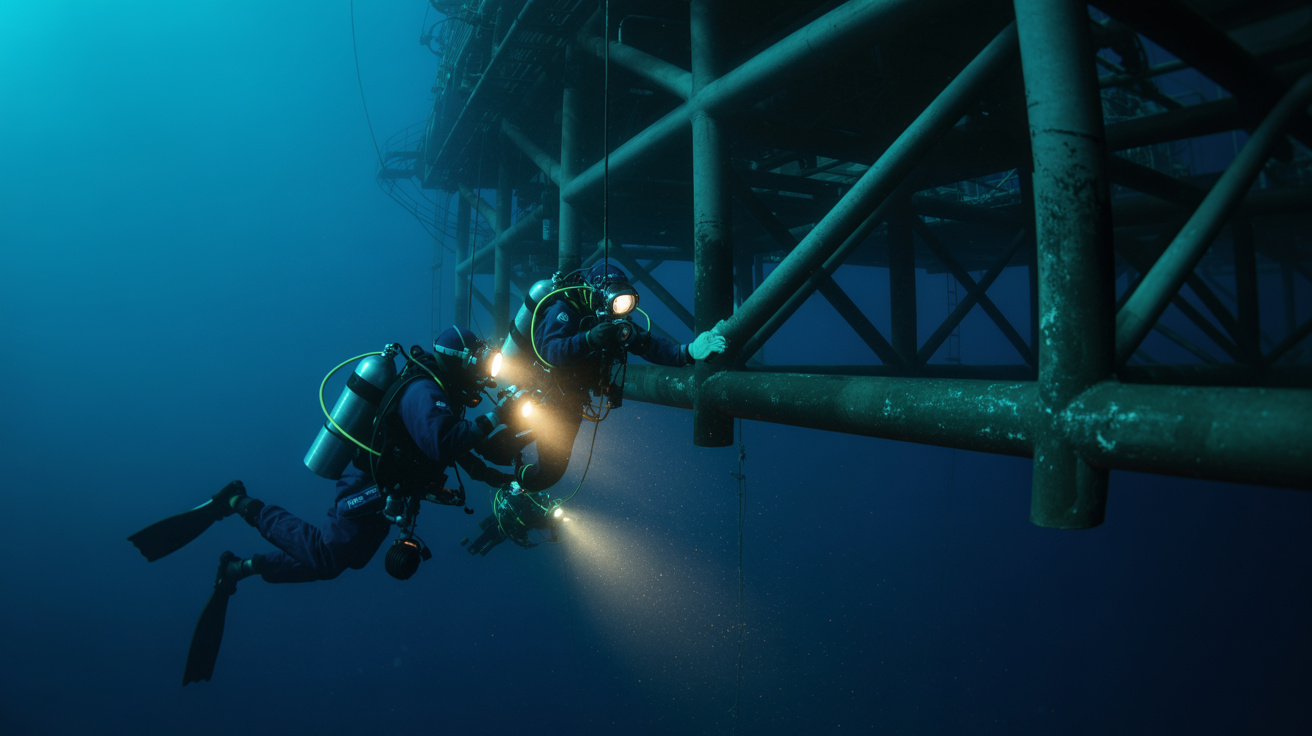


Saturation Divers Live Up To 28 Days In Pressurized Chambers And Work 300 Meters At The Bottom Of The Sea For Salaries Reaching US$ 45 Thousand Per Month On Offshore Platforms.
Could you live 28 consecutive days locked in a pressurized chamber the size of a small bathroom, breathing an artificial mixture of helium and oxygen that makes your voice sound like a cartoon character, without seeing sunlight, without taking a normal shower, sleeping in a cramped bunk with three other sweaty men, working 8 to 12 hours a day at a depth of 300 meters in near-total darkness? It sounds torturous. But that’s exactly what saturation divers routinely do to earn salaries ranging from US$ 30 thousand to 45 thousand per month. They are the highest-paid professionals in the world of commercial diving, but they also pay the highest price with their own health and longevity.
These divers work on oil platforms in the North Sea, Gulf of Mexico, and other offshore regions, performing critical maintenance, repair, and construction tasks at depths where a conventional diver would spend more time decompressing than working.
What Is Saturation Diving And Why Does It Exist
Saturation diving was developed in the 1960s by the U.S. Navy and commercial diving companies to solve a massive problem. When you dive deep, your body absorbs nitrogen (or helium, in deep dives). The deeper and longer you stay, the more gas is absorbed.
-
Bruno Guimarães, 28, Misses Crucial Penalty Against Norway in World Cup After Replacing Vinicius Jr.

-
Inspired by a school lesson on Africa’s water crisis, a young boy raised money through chores to fund a well that transformed a Ugandan community.

-
Brazilian Construction Worker Moves to France, Earns Up to €2,500 Monthly with Home Renovations, Gains Social Media Attention

-
US Navy Sinks USS Oriskany with 230 kg of C-4, Creating World’s Largest Artificial Reef in 37 Minutes





Upon ascending, you need to decompress slowly to eliminate this gas without forming dangerous bubbles in the blood. At 300 meters deep, a dive of only 30 minutes would require several hours of decompression, stopping at different depths on the way back to the surface.
Making multiple dives a day would be impossible because you would spend the entire day decompressing. The brilliant solution was to keep the divers permanently under pressure for the duration of the project.
Once the body’s tissues are completely saturated with gas at the work depth (which takes about 24 hours), the necessary decompression time no longer increases, no matter if you stay another day or another 30 days down there.
So, the divers spend 28 days at the same pressure of the work depth, come out to work multiple times a day without needing to decompress between dives, and then do a single long decompression at the end of the mission.
How Life Inside The Chamber Works
The divers live in a hyperbaric chamber system installed on the support vessel’s deck. The system consists of three main parts: the living chambers where they sleep and eat, a transfer chamber, and the diving bell that takes them to the bottom of the sea.
All three parts are pressurized to the same pressure as the work depth. If they are working at 300 meters, the pressure inside the chambers is 31 atmospheres, equal to the pressure of the water down there.
The living chambers are metal cylinders with a diameter of 2 to 3 meters. Inside, there are stacked bunks, a small living area, a tiny toilet, and a hatch through which food is passed. Four to six divers share this cramped space for almost a month.
They breathe a mixture of helium and oxygen called heliox. Helium replaces nitrogen to avoid narcosis (nitrogen intoxication) at extreme depths. But helium makes the voice high-pitched and ridiculous, as if you had inhaled party balloon gas.
The temperature is kept high, around 30-32°C, because helium conducts heat much faster than normal air, and the divers would suffer from hypothermia if the temperature were normal. So they live sweaty and uncomfortable all the time.
The humidity is extremely high because there can be no ventilation. Everything gets damp and moldy. Skin infections like athlete’s foot and outer ear infections are extremely common. Virtually every saturation diver comes out with some form of fungal infection.
The Workday At 300 Meters Deep
The work shift begins when the divers enter the diving bell through the transfer chamber. The bell is a 2-meter-diameter metal sphere with thick windows and life support systems. It accommodates two divers at a time plus a technician who operates the bell.
A giant crane slowly lowers the bell 300 meters down to the ocean floor. The descent takes 10 to 15 minutes. Down there, it is completely dark except for the lights of the bell and the divers’ helmets.
The water at 300 meters is at 4°C. The pressure is overwhelming. A small leak in the suit can cause instant severe injury. The divers work in pairs, one in the water and the other in the bell as a backup and to help in emergencies.
They work 6 to 8 hours per shift, usually making two outings of 3-4 hours each. They use heavy hydraulic tools to weld pipes, inspect structures, install or remove equipment, repair damage.
Visibility can be zero. Sometimes they work completely blind, navigating only by touch and experience. Strong currents can sweep away equipment or the divers themselves. Dangerous marine life is present.
After the shift, they climb back into the bell to the living chambers. They change clothes, eat meals prepared by chefs on the ship and passed through the hatch, rest for a few hours, and then go out again.
They do this 7 days a week for 28 consecutive days. There are no weekends. There are no breaks. There are no rest days. It’s non-stop work for an entire month.
The Salaries That Compensate (Or Not) The Suffering
Saturation divers are among the highest paid in the world in the diving field. The numbers vary enormously by region, experience, and employer, but the amounts are always substantial.
In the North Sea (Scotland, Norway), where conditions are harshest and unions are strongest, experienced divers earn £600 per day of work plus £37 per hour while under pressure. This results in a rough total of £1,500 per day (about R$ 11 thousand) during the 28 days in saturation.
One month of work yields £42 thousand (around R$ 310 thousand). Working 5 to 6 months a year, the annual salary easily reaches £100-150 thousand (R$ 740 thousand to 1.1 million).
In the Gulf of Mexico and other regions of the U.S., daily rates vary from US$ 300 to 600 per workday, plus US$ 20-40 per hour while in saturation. Veterans with specialized certifications can earn US$ 1,500 or more per day.
The annual average in the U.S. is around US$ 90 thousand to 150 thousand, but top performers working emergency contracts and specialized projects can exceed US$ 200-300 thousand per year.
In the Asia-Pacific region, particularly in offshore projects in Australia, daily wages can reach US$ 1,400. However, in less regulated areas like Iranian waters, Indian divers work for only US$ 300-400 per day.
It sounds like a lot of money. And it is. But when you consider that you are literally shortening your life expectancy and destroying your body with every dive, the balance becomes less appealing.
The Price The Body Pays: Dysbaric Osteonecrosis
The main long-term health risk for saturation divers is dysbaric osteonecrosis (DON), also called avascular necrosis. It is the death of portions of bone likely caused by bubbles of nitrogen or helium blocking blood flow inside the bone.
The incidence is alarming. Studies show that up to 50% of Japanese commercial divers develop DON. Among Hawaiian dive fishermen, the rate reaches 65%. In the UK, 16% of commercial divers and coffin workers have detectable bone injuries.
Osteonecrosis primarily affects long bones containing yellow (fat) marrow: humerus in the arm, femur and tibia in the leg. The most common site is the head of the humerus in the shoulder. The lesions are typically bilateral, affecting both sides of the body.
In most cases, osteonecrosis is asymptomatic at first. Divers don’t feel anything wrong. The problem is only discovered in routine X-ray exams years later. The British Royal Navy requires mandatory screening of all divers, and any evidence of DON results in an immediate ban on continuing to dive.

When the injury affects the surface of the joint, symptoms appear. Chronic pain, stiffness, and loss of range of motion. In severe cases, the bone completely collapses requiring total joint replacement. Imagine needing a hip or shoulder prosthesis at age 40.
There is no effective treatment. Once the bone dies, it does not regenerate. The only option is joint replacement surgery, which in itself brings complications and limitations, especially considering the young age of the affected population.
The correlation between depth/duration of exposure and DON is clear. There are no documented cases in divers who have never exceeded 30 meters. The incidence dramatically increases with dives over 100 meters, and it is much higher in saturation divers than in conventional divers.
Other Health Problems That Accumulate
Aside from osteonecrosis, saturation divers face an extensive list of chronic health problems. Studies involving 40 saturation commercial divers with an average age of 35, examined 1 to 7 years after their last deep dive, revealed that 68% had neurological symptoms.
Difficulties with concentration and paresthesia (tingling) in feet and hands were common. Neurological exams showed more abnormal findings consistent with dysfunction in lumbar spinal cord or nerve roots. Electroencephalograms also showed a greater proportion of abnormalities compared to the control group.
Pulmonary function declines over time. Long-term saturation diving is associated with cumulative reductions in pulmonary function due to narrowing of the airways. Breathing dense gases under high pressure for prolonged periods permanently damages the lungs.
Long-term exposure to high partial pressures of oxygen accelerates cataract development. Saturation divers develop cataracts earlier than the general population.
Endothelial dysfunction and inflammatory stress are known effects of saturation diving, although the body recovers with a period of rest. This makes the interval between exposures critical.
Hearing loss is common due to repeated exposure to pressure changes and noise from life support systems in the chambers.
The combination of all these factors results in significantly reduced life expectancy. Although accurate data are hard to obtain, conservative estimates suggest that saturation divers lose 10 to 15 years of life expectancy compared to the general population.
Forced Retirement At 45
Most companies and regulators impose mandatory retirement for saturation divers between 45 and 50 years old. This is not optional. At 45, you can no longer pass the rigorous medical exams required to maintain certification.
Even if you feel physically capable, the accumulated damage over 15 to 20 years of a career makes it impossible to continue safely. The body simply cannot withstand the extreme demands anymore.

This means that the “useful career” of a saturation diver lasts only 15 to 20 years, typically from ages 25-30 to 45. Compare this with normal professions where you work from 20 to 65 years.
Many divers end up with chronic health problems that prevent them from working in any capacity after retiring from diving. Chronic pain from osteonecrosis, neurological issues, reduced pulmonary function, destroyed joints.
The high salaries during the working years need to finance not only the current lifestyle but also decades of retirement starting at 45, potentially with substantial medical bills.
The Decompression Process That Takes A Week
After 28 days in saturation, the most critical and dangerous part comes: decompression. Divers cannot simply depressurize quickly because lethal bubbles would form throughout the body.
The decompression from 300 meters takes a full 5 to 7 days. That’s right, a whole week locked in the chamber while the pressure is gradually reduced at a rate of approximately 15 meters (50 feet) per day.
During decompression, the divers remain in the same cramped chambers, now unable to even go out to work. They only sleep, eat, watch movies, play cards, and wait. The rate of decompression is rigorously controlled by computers.
If there is an emergency requiring rapid evacuation, special accelerated decompression protocols may be used, but they drastically increase the risk of severe decompression sickness. In some cases, the choice is between the risk of death from rapid decompression or certain death if they stay in the chamber.
Even with proper decompression, many divers experience symptoms like joint pain, extreme fatigue, intense skin itching, and occasionally more severe symptoms indicating bubble formation.
Why Would Someone Choose This Profession
Despite all the risks and difficulties, thousands of men around the world choose saturation diving as a career. Why?
Money, obviously. For working-class youth without a college degree, very few careers offer the potential to earn £100-150 thousand a year before the age of 30.
Adventure and exclusivity. Not everyone can say they work 300 meters deep at the bottom of the ocean. It has cachet, it has status, it has stories that no one else can tell.
Intense brotherhood. Spending 28 days in close quarters with your life literally depending on your teammates creates bonds impossible to replicate in office work. Many divers say the friendships are the best part of the job.
Free time. Working 5 to 6 months a year means 6 to 7 months off. Saturation divers have more free time than virtually any other profession. They can travel, spend time with family, have hobbies.
Technical challenge. The job requires extreme skills: underwater welding, operating heavy hydraulic tools, non-destructive inspection, navigating in zero visibility conditions. It is intellectually stimulating for those who enjoy solving complex problems under pressure.
For some, there simply isn’t another viable option. In regions with few economic opportunities, commercial diving may be the only way to earn enough money to support a family.
The Truth That Nobody Tells
The commercial diving industry glorifies the positive aspects of the career and minimizes the negatives. Commercial diving schools sell dreams of high salaries and adventure without adequately explaining the long-term health costs.
Many novice divers enter the profession without fully understanding that they are trading years of life for money. When health problems appear at 40, it is too late.
The job market is extremely competitive and unstable. There are far more certified divers than available positions. Work is by contract with no guarantee of a call for the next project. Long periods of unemployment are common.
Self-employment means no benefits, no pension, no safety net. If you injure yourself or develop a medical condition that prevents diving, your career ends instantly without compensation.
Divorce and family problems are epidemic. Spending half the year away from home, living in a pressurized chamber with other men, coming home physically exhausted and emotionally drained destroys many relationships.
Alcohol addiction is common. Divers use drink to cope with the physical and psychological stress of the job, the loneliness of months offshore, and the chronic pain from accumulated injuries.
Is It Worth It?
There is no simple answer. For some divers, it is definitely worth it. They earn money they would never have access to otherwise, live extraordinary adventures, and consciously accept the trade-off between health and wealth.
For others, it is deep regret. They reach 45 with destroyed bodies, broken relationships, health problems that limit their quality of life, and realize that no amount of money compensates for what they have lost.
If you are considering this career, go in with your eyes wide open. Talk to retired veteran divers, not just to the young ones still in their prime. See how they are doing at 50-60 years old. Ask if they would do it again.
Understand that you are not just choosing a profession. You are choosing to trade part of your longevity and future quality of life for money now. It is a decision only you can make, but it needs to be an informed decision.





