Portuguese
  Spanish


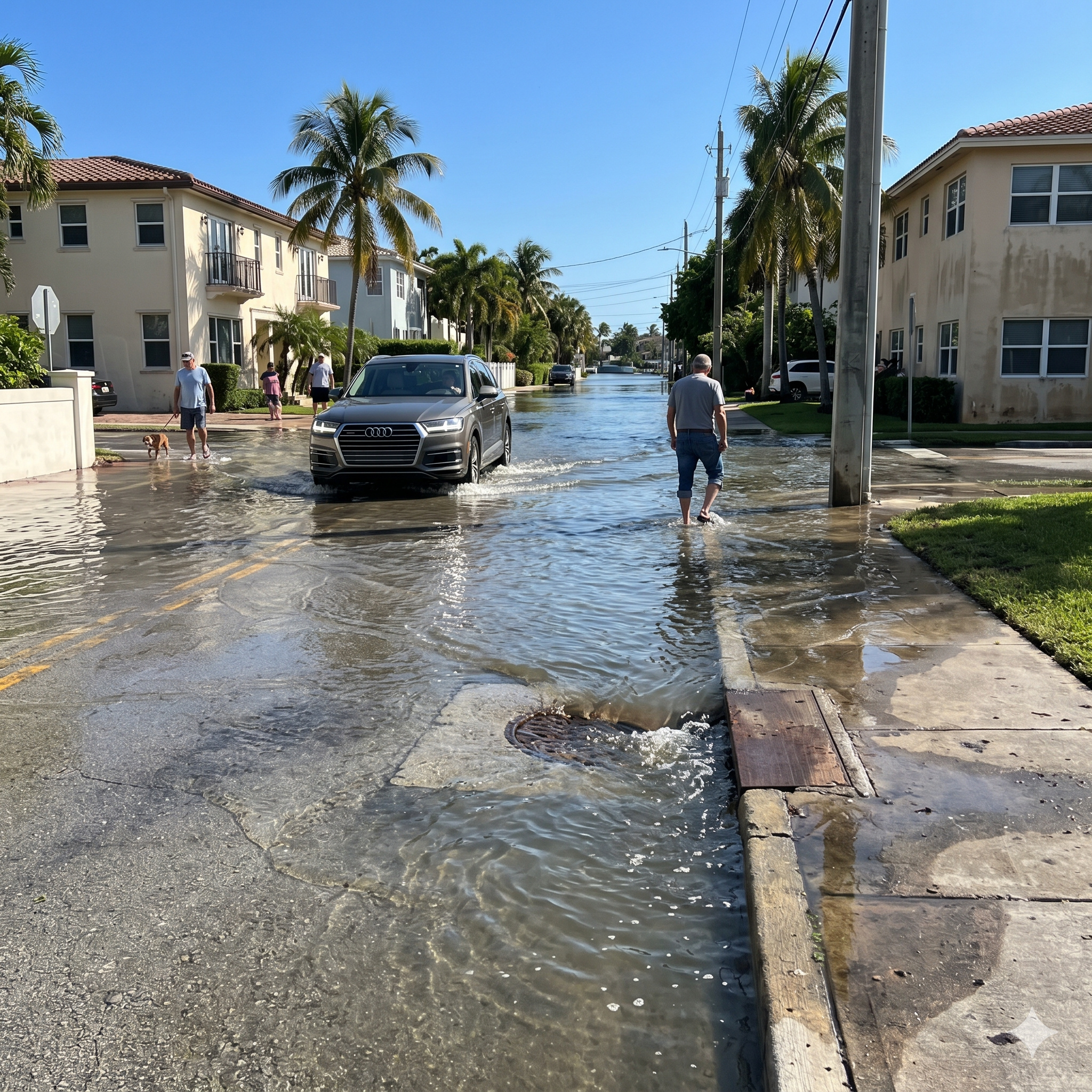

Miami faces sea-level rise from above and below, with soil infiltration and a growing risk of frequent flooding before 2040.
The vulnerability of Miami, Florida, doesn’t just start at the ocean, but in the subsoil itself. According to the USGS, the Biscayne aquifer is formed by highly permeable rocks, including the Miami Oolite, a porous limestone found in much of the former Dade County; in an update published on December 8, 2025, the agency also showed that saltwater intrusion advanced into inland Miami-Dade between 2018 and 2022.
This geology makes sea-level rise more difficult to contain because the water doesn’t just threaten from the surface. The City of Miami itself states that the Florida peninsula is composed of a porous limestone base and that sea-level rise is pushing groundwater upward, reducing natural drainage capacity; Miami-Dade projects a rise of 10 to 17 inches by 2040, relative to 2000 levels.
Understand why this combination of porous limestone, rising groundwater, and sea-level rise makes Miami one of the most complex cases of urban climate adaptation on the planet.
-
Daughter of Farmers from Brazil Uses Social Media to Highlight Rural Life and Promote Agriculture

-
Free Willy’s Orca, Captured as a Calf, Became a Global Star in a Mexican Tank and Was Part of the Most Controversial Attempt to Return a Captive Whale to the Wild

-
15-year-old Palestinian girl who fled Gaza war learns Portuguese in Brazil and wins gold at São Paulo Math Olympiad, inspiring teachers and classmates on social media.
-
“Vampire Deer” Rediscovered in Remote Afghan Forest After Nearly 60 Years, Highlighting Urgent Conservation Efforts


Flooding already occurs without rain during high tides
One of the clearest signs of this vulnerability is already visible in the city’s daily life. Miami faces the phenomenon known as “sunny day flooding”.


During higher tides, seawater invades drainage systems and emerges onto the streets, even without any rain. This type of flooding has become more frequent in recent decades.
Data from NOAA shows that this type of flooding has been increasing consistently, tracking with sea-level rise. What was once a rare event has become part of the routine in some areas of the city.
Drainage system starts to work in reverse with sea-level rise
Another direct effect of sea-level rise is on the functioning of the urban drainage system. Designed to drain rainwater to the ocean, these systems depend on the height difference between the city and the sea. As the ocean level rises, this difference decreases.
At times, the flow can reverse, allowing seawater to return through the pipes. This process turns the drainage system into a point of water entry, not just an exit.
Barriers and dikes face structural limitations
In cities like Amsterdam or Venice, dikes and barriers are effective solutions against sea-level rise. In Miami, the situation is different.
The presence of porous limestone prevents these structures from working completely. Even if a barrier prevents the direct entry of water from the surface, the sea can continue to advance underneath it.
This limits the effectiveness of traditional containment works. The problem is no longer just one of structural engineering but also involves the geology of the region itself.
Projections indicate an increase in frequent flooding in the coming decades
Climate studies indicate that with continued sea-level rise, Miami could face frequent flooding before 2040, especially in lower-lying areas. These projections do not mean the entire city will be submerged, but they do indicate that:
- flooding events may become more common
- areas that are currently dry may begin to flood regularly
- urban infrastructure will come under increasing pressure
Sea-level rise does not happen suddenly, but progressively, changing the city’s functioning over time.

Billion-dollar investments try to contain a structural problem
Faced with this scenario, Miami has invested billions of dollars in adaptation projects. Among the measures adopted are:
- installation of pumps to remove water
- raising streets
- reinforcement of drainage systems
These actions help reduce immediate impacts, but they do not eliminate the structural problem caused by the local geology. Current solutions act as mitigation, but they do not completely solve the root of the problem.
Lower-lying areas have a higher risk of flooding
Within the city, the risk is not uniform. Lower-altitude regions are more vulnerable to sea-level rise and recurrent flooding. These areas tend to feel the effects first, with more frequent flooding.
Furthermore, intense urbanization reduces the soil’s natural ability to absorb water, worsening the problem. The risk is unevenly distributed, affecting certain regions more intensely.
Sea-level rise and frequent flooding also have a direct impact on the local economy. Affected sectors include:
- real estate market
- tourism
- insurance
- urban infrastructure
The perception of risk can influence property values and the way the city develops. The problem is no longer just environmental and now has relevant economic and social consequences.
Comparison with other coastal cities highlights Miami’s uniqueness
Many coastal cities face rising sea levels, but few have the combination of factors found in Miami.
While other regions can build effective barriers, Florida’s geology imposes unique limitations. This makes Miami one of the most complex cases of urban adaptation to sea-level rise.

With the sea advancing not only on the surface but also through the subsoil, Miami faces a challenge that goes beyond traditional solutions.
The city is already living with clear signs of change, such as sunny-day flooding and increasing pressure on its infrastructure.
The question that remains is direct: to what extent can a city built on porous rock contain an ocean that doesn’t need to go over the top to advance?