






 Portuguese
  Spanish
  5 min of reading
  0 comments


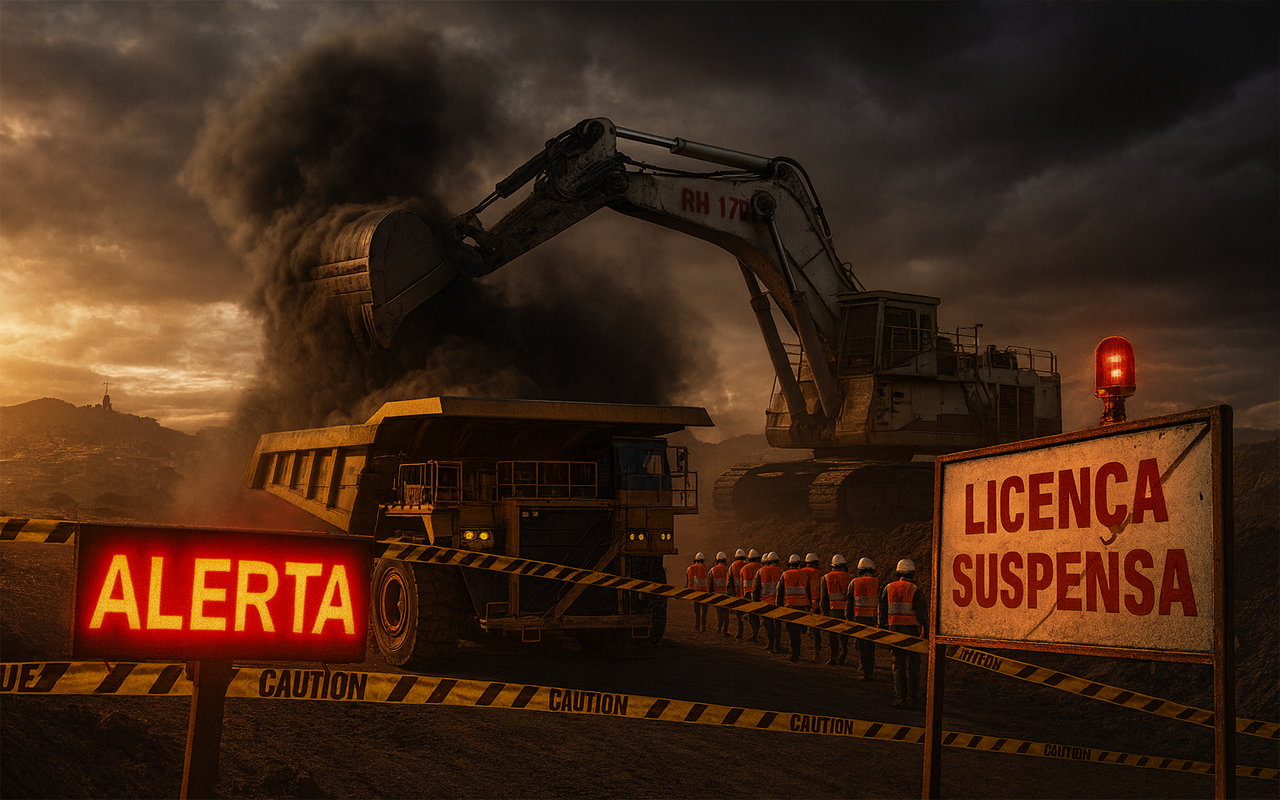
Court Hearings and Judicial Decisions Place the Expansion of CSN Mineração in Congonhas Under Scrutiny. Without the New Waste Pile and Mining at Esmeril, the ALMG Indicates Risk to Production Continuity, Pressuring a City Highly Dependent on Mining.
The possibility of a pause in mining in Congonhas (MG) has gained traction in recent weeks due to the advancement of lawsuits and delays in the environmental licensing of projects deemed essential by the company and the state government. In a recent hearing, the Legislative Assembly of Minas Gerais (ALMG) noted that expanding the waste pile at Batateiro and opening a new mine at Serra do Esmeril are seen as necessary to maintain production at the Casa de Pedra Mine, operated by CSN Mineração. Without these structures, the risk of a partial or total halt in activities increases.
The issue mobilizes authorities, residents, and social movements. In court, injunctions that allowed for expropriations in rural communities tied to the expansion were suspended, adding uncertainty to the company’s timeline. At the same time, Mayor Anderson Cabido advocates for reducing the municipality’s “mining dependence” and diversifying the economy with tourism and new investments.
As the debate unfolds, the city remains on a knife’s edge. Mining supports thousands of jobs and a significant portion of local revenue, but the population demands environmental guarantees, transparency, and effective dialogue before any expansion.
-
Coal mine purchased for $2 million in Wyoming, the Brook Mine holds rare earth elements and critical minerals estimated at up to $37 billion, in an asset that the US is competing for with China.

-
In the year Brazil won the World Cup, gasoline cost R$ 1.77, the cheapest car was worth R$ 13,000, there were no flex-fuel cars, SUVs were rare, and no Chinese brand sold a single vehicle in the country.
-
Neighboring Balneário Camboriú will receive a R$ 1 billion airport with 225 hangars, an area of 2.2 million m², a technology park, and an export zone that promises to transform the economy and generate thousands of jobs.
-
After investing R$ 5,000 in fried chicken in his backyard, a Brazilian transformed two fryers and a freezer into a network with 115 sales points, presence in up to 17 states, and revenue exceeding R$ 115 million per year.



Congonhas and Mining Dependency: Jobs and Revenue at Stake
Congonhas is at the heart of the Iron Quadrangle and houses the Casa de Pedra, one of the pillars of CSN’s iron ore production. Public estimates and specialized reports indicate that the mineral chain there supports thousands of jobs, with historical data varying from 6,000 to 8,000 jobs between direct and indirect jobs over the past few years. In 2018, for instance, CSN mentioned around 6,000 direct jobs and 2,000 indirect jobs linked to operations in the municipality.
In recent interviews, Mayor Anderson Cabido has reiterated that the city needs to reduce its economic dependence on mining and expand fronts such as tourism and services to cushion shocks from ore supply and price, as well as licensing impacts. The discussion gained momentum in 2025 with the series “Minas S/A” by the newspaper O Tempo.
A potential halt would not only affect jobs at the mine and contracted companies but the entire commerce and service ecosystem surrounding the activity. For this reason, unions, the mayor’s office, and residents closely monitor every step of the licensing and legal actions with increased attention.
For public planning purposes, the indication of “mining dependence” serves as a warning. Diversifying the productive base is seen as a way to protect jobs in Congonhas and reduce fiscal volatility.
What Is Halting Operations: Waste Pile at Batateiro and Mining at Esmeril
The environmental licensing for the waste pile at Batateiro – Phase 4 and for the mine at Esmeril is the main bottleneck. Documents and notes from the ALMG state that such structures are necessary to ensure the continuity of production at Casa de Pedra, without increasing capacity, according to the company. The Environmental Impact Report describes 152.3 million m³ of material disposed of and a maximum height of 350 m, dimensions that explain the intense technical scrutiny.
The project faces social contestation. Residents report dust, risk to springs, and soil instability, in addition to questioning the absence of specific legislation for dry tailings piles. The newspaper O Tempo described the structure as equivalent to a 115-story building, highlighting the scale of the project that would be installed at Serra do Esmeril.
The company argues that the mine at Esmeril will supply the necessary ore to maintain the current level of production, and that the waste pile at Batateiro will ensure the disposal of waste “safely.” Nevertheless, the process remains under review at the State Department of Environmental Affairs, with hearings and requests for information.
In summary, if the licenses do not advance, the ALMG’s own public documentation supports that operational continuity is at risk, fueling the debate about a possible halt and its effects on jobs and revenue.
Justice, Expropriations, and Legal Uncertainty in Santa Quitéria
On the legal front, the expansion has run into the state decree of 2024 that authorized expropriations in rural areas of Congonhas to facilitate structures linked to CSN. In July 2025, decisions from the TJMG and subsequent rulings suspended evictions and repossessions in Santa Quitéria, mandating an analysis by the Federal Court following provocations from the MPF and entities.
The suspension of expropriations does not close the process but adds uncertainty to the miner’s timeline and reinforces the need for mediation among the community, the company, and the government. Local organizations and socio-environmental movements continue to pressure for transparency and independent studies.
This legal context, coupled with the still incomplete licensing, helps explain why the discussion of a halt has returned to the center of regional news this semester.
Minas Gerais on the Map of Mining: Iron Quadrangle and National Leadership
Understanding the Congonhas case requires context. Minas Gerais remains the leader in mineral revenue in the country. In 2024, the state recorded R$ 108.3 billion and maintained its lead in 2025, according to reports from IBRAM and Agência Brasil. The iron ore accounts for the largest share of the sector.
The Iron Quadrangle concentrates a significant portion of the national reserves and production. The Geological Survey of Brazil (SGB) indicates that the region is responsible for about 60% of Brazil’s iron ore production, as well as gold and manganese, which reinforces the sensitivity of any regulatory or judicial intervention in the area.
In the first half of 2025, Brazilian mineral revenue totaled R$ 139.2 billion, with Minas accounting for nearly 40% of the total, amplifying the state impact of local licensing difficulties.
In other words, decisions regarding Congonhas transcend the municipality and have systemic effects on the productive and logistics networks of iron ore.
Paths to Avoid a Halt: Diversification, Counterparts, and Transparency
As the issue progresses in licensing and courts, the Mayor’s Office proposes socio-environmental counterparts, ongoing dialogue, and projects for economic diversification. In an official statement and public remarks, the municipality called for a new model of relationship between sector companies and the city, focusing on security, stable revenue, and quality of life.
The equation includes measures for dust control, water protection, independent monitoring, less impactful transportation routes, and professional training programs, in addition to the transparent definition of compensations. These requirements are at the center of the public hearings at the ALMG, which will continue to influence the technical decision regarding the licenses.
For the population, the goal is clear: balancing economy and sustainability. For the company, the urgency is to ensure production continuity within parameters accepted by environmental agencies. For the state, the aim is to preserve mineral leadership without repeating past mistakes. The outcome in the coming months will determine whether Congonhas can avoid a halt and preserve jobs, with more transparency and security.


-

-

-

4 people reacted to this.