






 Portuguese
  Spanish


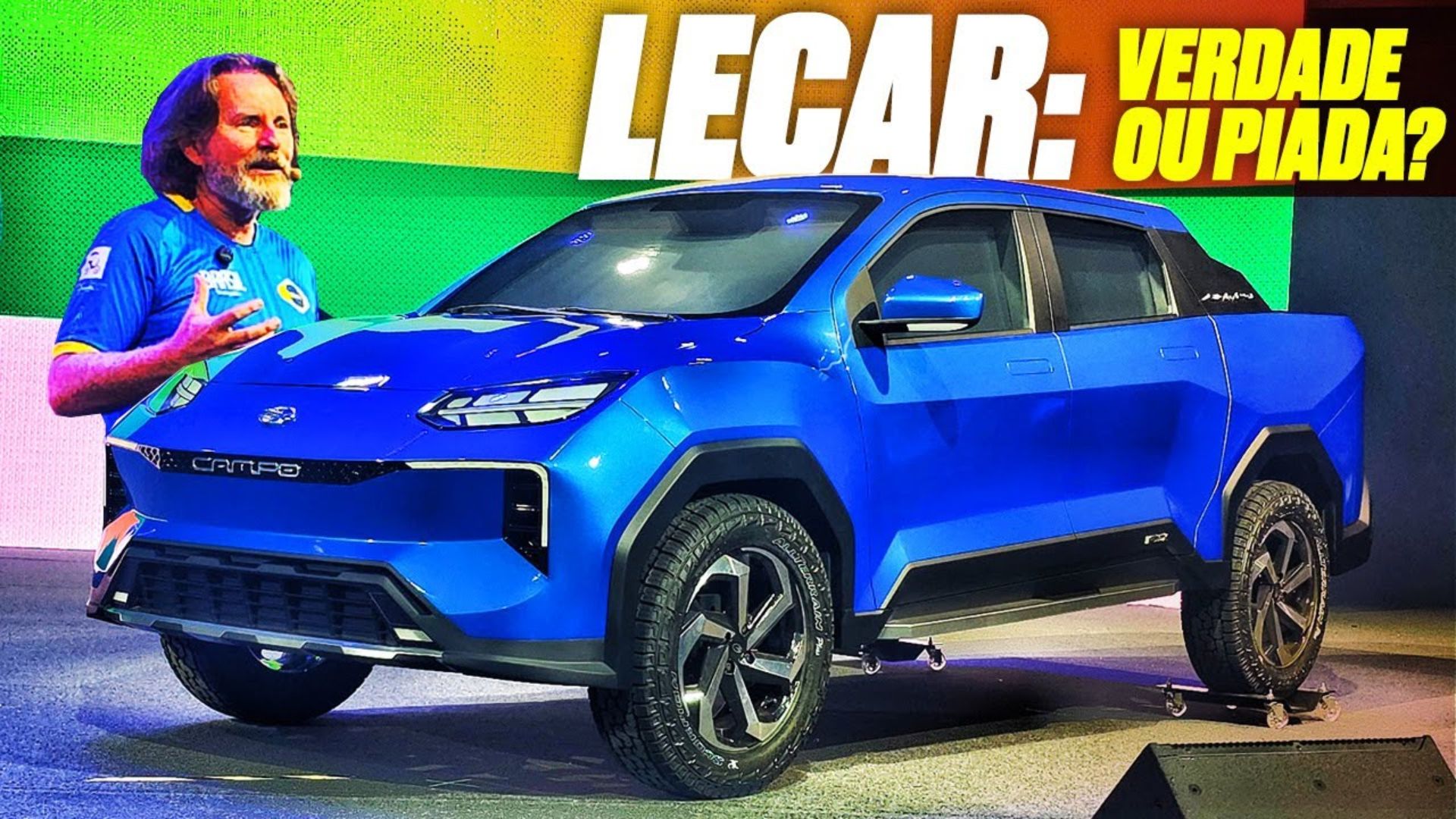


Automaker Displays Styrofoam Models and Raises Doubts About Industrial Project When Announcing Targets and Deadlines Still Lacking Technical Backing, According to Industry Experts.
Lecar, an automaker presenting itself as “a Brazilian manufacturer of hybrid and electric vehicles created to revolutionize mobility in Brazil”, used the Auto Show to announce new deadlines and present yet another digital concept.
However, the company left the event under scrutiny from industry professionals, who pointed out inconsistencies between the speech and the actual stage of the project.
According to a report published by Autoesporte, instead of presenting a functional vehicle, the brand showcased a factory model, a Styrofoam model of the Campo pickup sold to dealers for R$ 200 thousand and announced plans to inaugurate a network of 150 sales points even before starting production.
-
Couple Sold Their Home to Save Business, Now Run Platform Handling $180 Million Monthly and Managing Over 51 Million Listings

-
Brazil’s 2026 Tax Refund: Record 9.58 Million Filers in Largest Payout Ever, But a Key Detail on Priority Recipients Draws Nationwide Attention

-
Itaú Alters Hybrid Work Model, Increasing Office Days from 2028, Prompting Employees to Adjust to New Routine
-
Facing Labor Shortage, Japan Plans to Invest $34 Million to Attract Foreign Workers in Construction, Healthcare, Industry, and Commerce





Lecar Projects and Promise of a National Car
For over two years, Lecar has been publicizing plans to launch a national electrified vehicle, but so far, what they have presented to the market are preliminary product studies, business model, and industrial operation.
Experts consulted by the report state that the disclosed schedule does not follow the standard observed in automakers looking to enter the automotive sector, especially regarding the prior construction of functional prototypes.
During the press conference at the Auto Show, journalists and executives present reported discomfort with the lack of alignment between the presentations and what is typically disclosed by manufacturers at events of this magnitude.

Among those present was the president of BYD Brazil, Tyler Li, who later participated in the launch of the Denza brand.
According to Autoesporte’s findings, some of the audience evaluated that the presentation diverged from the level of technical preparation typically adopted at automotive fairs.
Press Conference with Flaws and Presentation of Industrial Model
The presentation faced technical and organizational issues.
Sources who attended the event highlighted the use of AI-generated images without audio and the misspelling of the founder’s name, Flávio Figueiredo, on the screens.
Without a structured script, Figueiredo alternated comments about a third model still virtual and displayed images of the future factory’s model, whose completion is expected by the end of 2027.
On stage remained the full-size Campo pickup made of Styrofoam and wood, used as a demonstrative piece.
Months earlier, Lecar had announced it would present a functional prototype at the event.
According to consulted professionals, the absence of a rolling vehicle contrasts with what is typically presented in a pre-production phase.
Pre-Sale and Styrofoam Model Sold for R$ 200 Thousand

The Styrofoam model available at the booth is also marketed by the company.
Lecar claims that each unit of the so-called “mockup” is sold for R$ 200 thousand to those interested in opening a dealership for the brand.
The amount exceeds that of the vehicles in pre-sale.
The cars are offered to the public for R$ 159,300, exclusively in the Scheduled Purchase plan, consisting of 72 installments of R$ 2,212.50.
There is no option for cash payment.
Delivery, according to the company, will occur when half of the installments are paid, within up to three years.
Industry professionals note that pre-sale models applied by automakers usually require the existence of homologated prototypes or pre-series, which is not the case for Lecar.
The brand claims that its method allows for “predictability” and “adaptation to demand.”
Dealership Network Before Production
The company announced a target of having 150 dealerships by 2026, a year before the expected start of factory operations.
According to Lecar itself, some of these units will consist of used car stores and commercial representatives acting as sales intermediaries, with outsourced workshops.
Consulted experts assess that this model is unusual for manufacturers that do not yet have a final product, as it involves network maintenance costs and the need for technical support.

Lecar states that the strategy is appropriate for the company’s moment and allows for gradual scalability.
Factory Plan and Numbers Questioned by Experts
The industrial project disclosed by the automaker envisions a plant of 90,000 m² in Sooretama (ES), with a capacity for 120,000 vehicles per year.
The cafeteria, according to data presented by the company, would have 6,000 m², a dimension that drew attention from industrial engineering professionals consulted by the report for exceeding similar structures in larger automakers.
The comparison with previous Brazilian manufacturers is often cited by analysts.
Gurgel, for example, produced about 40,000 vehicles over 25 years with a factory of approximately 15,000 m² in Rio Claro (SP).
Experts stress that large-capacity industrial projects require advanced planning and significant investments to avoid idleness.
Autoesporte also pointed out that the discrepancy between promises and the current state of the project is one of the factors that have raised doubts in the automotive sector.
Chinese Partnership Without Disclosed Name
Lecar states that there is interest from a Chinese company in the project, described at different times as a startup and as a potential partner.
The company, however, has not disclosed the name of the involved group.
On other occasions, the brand mentioned that the car could be produced in China and later stated in an online broadcast aimed at prospective dealers that it was facing difficulties with the partner.
The statements were not detailed.
Experts point out that starting a car from an external project is not uncommon.
Manufacturers like Tesla relied on existing platforms for their first models.
Nonetheless, analysts emphasize that, even in these cases, extensive technical validation is required before mass production.
Homologation and Technical Challenges

In addition to developing a functional prototype, Lecar will need to carry out mandatory stages of homologation, including testing of components, electronics, safety, crash tests, and checks on energy efficiency.
Consulted technicians explain that this process typically takes months or years, even in established companies, especially when there is an intention to offer ADAS systems, as announced by the brand.
These professionals expect that the timelines presented by Lecar will require adjustments throughout the process, due to the regulatory nature of the sector.
Technical Questions Unanswered at the Auto Show
The technical doubts mentioned by engineers and consultants include the absence of information about the final chassis and body project, essential for determining presses, welding robots, and other industrial equipment.
There is also uncertainty regarding deadlines for the supply of heavy machinery, integration of factory systems, and the feasibility of sustaining a national network without homologated vehicles and a defined production scale.
These issues are typically addressed by manufacturers during technical presentations at industry fairs.
In Lecar’s case, professionals present state that this information was not detailed.
According to Autoesporte, some of the questions were received by the company, but no additional technical details were provided during the event.







