Portuguese
  Spanish


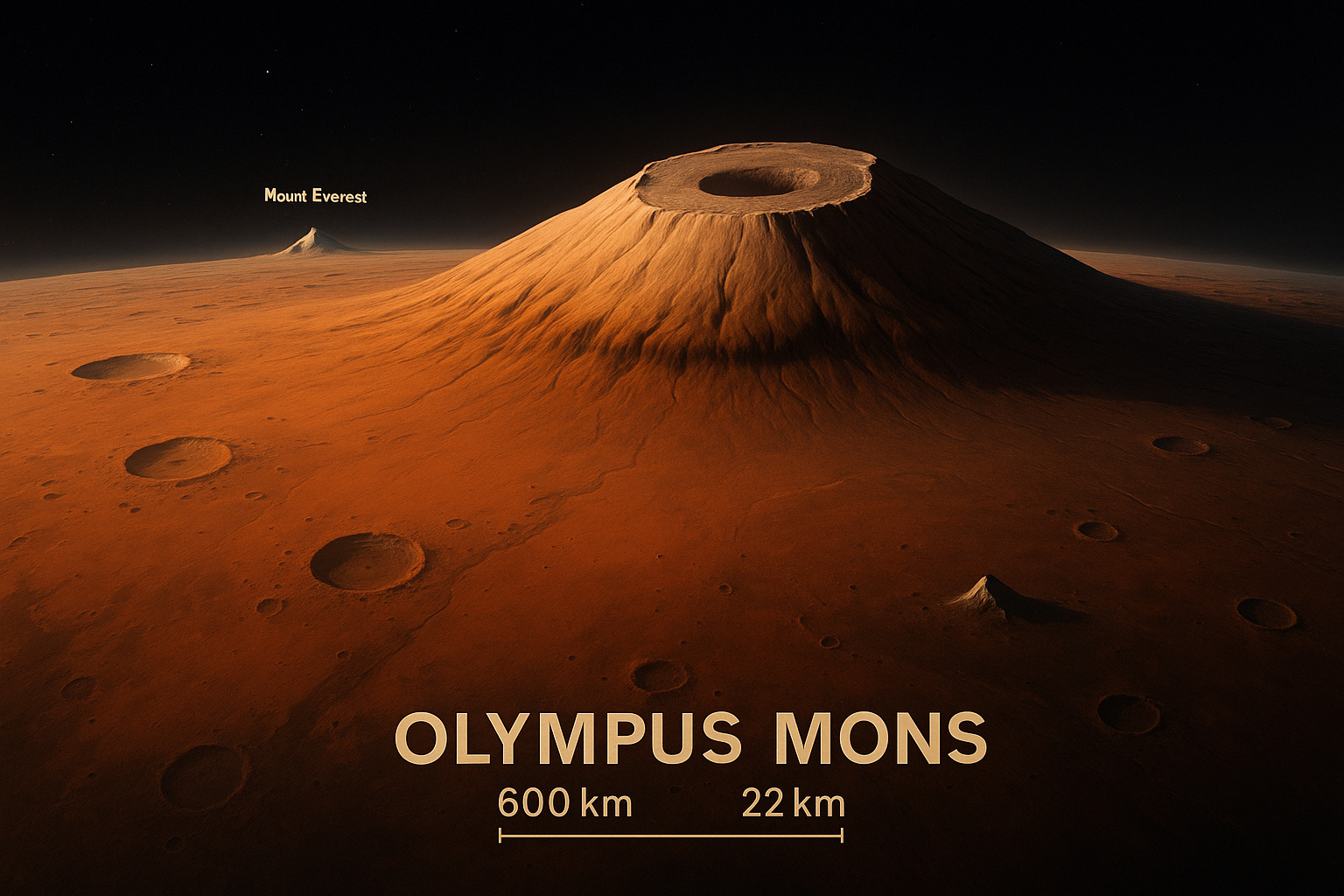


With More Than 20 Kilometers in Height and a Base of 600 km in Length, Mount Olympus on Mars Is the Largest Volcano in the Solar System and Intrigues Scientists About the Presence of Water, Ice and Possible Signs of Geological Activity on the Red Planet
At First Glance, Mars May Seem Like Just a Silent and Uninhabitable Desert, Covered by Reddish Dust, Craters and Arid Landscapes. However, Behind This Apparently Motionless Scene, the Red Planet Houses One of the Most Impressive Formations Ever Discovered by Science: Mount Olympus, a Volcano So Gigantic That Redefines Our Notion of Cosmic Proportion.
With More Than 20 Kilometers in Height and a Base That Extends Over 600 Kilometers, It Holds the Title of Largest Volcano in the Solar System. To Get an Idea of the Scale, Mount Everest, the Highest Point on Earth, Stands at “Only” 8.8 km. The Comparison Makes It Clear: While Everest Is Considered an Extreme Challenge for Climbers, Mount Olympus Makes the Terrestrial Mountain Seem Like a Simple Hill in the Face of Its Grandeur.
How NASA Revealed Mount Olympus on Mars
The Discovery of Mount Olympus Dates Back to the 1970s, When Space Probes Sent the First Detailed Images of the Martian Surface. The Scientific Impact Was Immediate: For the First Time, Humanity Faced a Mountain That Surpassed by Several Times Any Known Structure on Earth.
-
Award-Winning Japanese Restaurant Reveals It Has Preserved Part of the Same Frying Oil for 66 Years

-
American Youth Transforms from Severe Obesity to U.S. Air Force Enlistment, Losing 90 Kilograms in Two Years
-
11-Year-Old Entrepreneur Sells 60 Homemade Sweets Daily, Mastering Cost Calculation, Social Media Promotion, and Client Negotiation Since Age 7

-
Peruvian Mountain’s 5,200 Aligned Holes May Unveil Ancient Indigenous Market for Corn and Cotton


Decades Later, With Advancements in Technology, the MOLA (Mars Orbiter Laser Altimeter) Instrument, Installed on the Mars Global Surveyor Probe, Allowed for Unprecedented Mapping of Mars’ Relief. It Was Then Confirmed: Mount Olympus Surpasses the Mark of 20 km in Altitude Relative to the Martian Datum, Solidifying Its Status as a Unique Geological Landmark and an Enigma for Planetary Scientists.
As Reported by CNN Brasil in Articles About Recent Discoveries on Mars, Mount Olympus Not Only Impresses With Its Dimensions, But Also Offers Valuable Clues to Understand How the Planet Evolved Over Billions of Years.


Why Is Mount Olympus So Gigantic?
The Fascination Surrounding Mount Olympus Is Not Just in Its Colossal Size, But Also in the Conditions That Allowed Its Formation. Various Studies Show That the Volcano Is a Key Piece to Understanding Martian Geology. Among the Factors That Enabled Its Growth Are:
- Reduced Gravity: Mars Has Only 38% of Earth’s Gravity, Which Allows Mountainous Structures to Grow Much Larger Before Succumbing to Their Own Weight.
- Absence of Tectonic Plates: Unlike Earth, the Red Planet Does Not Have Significant Tectonic Movement. Thus, Lava Can Accumulate in the Same Place for Millions of Years, Continuously Elevating the Mountain.
- Repeated Eruptions: Mount Olympus Was Formed by Numerous Successive Eruptions That Spread Layers of Lava Around It, Creating a Peak With Broad and Gently Sloping Sides, Typical of Shield Volcanoes.
This Unique Combination of Geological Factors Helps Explain Why Mount Olympus Reached Such Unimaginable Proportions, Becoming a True Colossus on the Stage of the Red Planet.
Unresolved Mysteries About the Martian Volcano
Despite Decades of Study, Mount Olympus Remains Shrouded in Mysteries. There Are Hypotheses Suggesting That It May Have Been a Volcanic Island in the Midst of an Ancient Martian Ocean When Liquid Water Existed Abundantly on the Planet’s Surface. Another Intriguing Question Is Whether There Is Still Residual Heat Inside, Which Could Indicate That Mars Is Not Completely Geologically Dead.
This Enigma Is Central to Future Space Missions. Exploring the Base or Slopes of Mount Olympus May Provide Crucial Answers About Volcanic Activity and Environmental Conditions That Shaped Mars in Past Eras. Additionally, Studying This Colossal Mountain May Yield Clues About the Possible Habitability of the Planet in Distant Ages, When Water and Ice Played Determining Roles.
Thus, Mount Olympus on Mars Is Not Just an Impressive Natural Monument, But Also a Key to Understanding the Past — and Perhaps the Future — of the Red Planet.