





 Portuguese
  English
  Spanish
  7 min of reading
  0 comments


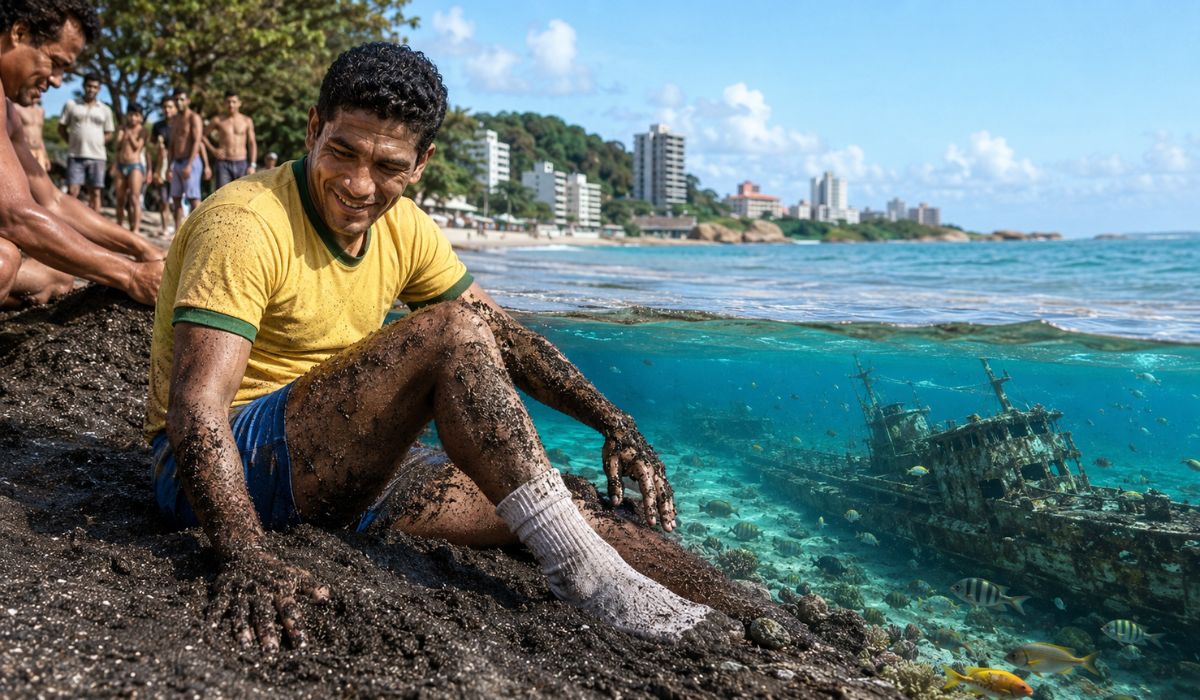
On the coast of Espírito Santo, Guarapari gathers monazitic sands, marine biodiversity recognized by law, dozens of beaches, and shipwrecks that attract tourists, researchers, and divers interested in rare natural phenomena.
Guarapari, on the central coast of Espírito Santo, gathers urban beaches, islands, shipwrecks, natural reefs, and stretches of sand with naturally occurring radioactive minerals.
Known for decades as Health City, the city became associated with the monazitic sands of Praia da Areia Preta and Meaípe and, in 2024, was legally awarded the title of National Capital of Marine Biodiversity.
Located about 50 kilometers from Vitória, the municipality has more than 50 beaches, according to the Guarapari City Hall, and hosts areas sought after by bathers, researchers, and divers.
-
A Canadian who has lived in Sri Lanka, India, and Portugal chose the small town of Timbó, in the interior of Santa Catarina, to raise his three children, attracted by the safety and climate, in a sincere account of the advantages and also the limitations of life as a foreigner in southern Brazil.

-
Norway finds an 18th-century ship at a depth of 600 meters with Chinese porcelains, European cups, fabrics, grains, and preserved parts of chandeliers at the bottom of the sea.

-
Tiny micro-apartments invade São Paulo, can be as small as a cramped room, can cost up to R$ 700,000, and reveal the dilemma of those who need to trade space for metro access, work, and urban survival.

-
House on wheels with the look of an apartment surprises by swapping cramped spaces for two bedrooms, a spacious living room, a full bathroom, and a ground floor layout in just 35 m² designed for real living.



On the same coast, rare geological formations, coastal waters with a great variety of species, and submerged structures create an environment of tourist and scientific interest.
Monazitic sands explain the fame of Health City in Guarapari
The fame of Guarapari as Health City is mainly linked to the dark sands found in specific stretches of the coast.
They are called monazitic because they concentrate monazite, a mineral associated with elements like thorium, which emits low-intensity natural radiation.
This characteristic is not related to accidents, industrial waste, or human interference.
It is a natural geological process, where heavy minerals have accumulated on the coastal strip over time, especially in areas like Praia da Areia Preta and Meaípe.
At Praia da Areia Preta, in the Center, the dark sand has become one of the city’s tourist trademarks.
In Meaípe, on the southern coast of the municipality, there is also a concentration of monazitic sands, making the region one of the most cited points in studies and institutional materials on the subject.
The fame of the black sand also attracted well-known figures from Brazilian culture.
In 1963, the former player Garrincha, two-time world champion with the Brazilian national team, visited Guarapari accompanied by Elza Soares, according to a record published by A Gazeta.
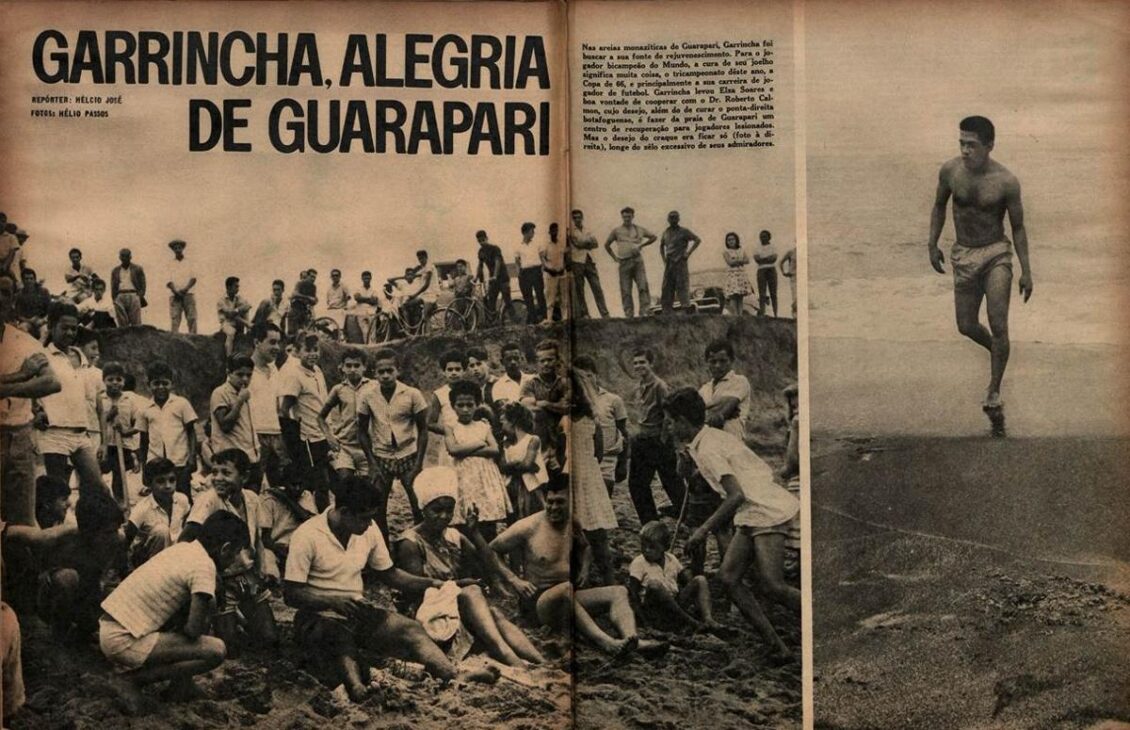
Credit: Hélio Passos/Revista O Cruzeiro – National Library Collection
The athlete lived with pain, especially in his knees, and sought the monazite sands of Praia da Areia Preta at a time when alternative treatments were more common in sports.
The episode became part of the memory associated with the therapeutic fame of the city, which became nationally known by the nickname Health City.
The City Hall of Guarapari associates Praia da Areia Preta with the tradition of therapeutic properties attributed to the sand.
However, researchers and health professionals approach the subject with caution, as possible biological effects require scientific investigation and cannot be presented as a cure.
Research from the Federal University of Espírito Santo analyzed the composition and biological effects related to gamma radiation in monazite sand from Meaípe.
A thesis registered in the Ufes repository indicates that deposits of this type on Brazilian beaches can present average levels of external radiation of up to 20 µGy/h, in addition to highlighting gaps in the literature on the effects of low natural doses of radiation.


Studies on natural radioactive sands and health
The relationship between the sands of Guarapari and possible health benefits has appeared for decades in local tradition.
In 2017, Ufes released results of a ten-year research conducted by Professor Marcos Tadeu Orlando and team, which investigated properties of monazite sands and their possible relationship with health indicators in the municipality.
According to the university’s disclosure, the study observed an association between the local environment and the lower per capita incidence of breast cancer in Guarapari, according to SUS data analyzed by researchers.
The information, however, does not allow us to affirm that exposure to the sand prevents or treats the disease.
In the survey cited by Ufes, Guarapari recorded two cases of malignant breast cancer per 100,000 women.
In the same disclosed segment, Colatina appeared with 178 cases per 100,000 and Linhares with 148.
These numbers were used by researchers to formulate hypotheses, not to establish a direct cause-and-effect relationship.
Another study supported by the Espírito Santo Research and Innovation Support Foundation investigated possible effects of monazite sands on people with knee osteoarthritis.
The research involved monitoring volunteers, clinical tests, and comparison with a group exposed to a beach without the same incidence of radiation.
The aim of this work was to verify if exposure could reduce pain and stiffness in patients with osteoarthritis.
For this reason, the scientific approach differs from popular tradition: instead of claiming anticipated benefits, it seeks to measure effects, compare results, and identify limits.
Any use of the sands for health purposes should be interpreted within this context.
Radioactivity is natural and part of the region’s geological formation, but exposure does not replace diagnosis, medical monitoring, or treatment recommended by health professionals.
National Capital of Marine Biodiversity in Espírito Santo
In addition to monazite sands, Guarapari has gained federal recognition for its diversity of marine species.
On October 16, 2024, Law No. 15,004 was enacted, granting the municipality the title of National Capital of Marine Biodiversity.
The law originated from Bill 4,258/2021, presented by then-federal deputy Dr. Soraya Manato.
During its processing, the justification highlighted the position of the Guarapari Islands in a biogeographic transition area, where species associated with tropical and subtropical environments occur.
Legislative documents also recorded comparisons with regions known for marine life, such as Abrolhos and Fernando de Noronha.
According to the justification presented in Congress, the Guarapari islands stood out for their diversity of reef fish, which supported the official recognition.
The Guarapari City Hall reports that the local seabed houses more than 766 cataloged species.
This data is used in institutional materials related to the marine biodiversity title and the promotion of the municipality as a destination for diving, environmental tourism, and research.
Victory 8B: sunken ship became an artificial reef in Guarapari
Among the submerged points associated with diving tourism is the Victory 8B, a cargo ship 89.77 meters long that was deliberately sunk on July 3, 2003.
The vessel rests between 18 and 36 meters deep, about 12 kilometers from the main beaches of Guarapari.
Before sinking, the ship underwent a cleaning and preparation process to reduce environmental risks.
The structure became part of the Espírito Santo Marine Artificial Reefs project and has since become a point used by diving operators.
Over the years, the hull was colonized by marine organisms.
Algae, corals, fish, and other species began to occupy the structure, which functions as a submerged shelter and observation point for certified divers.
The Victory 8B is featured in tourism and diving materials as one of the main artificial reefs in the country.
The Guarapari region also includes other shipwrecks, such as the Beluccia, a British cargo ship that sank in 1903 near the Rasas Islands after hitting a reef.
These submerged structures integrate with the local marine environment and help explain the interest of divers in the Guarapari coast.
Alongside the islands and natural reefs, the shipwrecks form areas of shelter and circulation for species.

Guarapari Beaches Unite Tourism, Science, and Biodiversity
Guarapari has beaches with different profiles along the coast.
Praia do Morro features an urbanized shoreline and usually sees a lot of activity during peak season.
Praia das Castanheiras, in the Center, is known for natural pools formed between rocks.
In the southern coast, Bacutia and Peracanga attract visitors seeking coves and calmer waters.
Meaípe, in turn, maintains a connection with fishing, local cuisine, and the monazite sand strips that are part of the city’s tourist history.
This combination contributes to Guarapari being approached from different perspectives.
The municipality appears in summer itineraries for its beaches, in scientific studies for its natural radioactive sands, in environmental materials for its marine biodiversity, and in diving circuits for its reefs and shipwrecks.
Recognition as the National Capital of Marine Biodiversity also increases attention on coastal conservation.
According to coastal area specialists, environments with reefs, islands, and shipwrecks require monitoring, visitation rules, and environmental education actions to reduce the impacts of tourism.
In the case of monazite sands, tourist interest needs to be separated from claims without clinical proof.
The local tradition is part of Guarapari’s identity, but health information should be treated based on studies, professional monitoring, and clear scientific limits.
Guarapari combines, in the same coastal area, naturally radioactive sand, a national biodiversity title, dozens of beaches, and a sunken ship transformed into an artificial reef.


Be the first to react!