Portuguese
  Spanish


American operation against the New World screwworm advances at the border with Mexico, mobilizing planes, sterile flies, quarantines, and sanitary surveillance amid pressure on Texas livestock.
The United States Department of Agriculture decided to redirect planes and sterile insects to reinforce the containment of the New World screwworm at the border with Mexico, following new reports of the parasite in areas increasingly close to Texas.
The operation plans the release of 100 million sterile flies per week to reduce the risk of species reproduction in regions considered strategic by the American government.
The measure was announced by the Animal and Plant Health Inspection Service, Aphis, an agency linked to the USDA.
-
Excavation for Solar Park in Germany Uncovers Rare Celtic “Princely Tomb” with Elite Warrior Buried with Gold, Weapons, Etruscan Jug, and Two-Wheeled Chariot in Bad Camberg

-
NOAA Scientists Discover Mysterious, Perfectly Aligned Holes on the Mid-Atlantic Ridge Seafloor, Origin Still Unknown

-
California Startup Develops Giant “Space Sling” to Launch Vehicles at Mach 6, Reducing Fuel Use and Enabling Thousands of Satellite Deployments

-
ChatGPT Alerts FBI to Prevent Planned Murder of 8-Year-Old in Brazil’s Espírito Santo


The new dispersal area includes operations about 50 miles into Texas, along the United States border with Tamaulipas, in northeastern Mexico.
The alert increased after the identification of the New World screwworm in a young sheep in the Mexican state of Coahuila, about 31 miles, or 50 kilometers, from the American border.
According to Reuters, this was the closest record to the United States in the recent outbreak, amid efforts by Washington and the Mexican government to contain the parasite’s expansion.
On June 4, 2026, the USDA also confirmed the presence of the parasite in a calf in southern Texas.
Reuters reported that the case was identified in La Pryor, a city near the border with Mexico, and led federal and state authorities to expand surveillance and sanitary response actions.
Sterile flies are used to contain the New World screwworm
The technique adopted by the United States is known as the sterile insect technique.
The method consists of breeding sterile males on a large scale and releasing them in areas defined by sanitary authorities.
Since the female New World screwworm mates only once, mating with a sterile male prevents the generation of viable larvae.
Thus, the strategy aims to reduce insect reproduction and limit its territorial expansion.
The USDA states that the release of the flies needs to be combined with field surveillance, animal movement restrictions, import protocols, and guidance to rural producers.
“At Secretary Rollins’ direction, our highest priority is protecting the United States from screwworm,” said Dudley Hoskins, Deputy Secretary of Regulatory and Marketing Programs at the USDA, in the official statement.
According to the agency, the change in the so-called dispersal polygon was adopted to reinforce coverage along the border.
The sterile flies used in the operation receive a fluorescent dye while still in the pupal stage.
When they become adults, they carry the marking, which can be detected under ultraviolet light and, in some cases, observed with the naked eye.
This procedure allows animal health agents to differentiate government-released insects from wild flies capable of reproducing.
Texas Livestock is at the Center of Economic Concern
The projected economic impact by the authorities is one of the central points of the mobilization.
According to an estimate cited by Reuters, a widespread outbreak in Texas could cause $1.8 billion in losses to the state’s economy, which plays a significant role in the United States’ cattle production.
The threat occurs during a period of reduced cattle supply in the country.
Reuters reported that the American herd is at its lowest level in 75 years and that beef prices have reached record levels.
In this scenario, experts interviewed by the agency say that new restrictions on animal transport or calf losses could affect the production chain.
The New World screwworm does not only infest cattle.
The larvae can affect domestic animals, wild species, and, in less common cases, humans.
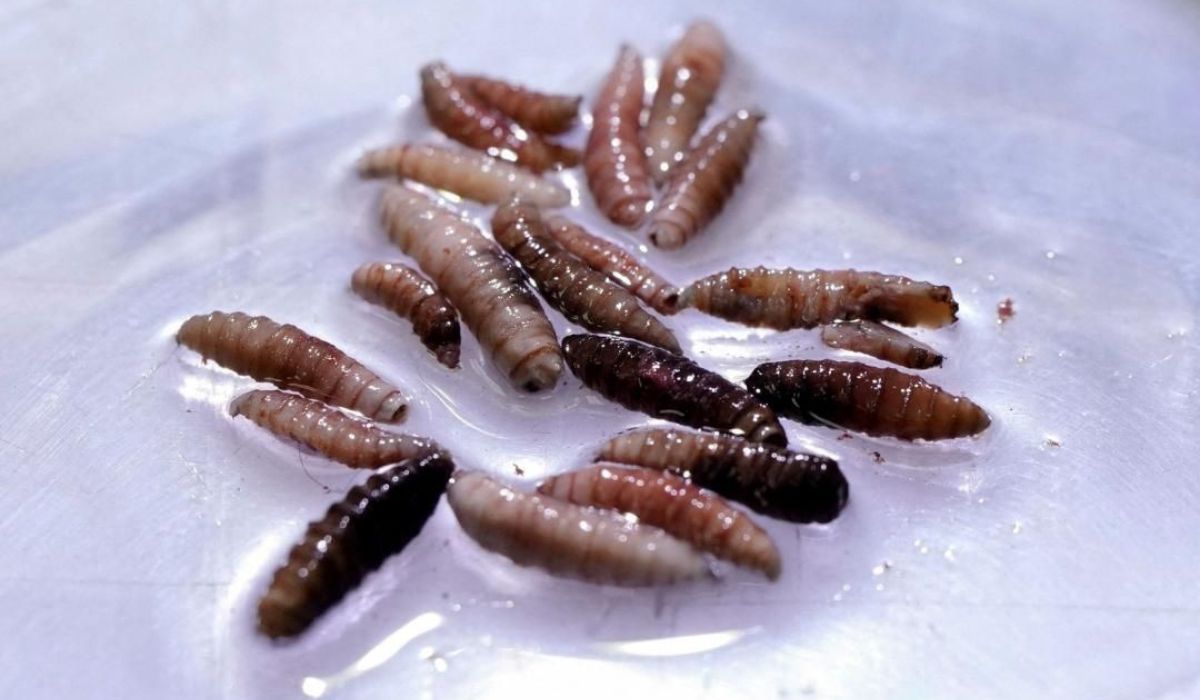
The fly lays eggs in open wounds or natural body openings, such as the nose, ears, genitals, and navel of newborn animals.
After hatching, the larvae penetrate the living tissue and enlarge the lesion.
According to the USDA, the infestation can cause wounds with discharge, increased size, and signs of discomfort in the animals.
Therefore, breeders, veterinarians, and pet owners are advised to report suspicions to health authorities.
Quarantines and inspections reinforce the US sanitary barrier
In addition to the release of sterile insects, the United States maintains sanitary protocols to reduce the risk of pest entry through imported animals.
Washington blocked cattle imports from Mexico at different times during the outbreak’s progression, a measure that affected trade between the two countries.
The USDA also reported a case identified at an equine import quarantine facility in Florida.
A horse from Argentina presented an open wound with larvae during a routine inspection.
Samples were sent to the National Veterinary Services Laboratory in Iowa, and tests confirmed the presence of the New World screwworm.
According to the agency, the animal remained in quarantine and received treatment as outlined in the sanitary protocols.
The USDA stated that the episode did not appear to be linked to the ongoing outbreak in Mexico but was cited by the agency as an example of the importance of inspections on animal entry routes.
In the highest risk areas of the border, American teams maintain specific traps for the New World screwworm and use monitoring structures for other insects.
The USDA also reported that it conducts inspections on wild animals, as free-ranging species can hinder the rapid detection of the pest in extensive areas.


Production of sterile flies depends on specialized units
The New World screwworm was once a significant sanitary problem for American livestock, but the United States eliminated the pest from national territory in the 20th century using the sterile insect technique.
The current challenge, according to health authorities, is to prevent the parasite from re-establishing itself after the expansion recorded in Central America and Mexico.
The production of sterile flies depends on specialized facilities.
The USDA reports that the Pacora unit in Panama, operated in partnership with local authorities through Copeg, is the only sterile fly production factory for the New World screwworm in operation in North America and produces approximately 100 million insects per week.
Another structure, located in Tuxtla Gutiérrez, Mexico, functions as a dispersal facility.
According to the USDA, the site has the capacity to release up to 100 million flies per week, with sterile pupae transported from Panama, incubated in Mexico, and then released in target areas.
The American response combines emergency actions, border monitoring, and expansion of operational capacity.

According to Reuters, after confirmation in Texas, authorities established containment measures, including movement restrictions in an area around the identified focus and road inspections.
For rural producers, the official guidance is to reinforce daily observation of animals, treat wounds quickly, and report any suspicion.
In humans, infestation is uncommon, but health authorities recommend seeking medical attention for suspicious lesions, especially after contact with animals or staying in areas with sanitary risk.