Portuguese
  Spanish


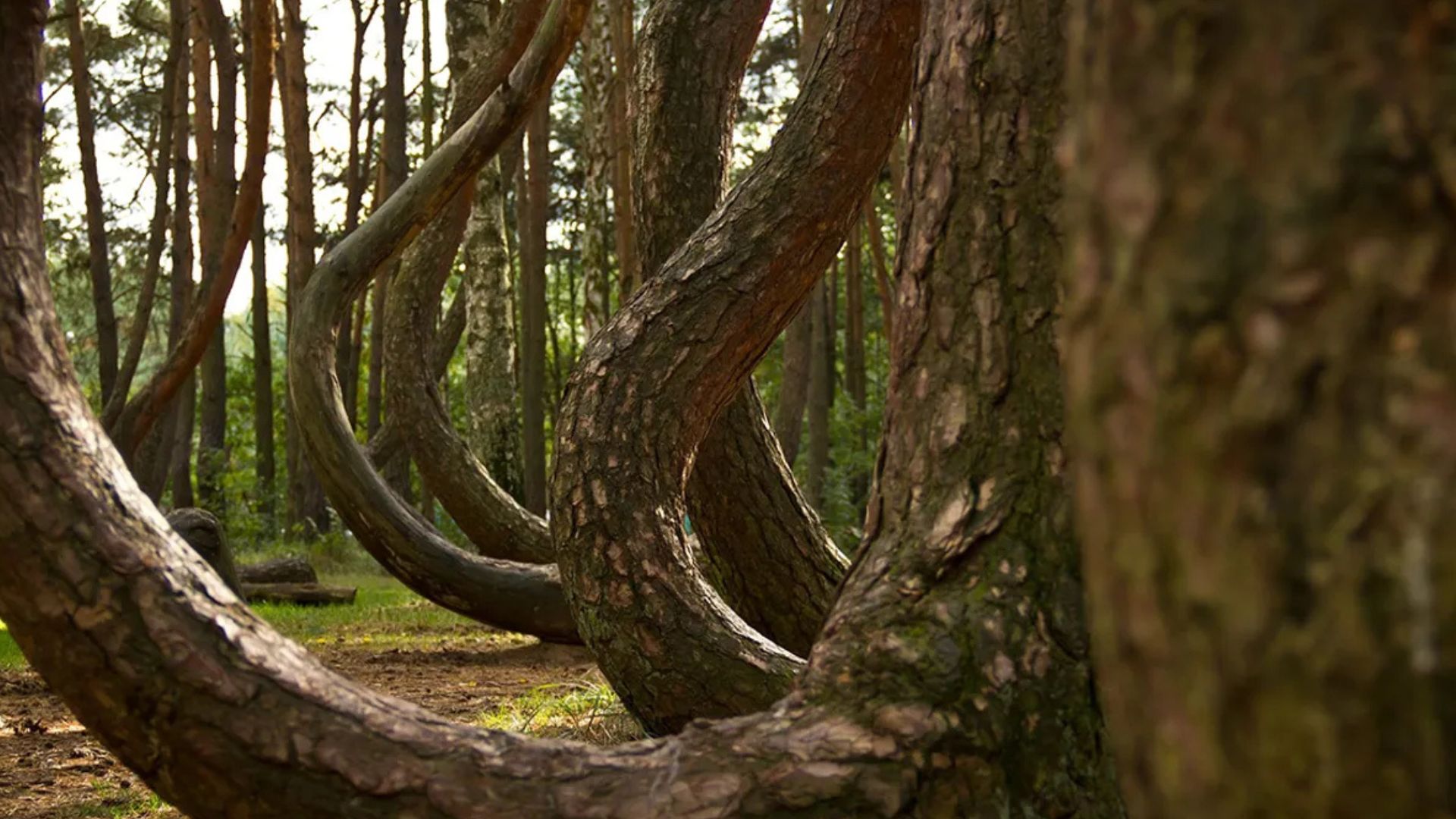

Decades after their planting, the enigmatic pines of the Crooked Forest continue to intrigue researchers and visitors, while theories about human intervention, snow, or natural phenomena remain without definitive proof to this day.
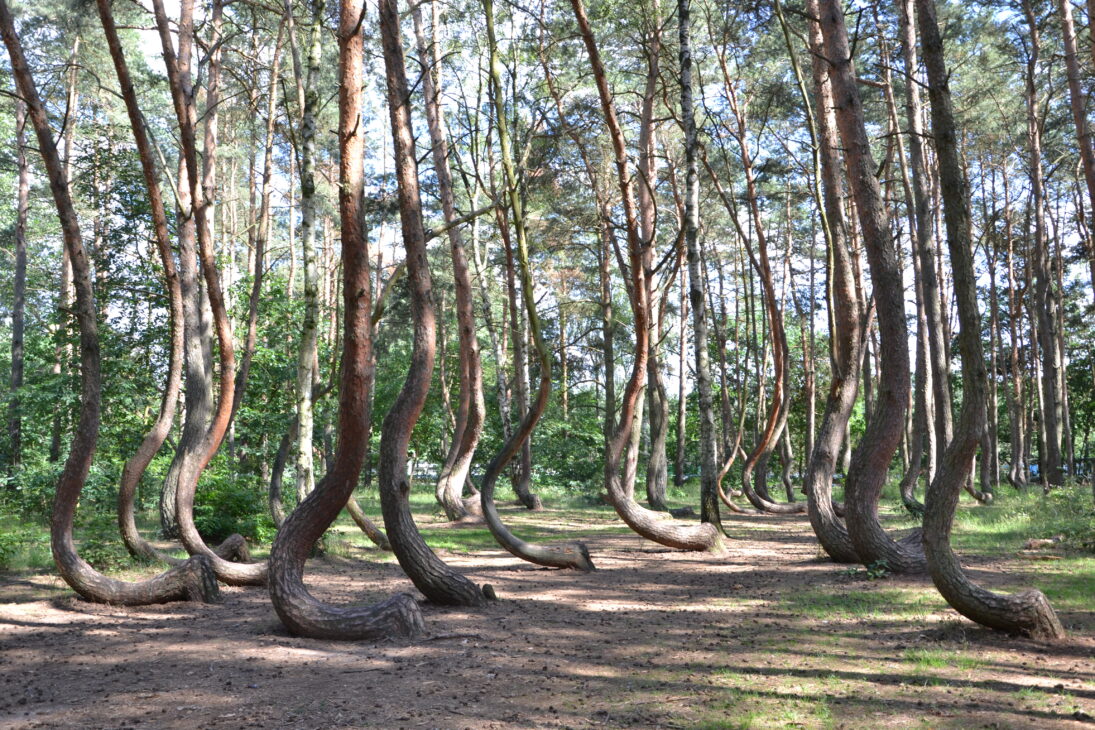
According to IFLScience, there is a forest in western Poland that holds a botanical enigma that has defied explanations for decades. Near the town of Gryfino, a group of pines—surrounded by other trees that grow normally—are bent at 90 degrees at their base, with most of them curving northward before straightening up again. The place is known as the “Crooked Forest,” or “Krzywy Las” in Polish.
What makes the phenomenon so intriguing is not just the dramatic curve of each trunk, but the almost impossible uniformity of the entire group: the trees bend all at the same height, in the same direction, and with the same hook shape, as if an invisible force had shaped them all at once, at the same moment. And, just a few meters away, the rest of the forest grows perfectly straight, as if nothing strange had ever happened.
It is known that the trees were planted around the 1930s, before the region was devastated by World War II—when local residents abandoned the area, taking with them the clues of what deformed those pines. The history of the Crooked Forest is proof that, even with the world seemingly all mapped and explained, there are still stubborn little mysteries, hidden in a silent clearing, capable of challenging science and fueling the imagination of those who pass by.
-
Chinese Buildings Use Mist System to Combat Extreme Heat, Cooling Surfaces by Up to 8°C; Water Consumption Limits Use in Drier Cities

-
German Shepherd Fails Guide Dog Test Due to Attachment to Plush Elephant, Viral Moment Captured at Train Station

-
50,000 Satellites with Giant Mirrors: Solar Light Sold via App Sparks Controversy Among Startup, FCC, Astronomers, and Environmentalists in the US

-
Brazil’s Cost-Cutting Housing Design Leaves Southern Residents Vulnerable to Cold Winters




A disturbing precision deformation
What most impresses those who visit or study the Crooked Forest is not the curvature itself, but the rigor with which it repeats in each tree—a consistency that, paradoxically, makes the mystery even harder to solve. According to Atlas Obscura, mixing science fiction and ecological anomaly, the group of pines in the Krzywy Las is bent in a mysterious and identical way. Hovering a few centimeters above the ground, the trees make a sharp curve towards the sky, rounding into small “J” shapes as they rise.


This uniformity is precisely what eliminates most natural explanations. What stands out is the precision: each tree leans in the same direction, each curve begins at approximately the same height, and, beyond that small stretch, the surrounding forest grows perfectly straight, as if nothing unusual had occurred. The uniformity rules out most natural explanations because wind, gravity, or uneven terrain would have created random shapes — and there is no randomness there.
The lateral displacement of each trunk can reach up to three meters before the tree corrects itself and returns to pointing upwards. It is this combination of extreme anomaly and perfect order that has fascinated scientists, curious individuals, and tourists for generations. A forest that seems to have been combed by a giant hand, leaving a pattern that nature alone would hardly produce.
The theories that try (and fail to) explain
Over the years, dozens of hypotheses have emerged to try to decipher the enigma — some plausible, others completely fantastic — but all encounter the same obstacle: the uniformity of the curves. There are many theories about the mystery, although there is little or no evidence to support any of them. One hypothesis suggests that a unique gravitational attraction in that specific area would have caused the trees to grow curved to the north — but this idea does not withstand basic scientific scrutiny, as gravity pulls things downward, not in a curve.
Another common assumption is that heavy snowfalls would have weighed on the trees as they sprouted, causing them to grow crooked at the base. The problem, according to the same source, is that this theory does not explain why other groups of pines and diverse vegetation in the same area were not affected. There is also the caterpillar hypothesis: it is speculated that the pine shoot moth (Rhyacionia buoliana), which feeds on pines in its larval stages, could have damaged the apical shoots of the trees during their development, stunting growth and causing these twisted shapes.
And, of course, there is no shortage of fantastic explanations: according to IFLScience, some believe that the trees were crushed by an alien spacecraft — perhaps, jokes the publication, by a civilization that mastered interstellar travel but still hasn’t quite learned how to park. None of these theories, however, manage to explain both the curvature and its astonishing regularity at the same time.
The most probable explanation: human hands and a war
Although the mystery officially remains unsolved, there is a hypothesis that gathers more evidence and makes more sense than all the others — and it involves a human intention interrupted by history. According to IFLScience, there are reports that traces of cuts and knots were found on the trees, suggesting that humans may have kept them close to the ground during the early years of growth, before allowing the natural response to gravity to do the rest of the work.
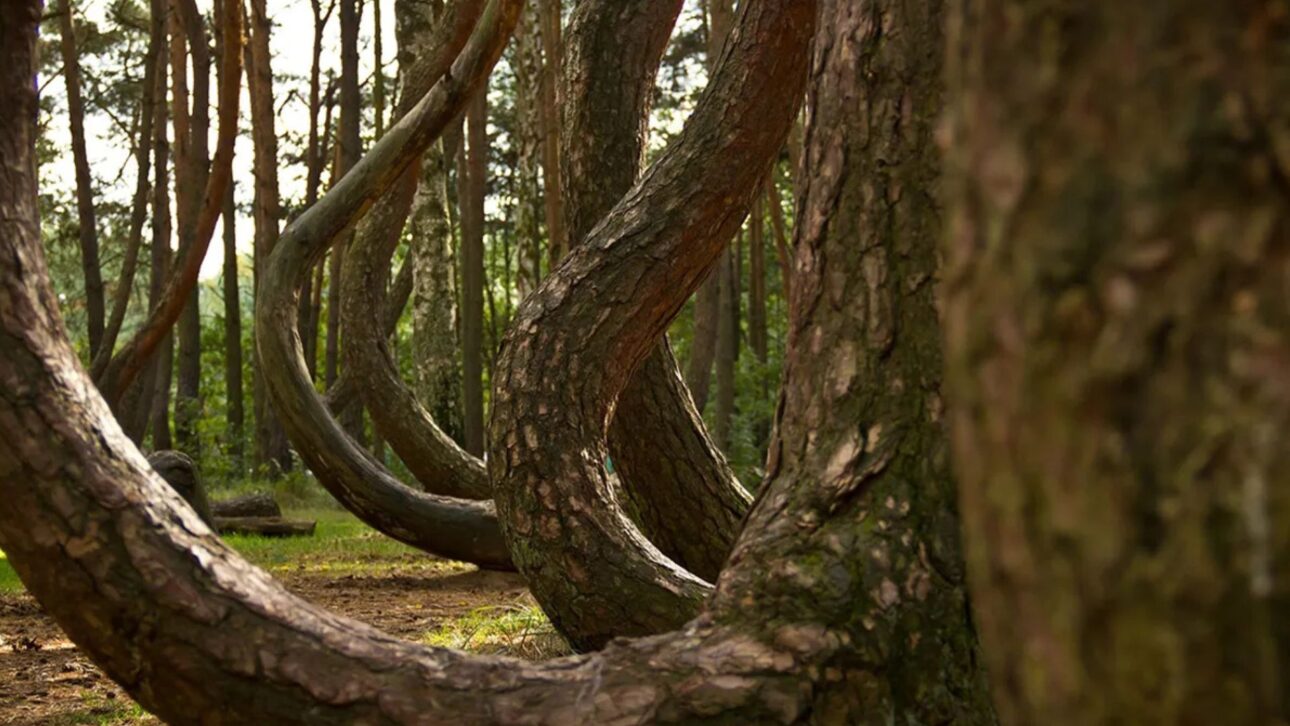
The most accepted theory is that it was a kind of “tree farm,” where the pines were deliberately bent for use in making curved furniture, frames, or barrels — after all, naturally curved wood is stronger than straight wood that is bent after being cut. Curved wood was valuable: shipbuilders, furniture makers, and craftsmen often needed naturally arched wood for structures and supports, and producing it this way would save time and labor. But then history intervened.
In 1939, Nazi Germany invaded Poland. The region around Gryfino was devastated, and many local residents fled or were displaced. Whatever project was started in that forest simply stopped. The trees were never harvested. The people who shaped them never returned. And with them went the knowledge of exactly how and why the forest was created. It is this historical rupture that turned a common agricultural technique into a permanent enigma.
The detail that almost no one mentions: are there really 400 trees?
Before concluding, it’s worth an important clarification — because part of what is repeated about the Crooked Forest on the internet does not exactly correspond to reality, according to those who manage the site. Despite internet rumors that there are 400 crooked trees, in fact, there are only about 80 pines, spread over two hectares, according to the managers of the Gryfino Forest District. They were likely planted between 1930 and 1945.
Each pine bends at 90 degrees at its base, with the curve occurring between 10 and 50 centimeters above the ground, and the trees were 7 to 10 years old when they were planted. This type of correction is important to avoid turning a real curiosity into an exaggeration. The same publication argues that, following the principle of Occam’s Razor — which states that the simplest explanation is usually the best — the most plausible answer is indeed human intervention.
The shaping of trees is a common agricultural practice in Europe, India, and the Americas: young trunks are bent to make furniture, instruments, carts, boats, and much more, and young trees are comparatively easy to manipulate and shape. Still, it is fair to acknowledge that, officially, the mystery was never solved — no one has provided definitive proof of who did the work, with what exact tool, and with what final purpose. Therefore, the Crooked Forest remains protected as a natural monument of Poland, attracting travelers from all over Europe.
A living enigma embraced by nature
Decades later, the Crooked Forest has become much more than a botanical curiosity — it has turned into a symbol of how time and nature can transform even a disturbing mystery into something strangely beautiful. What makes the Crooked Forest even more remarkable is that the trees did not simply collapse under the strain of deformation. After being bent, they continued to grow upwards, correcting their orientation through a natural process known as gravitropism — the ability of plants to orient their growth in response to gravity.
Today, many of these trees reach about 15 meters in height: near the ground, the trunks still display those sharp, sweeping curves; higher up, they straighten and grow like any pine would. Walking among them, according to the publication, creates a rhythmic sensation that seems almost deliberate, with the repetition of the curves forming a hypnotic pattern. In winter, snow accumulates along the arches, enhancing their shape; in summer, light filters through the canopy and casts long curved shadows across the forest floor.
There are no fences, no dramatic signs, no final explanation waiting at the end of the trail — just a silent grove that carries a decision made almost a century ago, and then abandoned. The story of Poland’s Crooked Forest is, in the end, an invitation to humility in the face of the unknown. In an era where almost everything can be researched, measured, and explained in seconds, it is comforting — and a bit magical — to know that there still exists, in a clearing in western Poland, a handful of trees that silently keep a secret that the men who created it took with them forever. And that nature, instead of hiding this scar, transformed it into one of the most surreal and fascinating landscapes on the European continent.