Portuguese
  Spanish


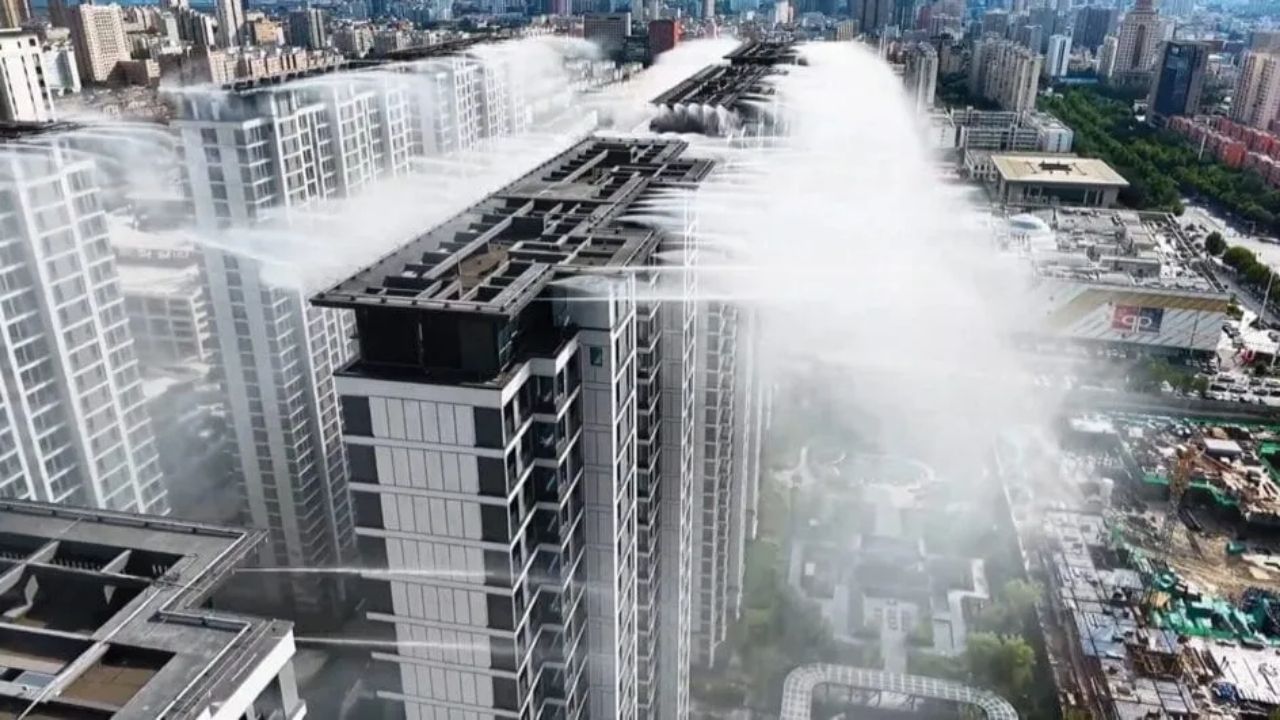

The extreme heat in Yuncheng, in China’s Shanxi province, has led residential buildings to draw attention with a misting system installed on rooftops to alleviate discomfort in outdoor areas. The solution spreads an ultrafine mist over the buildings and gained international attention on social media starting July 1, 2026, after posts on X showed the appearance of “rain” coming from the tops of the buildings.
According to reports that echoed the case in international and Chinese media, the system uses high-pressure nozzles installed on rooftops and can reduce the surface temperature of buildings by about 5°C to 8°C in a few minutes. However, the technology depends on the use of water and favorable environmental conditions, which limits its widespread adoption in dry regions or areas with water restrictions.
Rooftop System Creates Mist Over Buildings
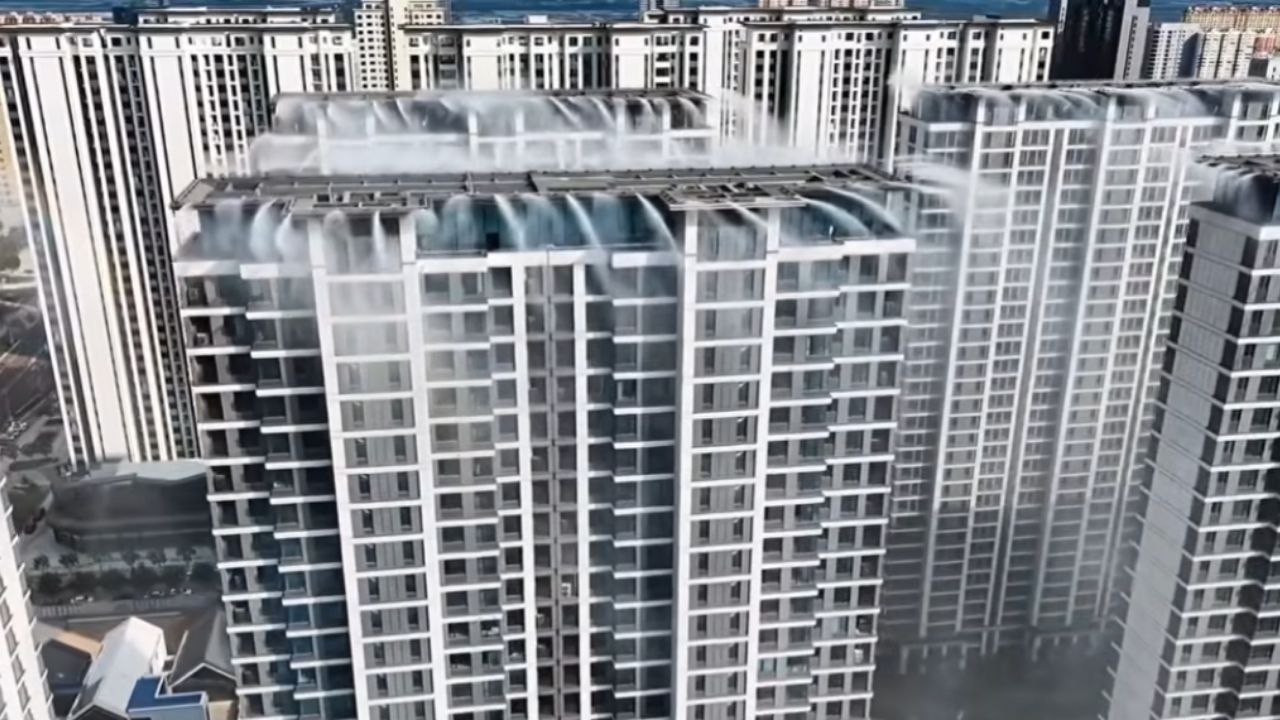
The operation starts with high-pressure nozzles installed on the rooftops of buildings. They spray ultrafine droplets of water into the atmosphere, forming a visible mist around the buildings.
-
German Shepherd Fails Guide Dog Test Due to Attachment to Plush Elephant, Viral Moment Captured at Train Station

-
50,000 Satellites with Giant Mirrors: Solar Light Sold via App Sparks Controversy Among Startup, FCC, Astronomers, and Environmentalists in the US

-
Brazil’s Cost-Cutting Housing Design Leaves Southern Residents Vulnerable to Cold Winters

-
Entrepreneur Turns Sweaty Helmet Problem into Million-Dollar Business with National Cleaning Machine, Aiming for $12 Million and 300 Locations by 2026 Amid Growing Demand from Delivery Services and 35 Million Motorcycles in Brazil




Before reaching the ground, these particles evaporate and absorb heat from the air. It is the same physical principle used by the human body to cool the skin through perspiration, but applied on an urban scale with automated activation.
Misting Works in Specific Heat Moments
The system does not need to operate continuously. According to the press that covered the case, the condominium administration activates the misting during periods of intense heat, usually for a few minutes, to reduce the accumulated heating on the building surfaces.
This detail is important because it shows that the technology functions as a specific response to external heat. It does not replace internal air conditioning but can relieve open areas, courtyards, facades, and circulation zones where conventional air conditioning would not be practical.
Temperature can drop up to 8°C
The technology is capable of reducing the ambient temperature between 3°C and 8°C in a few minutes, depending on humidity and air circulation conditions. Therefore, performance varies according to the local climate.
In drier locations, evaporation tends to work better. In areas with high relative humidity, efficiency decreases because the air is already more saturated with water vapor and absorbs less new water during the process.
“Outdoor AC” went viral on social media
The nickname “Outdoor AC” emerged on social media after videos showed buildings releasing large clouds of mist. The scene caught attention because it gives the impression of buildings “crying” water to combat the heat.
Despite the visual impact, the solution is not magical. The effect depends on the rapid evaporation of droplets and the system’s ability to remove thermal energy from the air, something that requires favorable environmental conditions.
Chinese government mentioned the initiative
The initiative also appeared in official communication from the Chinese government. In a press conference, Mao Ning, spokesperson for the Ministry of Foreign Affairs of China, cited the project as an example of measures to improve quality of life during periods of extreme heat.
The mention shows that the topic has moved beyond just internet curiosity. In dense cities, where concrete, asphalt, and buildings accumulate heat, urban cooling solutions have started to be treated as part of climate adaptation.
Heat islands increase pressure on cities
The system draws attention because it responds to the so-called urban heat island effect. This phenomenon occurs when materials like concrete, asphalt, and building facades retain heat and raise the temperature of cities.
During heat waves, urban areas can become more uncomfortable than less built-up regions. Therefore, cooling measures in streets, courtyards, common areas, and facades are gaining ground in the debate on urban infrastructure.
Water consumption is the main limit


The critical point of the technology is water usage. Experts cited in the report warn that consumption may hinder large-scale adoption, especially in regions prone to water scarcity.
This limitation changes the project analysis. In cities with water availability, misting can work as a complement in open areas. However, in dry cities, the same system may conflict with supply priorities.
Efficiency also drops with high humidity
Another limit is the relative humidity of the air. Evaporative cooling depends on the water’s ability to evaporate quickly. When the air is already humid, this process loses efficiency.
This means that the model used in Yuncheng cannot be copied without adaptation. Each city would need to evaluate climate, water availability, heat intensity, urban ventilation, and operational cost before installing similar systems.
Lower electric cost attracts interest
The technology has an advantage over conventional air conditioning: electricity consumption is significantly lower, according to the report. This makes the system attractive for outdoor areas, where traditional air conditioners would have high costs and low efficiency.
Even so, the electric savings need to be compared to water consumption. The solution may reduce energy demand, but transfer part of the environmental cost to water, especially when used by many buildings at the same time.
Climate change expands the search for alternatives
The popularization of “outdoor air conditioning” is occurring while different countries seek ways to tackle more frequent and intense heat waves. In densely populated urban areas, the thermal sensation can affect mobility, health, and staying in public spaces.
Passive cooling solutions and low energy consumption are gaining attention as a complement to traditional strategies. Among them are shading, vegetation, reflective materials, urban ventilation, and evaporative systems like the one adopted in China.
Technology draws attention, but doesn’t solve everything
The Chinese case shows a visually strong response to heat, but also highlights the complexity of climate adaptation. Reducing temperature in open areas requires a balance between comfort, energy, water, and real efficiency.
Mist on rooftops can relieve urban environments under certain conditions, but it does not eliminate the need for broader planning. Do you think misting systems could work in Brazilian cities during heatwaves, or would water consumption make the solution unfeasible? Leave your opinion in the comments.