






 Portuguese
  Spanish


A Unique Image Captured by the Mars Odyssey Probe Reveals Mount Arsia Emerging from Martian Clouds, Offering New Clues About the Planet’s Climate
Shortly before dawn on May 2, a camera aboard the Mars Odyssey probe captured a unique image: Mount Arsia, one of the largest volcanoes in the solar system, appearing above a sea of clouds on Mars. The scene resembles Everest rising among the clouds of the Himalayas. But in this case, the setting is Martian — and on a planetary scale.
The image shows clouds covering the flanks of the mountain while the summit rises prominently. The scene was captured about 240 million kilometers from Earth. It is the first time a photo shows a volcano on the Martian horizon in this way, surrounded by clouds formed by water ice.
A Unique View of Mount Arsia
The photo was taken by Mars Odyssey, a NASA probe in orbit around Mars since 2001. The operation of the THEMIS camera, which took the picture, is led by Arizona State University. The team aimed at Mount Arsia hoping that its summit would appear above the morning clouds. And it worked.
-
Scientists Uncover Why Gold Retains Its Shine So Well

-
Japan Allocates Nearly $6 Billion for AI Development, Aims to Deploy 10 Million Robots Across Industries by 2040
-
Nigerian Startup Converts Discarded Laptop Batteries and Broken TV Screens into Solar Lanterns for Off-Grid Areas

-
Young Innovators from Brazil Develop BioLuz: Generating Electricity from Plant Roots and Soil Microorganisms Using PET Bottles, Copper, and Zinc



“We chose Arsia Mons in hopes of seeing the summit rise above the early morning clouds,” said Jonathon Hill, who is in charge of camera operations. “And it did not disappoint.”
Mount Arsia is nearly 20 kilometers tall — more than double that of Mauna Loa, the largest volcano on Earth. It is located in the Tharsis region, a plateau that hosts other giant volcanic structures on Mars, such as Pavonis Mons, Ascraeus Mons, and Olympus Mons, the largest of all.
Innovation in Martian Orbit
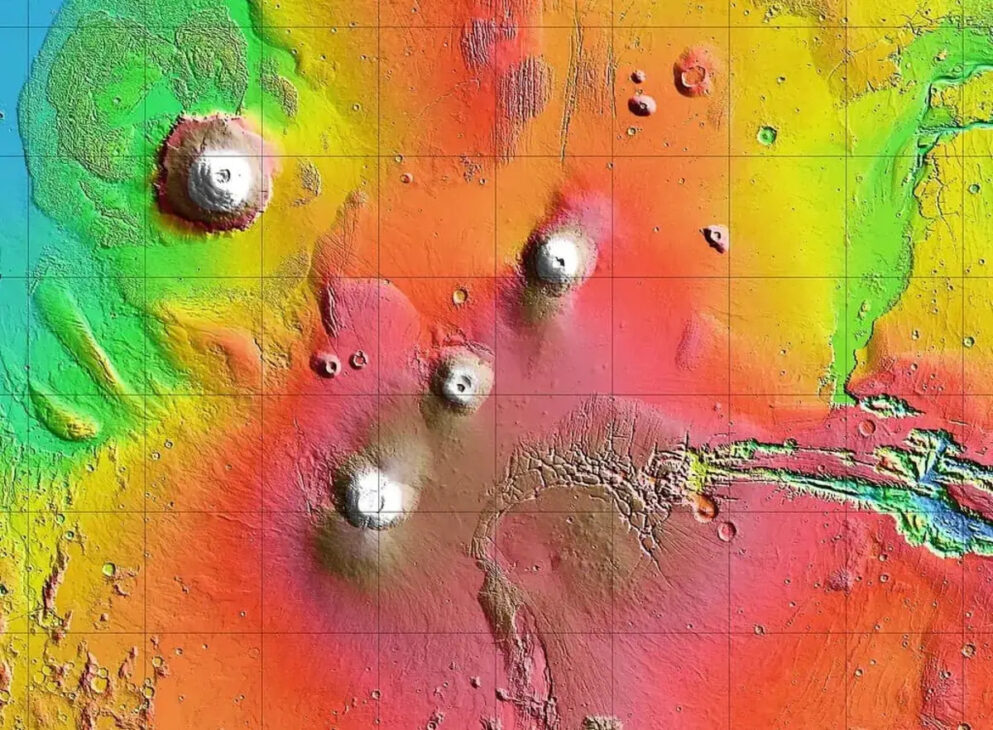
To achieve the record, Odyssey rotated 90 degrees in its orbit, starting to aim at the edge of the planet instead of observing directly the surface. This maneuver, called “member” observation, only started being used in 2023, even though the probe has been operating for over 20 years.
The image shows the silhouette of Mount Arsia against greenish clouds of water ice, captured at a moment when Mars was farther from the Sun, in a phase called aphelion. At this time, Martian weather gets colder, and a band of clouds forms around the planet’s equator.
While these aphelion clouds were already known, it is the first time scientists see a mountain summit crossing this layer on the horizon. “We are observing really significant seasonal differences in these horizon images,” commented Michael D. Smith, a NASA scientist.
Valuable Information for Future Missions

These clouds form when cold air rises up the slopes of the volcano, expands, and cools. At aphelion, the clouds become thicker, helping scientists understand how the Martian atmosphere reacts to the terrain.
The THEMIS camera, in addition to visible images, also captures infrared. This allows for the identification of water ice below the Martian surface — an essential resource for future human missions, as it can be converted into drinking water, oxygen, or even fuel.
Additionally, Odyssey also observes the moons Phobos and Deimos, and monitors the behavior of Martian dust and clouds throughout the seasons. This new image of Mount Arsia is the fourth taken from this new angle.
Striking Structures on the Volcano
Meanwhile, another space mission, ESA’s Mars Express, has identified large collapses on the flanks of Mount Arsia. These are cavities up to 2 kilometers deep. They formed when lava emptied underground chambers, which then collapsed, creating enormous holes in the surface.
This data helps plan future missions to the Red Planet. Knowing how the climate, clouds, and terrain function can determine when and where to land the next robots — or humans.
With information from ZME Science.


