






 Portuguese
  Spanish



Change in BPC rules alters the way family income is analyzed and creates automatic conversion to inclusion aid in cases of entry of a person with a disability into the labor market.
The Continuous Cash Benefit (BPC) now has new operational rules for analyzing cases where there is a variation in family income or the entry of a person with a disability into paid activity.
The change is part of the Joint Ordinance MDS/INSS No. 34, of October 9, 2025, published by the Ministry of Social Development and Assistance, Family and Fight Against Hunger and the National Institute of Social Security.
The regulation updates procedures for requesting, granting, maintaining, and reviewing the BPC, an assistance benefit paid to seniors from 65 years old and people with disabilities of any age, provided they meet low-income criteria.
-
$2.5 Billion Amazon Potash Mine Aims to Reduce Brazil’s 95% Import Dependency

-
Grendene’s Sales Decline in 2025, but Melissa Brand Surges 36% and Becomes Key Focus
-
World’s Largest Single-Line Pulp Mill Opens in Brazil, Costing $4.3 Billion

-
Pix Processed $35 Trillion in 2025, Becoming Brazil’s Leading Payment Method


Linked to social assistance, the payment corresponds to a monthly minimum wage and does not require prior contribution to the INSS, unlike social security benefits granted to insured workers.
What changes in the BPC for families with unstable income
The main change is in the way of evaluating the per capita family income in the processes of maintaining the benefit, especially when the declared values vary from one month to another.
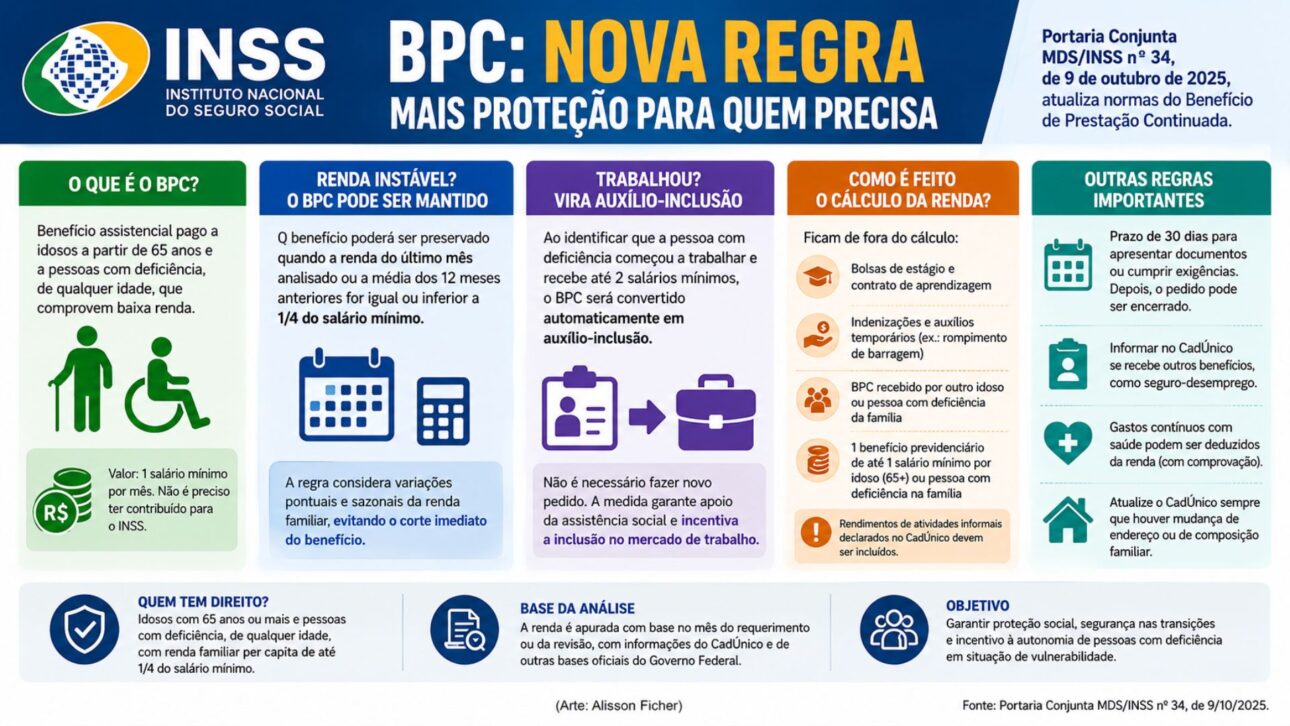
Under the new rule, the BPC can be maintained when the income of the last analyzed month or the average of the previous 12 months remains equal to or less than a quarter of the minimum wage.
In practice, the ordinance establishes a criterion of assessment that considers the most recent income and also the annual average, without limiting the analysis to a single punctual variation.
This rule reaches families that depend on occasional work, informal activities declared in the Single Registry, or income without fixed periodicity throughout the year.
According to the MDS, the measure addresses situations where there is a fluctuation in family income and seeks to regulate the maintenance of the benefit during review procedures.
The update also regulates changes introduced in the legislation at the end of 2024, as informed by the federal government when disclosing the new BPC rules.
Automatic conversion of BPC into inclusion aid
Another point provided in the ordinance involves the person with a disability who receives the BPC and starts to engage in paid activity within the legal criteria.
When the INSS identifies entry into the labor market with remuneration of up to two minimum wages, the BPC will be automatically converted into inclusion aid, without the need for a new request.
Provided for in the Organic Law of Social Assistance, the inclusion aid is intended for people with disabilities who stop receiving the BPC due to the start of paid activity.
With the automatic conversion, the procedure takes place from the identification made by the INSS, as long as the remuneration is within the limit provided by the legislation.
Before the operational update, the beneficiary needed to follow specific procedures to access the inclusion aid after starting paid activity, according to the applicable benefit rules.
According to the new system, the federal government states that the change organizes the transition between the BPC and the inclusion aid in cases where the person with a disability starts working.
How the calculation of family income in the BPC is affected
The ordinance also details which incomes should or should not be included in the calculation of family income used for granting, maintaining, or reviewing the Continuous Cash Benefit.
Among the disregarded amounts are supervised internship scholarships, earnings from apprenticeship contracts, and temporary indemnities or financial aid related to dam breakage or collapse.
Under the conditions provided by the norm, the BPC received by another elderly or disabled person in the same family and certain social security benefits of up to one minimum wage are also excluded from the calculation.
This exclusion applies to social security benefits paid to elderly people over 65 years old or people with disabilities, observing the limits defined by the regulations.
When the same family member receives more than one social security benefit of up to one minimum wage, only one of them can be disregarded in the calculation of family income.
On the other hand, earnings from informal activities declared in the Cadastro Único must be included in the assessment, as provided in the rules updated by the MDS and the INSS.
The applicant must also inform in the CadÚnico if they receive other Social Security benefits or from federal, state, or municipal regimes, including unemployment insurance.
This information will be used to compose the analysis of family income in administrative processes related to the BPC, along with data from other official federal government databases.
Health expenses can be deducted from income
The regulation maintains the possibility of deducting continuous and proven health expenses from family income, as long as they fall within the scenarios provided by the norm.
This rule includes expenses for treatments, medications, diapers, and special foods that are not provided by the Unified Health System or by services not offered by the Unified Social Assistance System.
These expenses need to be proven by the applicant or beneficiary during the administrative analysis, according to the procedures adopted by the INSS in granting or reviewing the benefit.
Income is assessed based on the month of the request or review, from the information recorded in the Cadastro Único and other official databases.
With this data cross-referencing, the INSS starts using the records available in the federal government to verify family composition, declared income, and benefits received by the family group.
The norm also reinforces that the analysis must observe the legal criteria of the BPC, including per capita family income and specific situations that can be excluded from the calculation.
Deadline for documents and updating CadÚnico
The ordinance also defines that, in case of pending issues in the request, the applicant will have up to 30 days to present documents or meet requirements made by the INSS.
If the deadline ends without a response, the process may be closed due to withdrawal, in which case a new request will need to be submitted for the analysis of the Continuous Cash Benefit.
Beneficiaries or legal representatives must update the Cadastro Único whenever there is a change of address, alteration in family composition, or modification in information used in the benefit analysis.
These data are used to confirm income, housing, family members, and ways of communication with the public authorities during maintenance and review procedures.
With the new rule, the BPC remains conditioned to low-income criteria and the reviews provided by law, but now includes specific procedures for cases of variable income and paid work.
The application of the ordinance depends on the information recorded in the Cadastro Único, consultation of official databases, and the administrative analysis carried out by the INSS in each case.


